
Top 12 Best 10 Miter Saw Blade Picks You Can’t Miss
Dealing with rough cuts and frequent blade replacements is a common frustration for anyone using a miter saw without the best 10 miter saw blade. Cheap or inappropriate blades tend to dull quickly or cause splintering, messing up projects and wasting material. The right blade prevents these issues, making your cuts cleaner and your work faster.
Key factors that distinguish a high-quality 10-inch miter saw blade include the number and type of teeth, the material it’s made from, and its compatibility with your saw. Typically, blades with 60 to 80 carbide-tipped teeth offer smoother cuts for finer woodworking, while fewer teeth are better for rough cuts. The steel and carbide quality affects durability and sharpness retention.
Proper fit with a standard 10-inch arbor and corrosion resistance also contribute to performance and longevity.
Need a Quick Check?
| Image | Product | Price |
|---|---|---|
Our Top Picks 1  | Professional 10-Inch 120T | Check Price |
Our Top Picks 2  | Professional 10-Inch TCG Aluminum | Check Price |
Our Top Picks 3  | DEWALT 10-Inch Combo Blades | Check Price |
Our Selected Top 12 10 Miter Saw Blade You Can Trust
This list features carefully chosen 10-inch miter saw blades ideal for various cutting tasks. Each review covers performance, suitability for different users, and highlights the strengths and weaknesses to help you make an informed decision.
1. Professional 10-Inch Miter Saw Blade 120T
Sharpness stands out immediately, making this miter saw blade a solid choice for woodworking enthusiasts who want fine, precise cuts. Its 120-tooth design is tailored for smooth finishes on wood and soft materials, fitting well with saws using a 16mm arbor.
Changing the blade is straightforward thanks to its standard arbor size, compatible with many saw models. Daily cutting feels steady because the engineered teeth pattern helps reduce vibration, delivering cleaner lines. The high-grade steel construction means you can expect long usability without frequent replacements.
Cutting results are consistently smooth and accurate, meeting the expectations set by its fine teeth count. Built with durability in mind, the blade holds up well over time, though some users mention it might not be ideal for tougher or harder materials.
The main praise centers on clean cuts, while the common complaint revolves around its suitability limited to softer materials.
The blade consistently produces clean, accurate cuts with minimal vibration, satisfying users looking for precision on wood. However, it is less effective on harder materials, which reflects its intended use on softer wood types. Many appreciate smooth finishes, but some find its limitations restrictive.
Woodworkers handling mostly soft materials will appreciate the fine 120-tooth blade and durable build. Those requiring a blade for tougher materials or a multi-purpose option may want to explore other alternatives better suited for heavy-duty or mixed-material cutting.
Pros
- 120-tooth design for fine finish
- Standard 16mm arbor fits most saws
- Engineered teeth minimize vibration
- High-grade steel ensures durability
Cons
- Not suited for cutting hard materials
- Single blade can limit versatility
| Specification | Details |
|---|---|
| Brand Name | TOYAKI |
| Part Number | TK-254W |
| Unit Count | 1 Count |
| Number of Items | 1 |
| Included Components | Saw Blade |
2. Professional 10-Inch TCG Aluminum Miter Saw Blade 120T
Designed for cutting aluminum, plastic, and non-ferrous metals, this 10-inch miter saw blade suits professionals needing precise, smooth cuts. Its biggest strength lies in the 120 teeth, which deliver a consistently fine finish that outperforms standard blades in detailed work.
Installing the blade is straightforward with a standard 5/8-inch arbor size, making it compatible with most common saws. Day-to-day use stays reliable thanks to the carefully balanced 2.8mm thickness, which keeps cuts stable and accurate throughout long sessions. The professional-grade carbide material means the blade won’t wear down quickly, saving time on replacements.
The blade excels at producing clean, fine cuts on aluminum and similar materials, maintaining consistency across multiple uses. Its construction from high-grade carbide ensures durability and edge retention.
One strong point is the fine finish it achieves without frequent sharpening. Some users mention that it requires proper alignment to avoid minor wobbling during cutting.
The blade consistently delivers a smooth finish thanks to its 120-tooth design, but requires precise installation to maintain stability during cutting. High-grade carbide keeps it sharp longer, though it’s mostly suited for aluminum and similar materials rather than all-purpose use.
Professionals working regularly with aluminum or plastic will appreciate the fine cuts and durability. Casual users or those needing a blade for general wood cutting might want to look for options better tailored to those tasks.
Pros
- 120 teeth for fine finish cutting
- Compatible with most common saw models
- Durable high-grade carbide construction
- Balanced thickness for stable cuts
Cons
- Needs careful alignment to avoid wobbling
- Primarily optimized for non-ferrous metals only
| Specification | Details |
|---|---|
| Diameter | 10-inch |
| Teeth Count | 120 |
| Thickness | 2.8mm |
| Arbor Size | 5/8-Inch (16mm) |
| Material | High-grade carbide |
3. DEWALT 10-Inch Miter and Table Saw Blade Combo 60T & 32T
Cutting precise angles quickly can be tough without the right blade. Great for anyone who uses a miter or slide miter saw regularly, this combo offers two blades tailored for different cuts. Its biggest strength is how the tungsten carbide teeth stay sharp longer, cutting cleaner without slowing down your projects.
Swapping blades is straightforward thanks to the standard 5/8” arbor size. Both 60 and 32 tooth blades have a thin kerf, which means less resistance and faster cuts with minimal waste.
The computer-balanced plate helps reduce vibration, so cutting feels steady, and you get smoother edges without extra sanding.
The blades hold a true edge well, thanks to the durable tungsten carbide teeth. Cutting through wood or trim feels consistent and smooth most of the time, with less dulling than with standard blades. Some complaints mention occasional slight vibration, though it tends to be minor due to the balancing.
Build quality feels solid, giving confidence during use.
The strongest praise centers on how the tungsten carbide edges remain sharp through extended use, making cuts clean and smooth without frequent sharpening. The most common complaint refers to minor vibrations that occasionally affect cutting stability, though these rarely impact overall performance significantly.
Anyone regularly working with miter or slide miter saws and wanting durable, precise blades will find this combo useful. Those needing more blade variety or ultra-vibration-free cutting might consider other specialized options instead.
Pros
- Tungsten carbide teeth stay sharp longer
- Thin kerf for fast and smooth cuts
- Computer-balanced plate reduces vibration
- Two blades cover different cutting needs
Cons
- Some users notice minor vibration
- No blades included beyond two sizes
| Specification | Details |
|---|---|
| Brand Name | DEWALT |
| Model | DW3106P5 |
| Included Components | 10 In. Construction Saw Blades (2 Pack) with 60 and 32 Tooth Blades |
| Arbor Size | 5/8” |
| Warranty Description | Satisfaction Guarantee |
4. Makita 10-Inch Carbide-Tipped Miter Saw Blade 80T
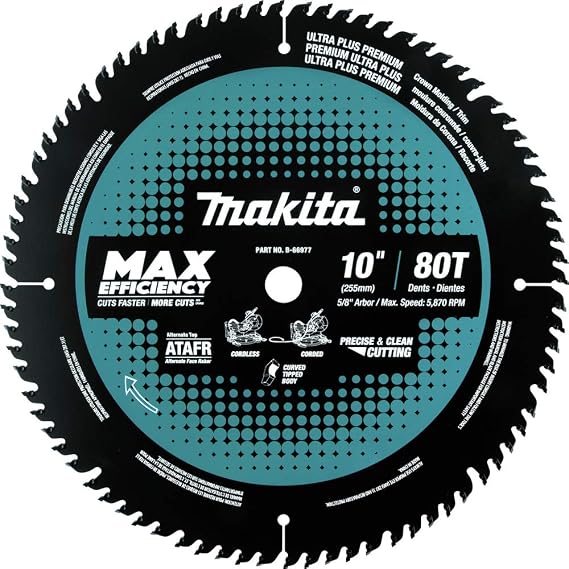
Cutting speed stands out with up to 100% faster progress compared to standard saw blades, making this a solid choice for anyone frequently working with a miter saw. Its thin kerf carbide-tipped design suits those focused on clean edges and less strain on their tools.
Setup involves swapping your current blade with the Makita 10-Inch Carbide-Tipped Miter Saw Blade 80T, which fits most compatible 10-inch miter saws thanks to its standard size. The blade stays light on the motor because of the specialized ATAFR tips and the engineered tooth design, helping you get through more cuts per battery charge and maintaining smoother operation throughout your projects.
Performance is reliable with sharp, efficient cuts that glide through wood smoothly. Build quality reflects Makita’s reputation, combining carbide tips for longer life and a thin kerf to reduce waste.
Strong praise highlights faster cutting speeds and cleaner finishes, while some users mention the blade may require careful handling during installation to avoid damage.
Many appreciate how much quicker the blade makes their cuts and how clean the edges come out, but some note the risk of chipping the tips if not installed gently. The blade’s thin kerf and quality carbide tips help keep the motor running cooler and extend battery life on cordless saws.
Ideal for anyone looking to speed up wood cutting with cleaner results on a 10-inch miter saw. Those requiring blades for different sizes or less frequent use may want to consider options with simpler setups or universal fits.
Pros
- Up to 100% faster cutting than standard blades
- Provides up to 30% more cuts per charge
- Thin kerf design reduces material loss
- Carbide tips ensure smoother, faster cuts
Cons
- Blade needs careful handling during installation
- Only fits 10-inch miter saws
| Specification | Details |
|---|---|
| Brand Name | Makita |
| Model | B-66977 |
| Unit Count | 1 Count |
| Number of Items | 1 |
| Included Components | 10″ 80T Carbide-Tipped Max Efficiency Miter Saw Blade |
5. FOXBC 10-Inch Saw Blade 90T Wood Cutting

Great for woodworkers who need clean, smooth cuts on their 10-inch miter saws. The FOXBC 10-Inch Saw Blade 90T focuses on producing polished finishes that rival fine sanding, making it ideal for cabinetry and finish carpentry. Its biggest strength lies in the smoothness of each cut, reducing the need for extra sanding.
Setting up the blade is straightforward, thanks to the standard 5/8 arbor size fitting most DeWalt, Skil, and Makita 10-inch saws. The 90 teeth and slim 0.087 kerf help you achieve precise, controlled cuts without much tear-out.
Using the double side grind design really shows in daily work, providing cuts that look finished right off the saw.
Performance matches the technical design well, with the Axial Shear-face grind (ASFG) helping to shear smoothly through wood, which makes working with delicate or hardwoods easier. The blade’s foxcarbide teeth hold up well through repeated use, resisting wear.
Reviewers praise its finish quality, although some find the fine teeth a bit slower on thicker, tougher cuts.
The blade stands out for its polished finish that requires little sanding after cutting, making it perfect for fine woodworking. A common drawback is its slower speed on denser woods, which can affect productivity with heavy-duty jobs.
Woodworkers focused on finish quality will appreciate the smooth cuts, especially in cabinetry or trim work. Those needing fast, aggressive cuts on tough materials might prefer a blade with fewer teeth and a wider kerf for better speed.
Pros
- Produces extremely smooth cuts like 220-grit sandpaper
- Durable, wear-resistant foxcarbide teeth
- Fits most 10″ miter and table saws
- Cleanly shears wood with ASFG tooth geometry
Cons
- Tends to cut slower on dense hardwoods
- Not ideal for non-wood materials
| Specification | Details |
|---|---|
| Diameter | 10 inch |
| Teeth | 90 Teeth |
| Kerf | 0.087 inch |
| Arbor size | 5/8 inch |
| Brand | FOXBC |
6. WEN 10-Inch Carbide-Tipped Miter Saw Blade 80T

Great for anyone working with both hard and softwoods, this 10-inch blade stands out because of its 80 carbide-tipped teeth designed for ultra-fine finishes. It suits miter saws and table saws aiming for precision and smooth cuts without sacrificing speed or control.
Setup is straightforward, fitting most 10-inch miter saws with a 5/8-inch arbor. Daily cutting feels consistent thanks to the ultra-thin 1/10-inch kerf, which helps reduce waste while maintaining clean slices.
Handling different wood types is easy, and it holds up well when switching between soft and hard materials.
Performance-wise, the blade cuts accurately and cleanly with minimal effort, making it reliable for fine woodworking. Its carbide tips stay sharp for a long time, and the build feels durable, though some have noted that it might dull faster with very abrasive materials.
The 80 teeth provide a quality finish but require a bit more care during cleaning to keep it performing well.
Many users find the blade delivers sharp, ultra-fine finishes while cutting through multiple wood types effectively. The most frequent drawback involves its tip becoming less sharp after heavy use with hard or dirty woods, requiring more attention to maintenance.
Ideal for hobbyists and professionals who need detailed cuts in wood, especially when using standard 10-inch saw setups. Those working primarily with very abrasive or unusual materials might want to consider a more specialized blade for longer durability.
Pros
- Clean, smooth cuts on hard and softwoods
- Fits most 10-inch miter and table saws
- Long-lasting carbide tips
- Thin kerf reduces material waste
Cons
- May dull faster with abrasive materials
- Takes more effort to keep clean over time
| Specification | Details |
|---|---|
| Diameter | 10 inches (254 mm) |
| Arbor Size | 5/8-inch (15.88 mm) |
| Number of Teeth | 80 carbide-tipped |
| Maximum RPM | 6000 |
| Kerf | 1/10-inch (2.4 mm) |
7. Luckyway 10-Inch Table and Miter Saw Blade 32T & 60T 2-Pack

Luckyway 10-Inch Table and Miter Saw Blade 32T & 60T 2-Pack is designed for precise cross-cutting and ripping on various wood materials. Ideal for woodworking enthusiasts who want sharp, durable blades that fit standard 10-inch miter and table saws.
The biggest strength is its versatility across softwood, hardwood, and composite panel cuts.
Setting up these blades is straightforward thanks to the standard 5/8-inch arbor size. The pack includes two blades, one with 32 teeth for ripping and one with 60 teeth aimed at finer cross cuts.
Daily use across different boards like MDF, plywood, and laminates shows the blades maintain edge quality and resist bending, allowing consistent, clean cuts with minimal effort on adjustment.
The fully hardened steel body adds toughness and stability, preventing deflection during use. These blades handle a variety of cutting angles while delivering smooth edges, especially on detailed work.
Most feedback highlights excellent cutting performance and durability, with occasional mention of reduced finish smoothness on exotic or very dense hardwoods.
Many users appreciate the reliable finish and durability of these saw blades, especially the variety in tooth counts for different cuts. Some experience less-than-perfect smoothness when cutting very hard woods, showing a limit in fine finishing capability.
People working with various types of wood and composite panels who need a solid, versatile blade set will find these suitable. Those requiring ultra-fine, professional-grade finishes on exotic materials might want to consider other specialized blades.
Pros
- Fits standard 10-inch miter and table saws
- Durable, hardened steel construction
- Two blades in one pack for multiple cutting needs
- Provides smooth, finished edges on most wood types
Cons
- Edge finish less smooth on dense hardwoods
- Not ideal for highly specialized cutting tasks
| Specification | Details |
|---|---|
| Blade Diameter | 10 inch |
| Tooth Count | 32T & 60T (2-Pack) |
| Arbor Size | 5/8 inch |
| Material | Fully hardened steel blade body |
| Manufacturer | Zhenjiang Luckyway Tools Co.,Ltd |
8. FOXBC 10-Inch TCG Saw Blade for Aluminum 100T

Cutting through aluminum feels steady and accurate with this 10-inch blade, built for metal work of all thicknesses. It suits anyone who needs clean, burr-free aluminum cuts without constantly swapping blades. Its biggest strength lies in tough tungsten carbide teeth that stay sharp well past many projects.
Installation works smoothly, fitting most 10 miter and table saws including DeWalt and Makita easily. The triple chip grind teeth make consistent slices through thin to thick aluminum without dragging or tearing.
Laser-cut vents help reduce noise and vibrations, which keeps cutting precise and less tiring during longer sessions.
Performance is solid on aluminum up to nearly half an inch thick, delivering clean edges every time. Made with high-density tungsten carbide, it resists wear and holds up through repeated use. Many praise the quiet operation and durability, while some mention that it’s mainly focused on aluminum rather than other metals.
Many users appreciate the blade’s quiet cutting and durability, thanks to tungsten carbide and vent design. The most frequent downside is its focus on aluminum, limiting use if you need a more versatile blade for different metals.
Perfect for anyone who primarily cuts aluminum with a 10″ saw and wants clean, reliable results. Those needing to cut a variety of metals may want to look for a more general-purpose blade.
Pros
- Compatible with major brands like DeWalt, Makita
- Triple Chip Grind teeth for clean, burr-free cuts
- Laser-Cut Stabilizer Vents cut noise and vibration
- Tungsten carbide ensures long blade life and wear resistance
Cons
- Specifically designed for aluminum, limited use on other metals
- Thicker materials near upper limit require slower cutting speed
| Specification | Details |
|---|---|
| Model | FOX356.M10100TCG |
| Size | 10 Inch |
| Teeth | 100 Tooth |
| Kerf | 0.095″ |
| Arbor | 5/8″ |
| Material | High-density tungsten carbide |
9. FOXBC 10-Inch Thin Kerf Crosscut Saw Blade 60T

Great for anyone working with different types of wood, this FOXBC 10-Inch Thin Kerf Crosscut Saw Blade suits those needing crisp, clean cuts without much fuss. Its biggest strength lies in the fine finish it delivers thanks to the 60-tooth design, which is ideal for precise miter cuts.
Installation involves a straightforward fit onto standard 10-inch miter saws or table saws with a 5/8-inch arbor, making it easy to swap in and out. The thin kerf of 0.087 inches helps reduce material waste and requires less motor power, so daily cutting feels smoother with less vibration and noise throughout use.
The blade cuts oak, pine, melamine, plywood, and molding cleanly, producing fine crosscuts without much tear-out. The high-density tungsten carbide teeth hold up to lots of use and stay sharp longer than typical blades. Some have noted occasional minor chipping on very hard woods, but most praise how smooth and quiet the blade runs.
The blade is praised for its ability to produce smooth crosscuts with minimal noise and vibration, making cutting more pleasant. A common complaint is occasional minor chipping on harder woods, which might affect finish on some projects.
People focusing on fine woodworking and those who work mostly with pine, melamine, or plywood will appreciate this blade. Those needing something for exceptionally hard or exotic hardwoods might want to consider a blade built specifically for tougher materials.
Pros
- Delivers smooth, fine finish cuts
- Compatible with many major saw brands
- Thin kerf reduces vibration and noise
- Durable tungsten carbide teeth
Cons
- May chip slightly on very hard woods
- Limited to 10-inch arbor saws only
| Specification | Details |
|---|---|
| Size | 10 inch |
| Tooth Count | 60-Tooth |
| Kerf | 0.087 inch |
| Arbor Size | 5/8 inch |
| Material | High-density tungsten carbide |
| Compatibility | Fits most 10-inch miter and table saws |
10. ANGELSWORD 10-Inch Table and Miter Saw Blades 32T, 60T, 80T

Tungsten carbide teeth shape these 10-inch blades, offering durability and heat resistance for smooth cutting. They suit people who need different tooth counts for various materials and prefer a thin kerf for faster cuts.
The biggest strength lies in their versatility and long-lasting edges that handle hardwoods, plywood, and molding alike.
Installing each blade on a compatible 5/8 arbor saw, like DeWalt or Makita, is straightforward. The set includes 32, 60, and 80 tooth options, covering rough cuts to fine slicing.
The thin 0.098 kerf helps reduce material waste and power draw. Switching between blades takes little effort, allowing quick adjustments for softer or harder woods.
Cutting results stay clean and smooth across materials such as oak, pine, and melamine. The carbide teeth resist wear over extended use, keeping cuts sharp longer than standard steel blades. Most users appreciate the quality build and sharpness; some note the blades can dull faster than expected under heavy use.
Thickness balance ensures speed and precision without bogging down saw motors.
Strong points focus on long-lasting carbide teeth and clean cuts across various wood types, praised for precision. The most frequent downside mentions blades dulling quicker than expected when cutting dense or abrasive materials frequently.
The set fits anyone needing a range of blade options for different woods and projects, especially with compatible power saws. Those requiring blades for other arbor sizes or larger diameters should consider alternatives made for those specs.
Pros
- Three tooth counts for varied cutting needs
- Tungsten carbide teeth resist wear and heat
- Thin kerf design for fast, clean cuts
- Fits major 10″ miter and table saws
Cons
- Blades may dull faster with heavy use
- Limited to 10-inch saws with 5/8″ arbor
| Specification | Details |
|---|---|
| Diameter | 10 Inch |
| Arbor Size | 5/8″ (15.88mm) |
| Kerf Width | 0.098″ (2.5mm) |
| Tooth Count | 32T, 60T, 80T (3 pack) |
| Compatible Brands | DeWalt, Makita, Skil, Metabo |
11. Makita 10-Inch Micro Polished Miter Saw Blade 80T

Sharpness stands out with the Makita 10-Inch Micro Polished Miter Saw Blade 80T, designed for those who demand precise, clean cuts. It fits perfectly for woodworkers or hobbyists needing accuracy without sacrificing smooth operation.
Setup takes moments since it matches standard 10-inch miter saws well. The ATAF tooth design cuts with minimal motor drag thanks to the ultra-thin kerf. Micro-grain carbide teeth, polished to a mirror finish, hold sharp edges longer, keeping daily cuts consistent and tidy around the workshop.
Cutting accuracy is impressive, driven by hand-tensioned steel plates that maintain true alignment throughout. The blade feels durable and maintains smoothness with little vibration. Most praise centers on the fine finish it delivers, while some note the thin kerf can wear faster on very hard materials.
The blade delivers excellent precision and smooth cutting thanks to its specialized tooth design and polished finish. Some users find the ultra-thin kerf less durable under heavy-duty cutting tasks.
Creatives and professionals focusing on wood projects will appreciate the clean cuts and long-lasting sharpness. Those needing broader compatibility or durability on tougher materials might consider other options.
Pros
- Ultra-thin kerf reduces motor strain
- Highly polished micro-grain carbide teeth
- Hand-tensioned steel blades for accuracy
- Consistent clean cuts on wood
Cons
- Kerf may wear quickly with very hard materials
- Only compatible with 10-inch miter saws
| Specification | Details |
|---|---|
| Brand Name | Makita |
| Model | A-93681 |
| Number of Teeth | 80 |
| Blade Diameter | 10 Inch |
| Warranty Description | 1 Year, 30 Day |
12. Makita 10-Inch Carbide-Tipped Miter Saw Blade 45T

Carbide tipping and a 45-tooth design deliver faster, cleaner cuts suited for anyone working with construction lumber or plastics. Its ability to cut up to 100% faster than standard blades makes it a solid pick for those needing efficiency without sacrificing precision.
Setting up the blade on a miter saw with a 5/8 arbor is straightforward. The thin kerf reduces drag on the saw’s motor, meaning it won’t slow down during longer cuts.
You’ll notice less material waste thanks to the slim kerf, and the special ATAFR tips keep each cut smooth, making daily use feel less like a battle with the blade’s resistance.
Performance-wise, the blade excels in crosscutting construction lumber, offering cleaner edges with minimal tear-out. Built to be durable with carbide tips, it handles frequent use well.
Most praise highlights how quick and smooth the saw cuts through materials. On the downside, some find the blade a bit pricey compared to basic blades, though the speed and quality justify it.
Many appreciate how quickly it slices through construction lumber and plastic with minimal roughness, making it feel efficient and reliable. Some critiques mention that the cost can be a drawback for those on a tight budget or using it for occasional cuts.
Anyone needing frequent crosscuts on wood or plastic will find it a good investment. Casual users or those working mostly with ripping tasks might consider a different blade designed specifically for those cuts.
Pros
- Up to 100% faster cutting speeds
- Thin kerf reduces material waste
- Carbide tips last longer than standard blades
- Special ATAFR tooth design smooths cuts
Cons
- Higher price than basic blades
- Designed primarily for crosscutting, not ripping
| Specification | Details |
|---|---|
| Model | B-62103 |
| Diameter | 10-Inch |
| Tooth Count | 45T |
| Arbor Size | 5/8″ |
| Included Components | 10″ 45T Carbide-Tipped Max Efficiency Miter Saw Blade |
Best 10 Miter Saw Blades Compared Side by Side
| Product | Brand | Size | Teeth Count | Included Components |
|---|---|---|---|---|
| Professional 10-Inch 120T | TOYAKI | 10-Inch | 120T | Saw Blade |
| Professional 10-Inch TCG Aluminum | TOYAKI | 10-Inch | TCG (tooth count unknown) | Saw Blade |
| DEWALT 10-Inch Combo Blades | DEWALT | 10-Inch | Combo (2 blades, tooth unknown) | 2-Blade Combo |
| Makita 10-Inch 80T Carbide | Makita | 10-Inch | 80T | Carbide-Tipped Blade |
| FOXBC 10-Inch Wood 90T | FOXBC | 10-Inch | 90T | Polished Finish Blade |
| WEN 10-Inch 80T Carbide | WEN | 10-Inch | 80T | Carbide-Tipped Blade |
| Luckyway 10-Inch 2-Pack | Luckyway | 10-Inch | – | 2-Pack Saw Blades |
| FOXBC 10-Inch TCG Aluminum | FOXBC | 10-Inch | 100T | Saw Blade |
| FOXBC 10-Inch Thin Kerf 60T | FOXBC | 10-Inch | 60T | Thin Kerf Blade |
| ANGELSWORD 10-Inch 3-Pack | ANGELSWORD | 10-Inch | 32T, 60T, 80T | 3-Pack Blades |
| Makita 10-Inch Micro Polished | Makita | 10-Inch | – | Micro Polished Blade |
| Makita 10-Inch 45T Carbide | Makita | 10-Inch | 45T | Carbide-Tipped Blade |
- BrandTOYAKI
- Size10-Inch
- Teeth Count120T
- Included ComponentsSaw Blade
- BrandTOYAKI
- Size10-Inch
- Teeth CountTCG (tooth count unknown)
- Included ComponentsSaw Blade
- BrandDEWALT
- Size10-Inch
- Teeth CountCombo (2 blades, tooth unknown)
- Included Components2-Blade Combo
- BrandMakita
- Size10-Inch
- Teeth Count80T
- Included ComponentsCarbide-Tipped Blade
- BrandFOXBC
- Size10-Inch
- Teeth Count90T
- Included ComponentsPolished Finish Blade
- BrandWEN
- Size10-Inch
- Teeth Count80T
- Included ComponentsCarbide-Tipped Blade
- BrandLuckyway
- Size10-Inch
- Teeth Count–
- Included Components2-Pack Saw Blades
- BrandFOXBC
- Size10-Inch
- Teeth Count100T
- Included ComponentsSaw Blade
- BrandFOXBC
- Size10-Inch
- Teeth Count60T
- Included ComponentsThin Kerf Blade
- BrandANGELSWORD
- Size10-Inch
- Teeth Count32T, 60T, 80T
- Included Components3-Pack Blades
- BrandMakita
- Size10-Inch
- Teeth Count–
- Included ComponentsMicro Polished Blade
- BrandMakita
- Size10-Inch
- Teeth Count45T
- Included ComponentsCarbide-Tipped Blade
How to Choose the Best Miter Saw Blade
Choosing the right miter saw blade depends on factors like blade material, tooth count, and size to match your cutting needs accurately. Selecting the proper blade ensures cleaner cuts, reduces wear on your tool, and helps avoid costly replacements or material waste over time.
Blade Diameter and Arbor Size
Installing a blade that doesn’t match your saw’s diameter or arbor size causes immediate problems. The blade either won’t fit or won’t be secure, leading to unsafe wobbling during cutting.
Common sizes for diameter range from 8 to 12 inches, with 10 inches being typical for many miter saws. The arbor hole must fit snugly on the saw spindle; a loose fit can damage the spindle or blade over time.
Pay attention to the saw’s maximum RPM rating as well. Using a blade not rated for your saw’s speed can lead to dangerous blade failure.
Most blades will specify their maximum safe RPM, so verify this before purchasing. Matching these specifications ensures the blade runs smoothly and safely every time.
Tooth Count and Configuration
A blade with a higher number of teeth generally delivers smoother cuts, which is ideal for finish work like trim or molding. For quicker, rougher cuts, a blade with fewer teeth cuts more aggressively and moves faster but leaves a rough edge.
Blades with 40 to 60 teeth tend to balance speed and finish for general woodworking.
The tooth configuration also has an impact. Alternate top bevel (ATB) teeth are great for crosscuts on wood, flat top grind (FTG) teeth work well for ripping, and combination blades blend attributes for versatility.
Selecting the right blade design is important depending on the material and cut quality you need.
Material and Coating
Carbide tips significantly improve a blade’s durability compared to steel teeth. The quality of these tips determines how long the blade retains sharpness before needing replacement or sharpening.
Lower-quality carbide dulls quickly, resulting in slower cuts and burn marks on wood.
Coatings on the blade help manage heat buildup, which cuts down on warping and keeps the blade sharper longer. They also reduce resin and pitch from sticking, especially when cutting softwoods or treated lumber. Sticking caused by resin can slow cutting and increase wear.
Cut Quality and Precision
Blades that are optimized for clean cuts minimize tearout, which makes a noticeable difference when working on visible surfaces. The kerf width, the thickness of the cut line, affects both the amount of material wasted and the smoothness of the cut.
Thinner kerf blades waste less wood and require less power, but thicker kerf blades provide more stability during cutting.
Blade balance also plays a role in the quality of the cut; an unbalanced blade vibrates more, leading to less precise cuts and increased user fatigue. Well-balanced blades reduce vibration and produce smoother operation, especially during longer cutting sessions.
Safety and Compatibility Features
Some blades include built-in antikickback features, such as special tooth designs that help reduce the risk of the blade binding and kicking back toward the operator. This can be critical for safety during faster cuts or when working with harder materials.
Compatibility with your miter saw’s safety guidelines is equally important. The blade must be rated for the saw’s maximum speed and fit securely without modifications. Blades designed to minimize noise and vibration improve comfort and reduce fatigue during extended use.
Proper Maintenance and Sharpening Techniques for Miter Saw Blades
Keeping a miter saw blade clean and sharp is crucial for accurate cuts and safe operation. Removing resin buildup and sawdust after each use prevents the blade from overheating and dulling quickly. Use a soft brush and mild cleaner designed for saw blades to avoid damaging the teeth.
Sharpening should be done when you notice the blade is producing rough cuts or burn marks on wood. You can sharpen carbide-tipped blades at home using diamond files, but this requires some skill and care to maintain the correct tooth angles. Many professionals recommend sending blades to a sharpening service for consistent results.
Key maintenance tips include:
- Cleaning the blade regularly to remove pitch and resin
- Inspecting teeth for chips or damage before use
- Sharpening or replacing the blade when cuts become less precise
Common Mistakes to Avoid When Using a Miter Saw Blade
Incorrect feeding speed and improper blade choice are common mistakes that reduce a miter saw’s efficiency and cut quality. Pushing the material too fast can cause blade binding, resulting in rough edges or kickback.
It’s better to feed wood steadily and let the blade do the cutting.
Using a blade not suited for the material type also leads to premature dulling. For example, a blade made for fine finish cuts on softwood won’t last long on hardwood or metals.
Match the blade’s tooth count and design to the material and cut style you need.
Avoid forcing the saw through cuts, as this increases strain on the motor and can cause misalignment over time. Also, always secure the workpiece firmly to avoid movement.
- Do not rush the cut; maintain consistent feed speed
- Select blades designed for your project’s material type
- Secure workpieces to prevent shifting during cuts
Comparing Miter Saw Blades with Circular Saw Blades: Which Is Best for Your Projects?
Miter saw blades and circular saw blades are designed for different tasks, despite their similarities. Miter saw blades usually have more teeth to produce smoother crosscuts and angled cuts, which are common in trim and framing work.
Circular saw blades often have fewer teeth, focusing on faster, rougher ripping cuts.
Compatibility is another factor. Miter saw blades often have specific arbor sizes and kerf widths matching their saws. Using a circular saw blade in a miter saw might not fit properly or may reduce cutting accuracy.
Consider the project’s requirements before choosing a blade type. For detailed finish work, the finer teeth on miter saw blades provide cleaner edges. For general ripping or cutting sheet goods, circular saw blades offer faster material removal.
- Miter saw blades: higher tooth count, better for precise cuts
- Circular saw blades: fewer teeth, optimized for ripping
- Ensure blade compatibility with your saw’s arbor and kerf
People Also Asked
How Do I Choose the Right Size Miter Saw Blade?
Select a blade size that matches your miter saw’s specifications, commonly 10 or 12 inches. Check the saw’s manual for the correct diameter and arbor size to avoid fitting issues and potential damage.
What Safety Precautions Should I Follow When Using a Miter Saw Blade?
Always wear safety glasses and ear protection while using a miter saw blade. Keep your hands clear of the blade path and ensure the saw is securely clamped or mounted before cutting.
How Often Should I Replace My Miter Saw Blade for Best Performance?
Replace your miter saw blade when it becomes dull, usually after several projects or when cuts start to burn or chip. Regular cleaning of pitch or resin buildup can extend blade life.
Are All Miter Saw Blades Compatible with Every Miter Saw Model?
Not all miter saw blades fit every model due to size, arbor, and tooth design differences. Verify blade compatibility with your saw’s manufacturer guidelines to ensure safe and effective cutting.
What Common Problems Occur with Miter Saw Blades and How to Fix Them?
Common issues include blade wobble, dullness, and pitch buildup. Tighten the blade securely to fix wobble, sharpen or replace blades for dullness, and clean pitch with a blade cleaner or mild solvent.
Conclusion
Choosing the right 10-inch miter saw blade mostly comes down to the material you’ll cut, the blade’s tooth count, and the motor compatibility with your saw. A blade with more teeth generally makes cleaner cuts on wood or trim, while fewer teeth work better for rough cuts or framing lumber. Checking the blade diameter and arbor size ensures it fits your saw properly and runs smoothly.
Consider how often you will use the blade and the kinds of projects you do to balance quality and cost. A higher-priced blade may last longer but isn’t always necessary for occasional use. Take a look at the comparison table above to find one that fits your setup and budget, then review the detailed picks to match your specific cutting needs.

I’m Cody Harrison, a lifelong hunter who has spent many seasons in the woods, marshes, and open country. I write about hunting gear, rifle and bow setups, scouting strategies, tree stands, and field safety. I share lessons from real hunts to help both beginners and experienced hunters prepare better, hunt smarter, and get more out of every trip.


