
Top 12 Best Miter Saw for Cutting Metal You Need Today
Using a miter saw not designed for metal often results in rough cuts, premature blade wear, and sometimes unsafe kickbacks. The best miter saw for cutting metal handles tough materials like steel or aluminum without bogging down or overheating. This kind of saw cuts cleanly and maintains precision even after multiple uses, which saves time and reduces waste in daily tasks.
Key features that separate a reliable miter saw for metal include a powerful motor, usually 15 amps or more, which keeps the blade spinning steadily through dense metal. The blade itself needs to be specifically designed for metal cutting, often a carbide-tipped blade with at least 80 teeth for smoother edges. A solid, stable base with adjustable angles up to 45 degrees allows accurate and consistent bevel cuts.
Safety features like blade guards and clamping are essential due to the nature of cutting metal.
Need a Quick Check?
| Image | Product | Price |
|---|---|---|
Our Top Picks 1  | Evolution S14 Miter Saw | Check Price |
Our Top Picks 2  | Evolution R185 Sliding Miter | Check Price |
Our Top Picks 3  | VEVOR 8-1/4 Compound Miter | Check Price |
Our Selected Top 12 Miter Saw for Cutting Metal Worth Considering
This list features carefully chosen miter saws designed for cutting metal, highlighting their performance, usability, and suitability for different users. Each review covers strengths and weaknesses to help you find the best tool that fits your specific needs and projects.
1. Evolution S14MCS 14 Mitering Chop Saw
Built for serious metalworkers, the Evolution S14MCS 14 Mitering Chop Saw stands out by cutting metal quickly and leaving clean, burr-free edges. It suits professionals who need precise, fast cold cuts with minimal cleanup and dust. Its strength lies in delivering weld-ready results without the usual mess abrasive saws create.
Setting it up involves plugging in the 15A corded motor that starts softly to avoid tripping breakers, which makes daily use straightforward and safer. The motor’s active speed optimization keeps the blade cutting efficiently, and the electronic blade brake stops it within seconds, making repetitive cuts safer. Adjusting angles up to 46 degrees lets you handle a variety of metal shapes and cuts without extra tools.
The saw cuts through 4” mild steel faster than abrasive options, producing clean burr-free edges that don’t need extra finishing. Its solid build feels heavy-duty and reliable for constant work. Most praise goes to its 3500+ cut blade life, while some find the power of 1800 watts might struggle with very thick metals over time.
The most praised feature is the saw’s ability to cut metal quickly and cleanly without burrs, saving extra finishing work. The common complaint lies in the power level, which can feel insufficient for cutting thicker metal pieces.
Anyone doing frequent metal fabrication will appreciate the speed and clean cuts this saw offers. Those needing a more portable or higher-powered unit for very thick metals might want to consider other options.
Pros
- Burr-free, weld-ready metal cuts
- Soft start reduces breaker trips
- Electronic blade brake for safety
- Long blade life with 3500+ cuts
Cons
- Power can be limited for very thick metal
- Heavy build may reduce portability
| Specification | Details |
|---|---|
| Power Source | Corded Electric |
| Speed | 1100 rpm |
| Cutting Angle | 46 degrees |
| Wattage | 1800 watts |
| Number of Teeth | 80 |
2. Evolution R185SMS+ Sliding Miter Saw
Heavy-duty metal construction and a precise brushless motor make this saw suited for metalworkers who need reliable, clean cuts. Its standout feature is cutting metal plates and tubes without producing much heat or sparks, keeping the work area safe and clean.
Setup involves plugging into a standard 120-volt outlet and securing the metal piece firmly. The sliding feature and 45-degree cutting angle let you make different cuts easily.
The 15 amp motor with a high torque gearbox means less strain on the machine during use. No coolant is necessary, so cleanup after cutting is minimal.
Cuts through a variety of metals like steel plate and angle iron smoothly, delivering a clean finish that doesn’t require extra sanding. The build feels solid and durable, suited for tough jobs onsite.
The longest praise is for the blade’s impressive lifespan, around 1000 cuts on 2×2 inch mild steel. Some mention the corded design limits mobility somewhat.
Users praise the blade life, which averages 1000 cuts on 2×2 inch mild steel without losing cutting efficiency. A frequent downside is the limitation of a corded power supply causing less flexibility during mobile use.
Metalworkers cutting common shapes like tubing, plates, and angle iron will find this saw very capable. For jobs demanding cordless operation or finer blade teeth for detailed cuts, exploring other tools might be better suited.
Pros
- Cuts metal with minimal heat or sparks
- Long blade life in mild steel cuts
- High torque gearbox reduces motor load
- No coolant required for clean finish
Cons
- Cord restricts movement around job site
- Blade limited to 60 teeth, less fine cuts
| Specification | Details |
|---|---|
| Power Source | Corded Electric |
| Voltage | 120 volts |
| Motor | 15 amp brushless |
| Speed | 3700 rpm |
| Wattage | 1200 watts |
| Cutting Angle | 45 degrees |
3. VEVOR 8-1/4 Compound Miter Saw
VEVOR’s 8-1/4 Compound Miter Saw stands out by combining what usually requires two machines into one compact system. Perfect for anyone needing solid straight and angled cuts without swapping tools often. Its biggest strength lies in flexibility and precision, especially useful when working on projects involving metal cutting, trim, or framing.
Setup involves plugging in the corded electric saw, which feels sturdy but manageable in a workspace without much excess bulk. The built-in laser guide saves a lot of time setting up cuts, showing exactly where the blade will hit, which makes lining up metal pieces faster and reduces mistakes. Adjusting the bevel and miter angles is smooth, thanks to clear scales that let you fine-tune cuts up to 45 degrees either way.
Power comes through a 1440-watt motor running the blade at 4800 rpm, handling metal cuts with consistent accuracy. Its 24-tooth blade shapes clean edges without requiring multiple passes.
The saw feels well-built with a solid base and clear, precise angle adjustments. The main praise revolves around its dual-purpose capability, trimming down workspace gear, while some mention the blade size can limit cutting bigger metal pieces.
The saw’s ability to replace two machines with one compact device is the biggest advantage, making metal cutting projects more efficient and cleaner. Many find the laser guide helpful for accurate cuts, but several note that the blade size restricts it from handling bigger or thicker metal sections effectively.
Those working on small to medium-sized metal projects or needing versatile angled cuts will appreciate this tool. Anyone regularly cutting large sheet metal or thicker materials might prefer a saw with a bigger blade and broader cutting capacity for better performance.
Pros
- Combines table saw and miter saw functions
- Built-in laser guide for precise cutting paths
- Adjustable bevel and miter with 0.1° scale
- Strong 1440 watt motor and 4800 rpm speed
Cons
- Blade size limits cutting larger metal pieces
- Only supports cutting angles up to ±45 degrees
| Specification | Details |
|---|---|
| Power Source | Corded Electric |
| Voltage | 120 volts_of_alternating_current |
| Speed | 4800 rpm |
| Number of Teeth | 24 |
| Cutting Angle | 45 degrees |
| Wattage | 1440 watts |
4. DEWALT 14-Inch Chop Saw D28710

A heavy-duty option designed for metal cutting, this 14-inch chop saw suits professionals and serious DIYers who need reliable power and precise angle cuts. Its strongest feature is the 15 amp/4HP motor with overload protection, allowing it to handle tougher jobs without bogging down.
Setup is straightforward with a spindle lock to change blades quickly, which saves valuable time. The QUICK-LOCK vise holds metal securely, so you don’t have to constantly readjust.
A pivoting fence makes cutting at 45 degrees simple, while the ergonomic handle reduces wrist strain during extended use. Carrying it around is easy thanks to the integrated top handle.
Cutting through metal at 3800 rpm feels powerful and precise, living up to the demands of heavy job sites. The all-metal construction feels durable and balanced.
Strong praise often focuses on how easily it clamps different materials and handles repeated use. A common complaint is the weight, which makes it less ideal for occasional light jobs.
Strong points include easy and fast clamping with the QUICK-LOCK vise and reliable cutting power. The most frequent concern is the saw’s weight, which can make transport and occasional use harder.
People needing consistent, precise metal cuts in a workshop or job site environment will appreciate this saw’s durability and power. Those looking for something lightweight or more versatile with angles beyond 45 degrees should consider alternatives.
Pros
- Powerful 15 amp/4HP motor with overload protection
- Quick-lock vise for fast, secure clamping
- Ergonomic handle reduces user fatigue
- Pivoting fence enables accurate angle cuts
Cons
- Heavy and less portable for occasional users
- Limited to 45-degree angle cuts only
| Specification | Details |
|---|---|
| Motor Power | 15 amp/4HP (maximum motor HP) |
| Speed | 3800 rpm |
| Blade Size | 14 inches |
| Cutting Angle | 45 degrees |
| Number of Teeth | 24 |
| Power Source | Corded Electric |
5. DEWALT 14-Inch Chop Saw D28730

Cutting through metal pipes and bars quickly without overheating or stalling can be a real challenge. Perfect for someone who needs a reliable and powerful metal chop saw, the DEWALT 14-Inch Chop Saw D28730 delivers strong cutting power with its 2300W motor.
Its toughest feature is how it balances raw strength with easy adjustments for different materials and angles.
Setting up the saw doesn’t take long, thanks to the quick-lock vise that grips metals of various sizes swiftly. The handle is ergonomically designed, so your hand stays comfortable during longer projects, reducing fatigue.
You can pivot the fence up to a 45-degree angle, making angled cuts straightforward without extra measuring hassle.
Cutting through metal feels smooth and controlled with this saw. Its brake stops the blade quickly after use, which adds safety during and after cuts. The build feels solid and specialized for metal, though some mention the saw can be a bit heavy to move around the workshop.
It slices through metal reliably and holds up under tough conditions.
The saw is praised for its strong motor and comfortable grip that keep productivity high during metal cutting tasks. Common feedback points to the saw being somewhat heavy, which can make repositioning less convenient in a busy workshop.
Tradespeople and metalworkers looking for power and precise angle cuts will find this saw highly capable. Those needing a lightweight or more portable saw might prefer to consider alternative, lighter models.
Pros
- Powerful 2300W motor with overload protection
- Ergonomic handle to reduce hand fatigue
- Quick-lock vise for fast clamping
- 45-degree pivoting fence for angled cuts
Cons
- Saw is quite heavy to move around
- Limited to 45-degree angle cutting capability
| Specification | Details |
|---|---|
| Power Source | Corded Electric |
| Wattage | 2300 watts |
| Cutting Angle | 45 degrees |
| Voltage | 120 volts |
| Current Rating | 15 A |
6. Evolution S355CPSL 14 Metal Cutting Chop Saw

Powered by a 15 Amp motor, this metal cutting chop saw suits anyone needing quick, precise metal cuts with little cleanup. Its standout feature is the dry-cut technology, which keeps the work cool and results burr-free, making it easy to handle fresh cuts immediately.
Setup involves placing the saw on its lightweight pressed steel base, which helps with portability. The integrated chip deflector keeps debris directed away from you, making cleanup easier after every use. Adjusting angles up to 45° is simple thanks to the cast steel vise and fence, while the quick release vice speeds up securing the material.
Cutting through mild steel, the saw delivers smooth and clean finishes due to its tungsten carbide-tipped blade spinning at 1450 rpm. Its durable construction feels solid and stable during use, though some find the six-tooth blade slower on thicker stock.
It’s praised for clean cuts and criticized for occasionally slower feed rates on tougher metal.
The saw is appreciated for producing cool, burr-free cuts with minimal cleanup thanks to its chip deflector and dry-cut blade. Most complaints mention the slower cutting speed when working through thicker metal pieces, which may require extra patience.
Those needing clean, precise angled metal cuts and portability will like it here. Users who prioritize faster cuts on heavy, thick steel might look for a saw with a higher tooth count or more power instead.
Pros
- Lightweight pressed steel base for portability
- Dry-cut technology keeps cuts cool and clean
- Quick release vice speeds up material clamping
- Adjustable miter up to 45 degrees
Cons
- Six teeth blade cuts slower on thick metal
- Heavier than some portable models
| Specification | Details |
|---|---|
| Power Source | Corded Electric |
| Voltage | 120 volts |
| Speed | 1450 rpm |
| Cutting Angle | 45 degrees |
| Wattage | 1800 watts |
| Current Rating | 15 A |
7. Metabo HPT 10-Inch Compound Miter Saw C10FCG2
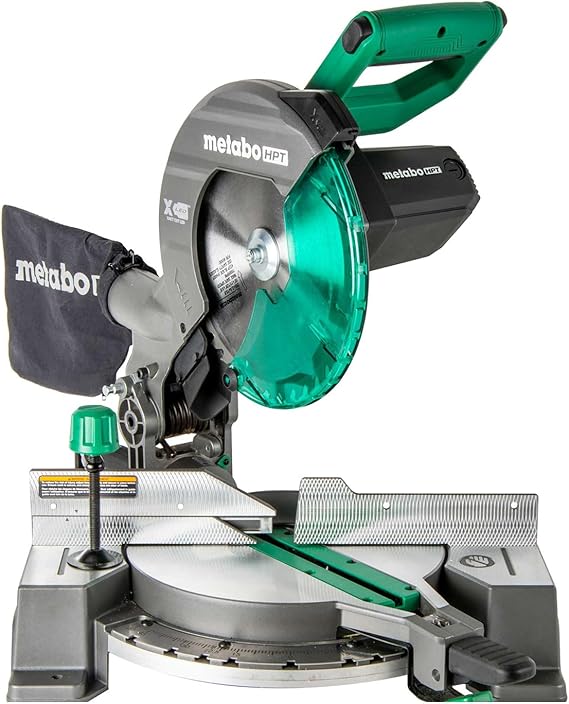
Great for those who cut metal on the go, the 10-inch compound miter saw suits users needing power and portability. Its standout feature is a strong 15-Amp motor combined with a lightweight design, making it easy to handle without sacrificing cutting power.
Setup is straightforward, thanks to the improved miter scale and controls that let you make accurate angle adjustments quickly. The large 10-inch table supports your materials well, while the vice clamping system holds things steady during work. Weighing just 24 lbs, moving it around the job site doesn’t require much effort at all.
Cutting through metal is smooth with the 1950-watt motor pushing up to 5,000 RPM, delivering precise and clean cuts. The saw is solidly built but still lightweight, striking a good balance.
Most users appreciate its accuracy and portability, though a few note that the single bevel limits cutting options compared to dual-bevel models.
The saw receives praise for its powerful motor combined with lightweight portability, allowing precise cuts without heavy lifting. The main limitation noted is the single bevel design, which reduces cutting options for more complex angles.
The tool fits well for metalworkers who need to move their saw frequently and want accurate, straightforward cuts. For users requiring dual bevel cutting or larger blade sizes, exploring other models might be more suitable.
Pros
- Powerful 15-Amp motor for strong cuts
- Lightweight at only 24 lbs for easy transport
- Vice clamping system secures material well
- Accurate miter scale and angle controls
Cons
- Single bevel limits cutting versatility
- Smaller blade size may restrict some cuts
| Specification | Details |
|---|---|
| Power Source | Corded Electric |
| Voltage | 120 volts |
| Number of Teeth | 40 |
| Cutting Angle | 52 degrees |
| Wattage | 1950 watts |
8. SKIL 10 Dual Bevel Sliding Compound Miter Saw

Power and precision define the SKIL 10 Dual Bevel Sliding Compound Miter Saw, designed for metal cutting projects demanding accuracy and adaptability. Ideal for tradespeople or DIYers needing quick, clean cuts at multiple common angles, it stands out with its powerful 15 AMP motor and dual bevel capability.
Setting up involves plugging into a standard 120-volt outlet, making it ready to run without fuss. Daily projects benefit from the LED Shadow Line, which helps mark exact cut lines with better precision than lasers. The sliding feature and ability to tilt on both sides make it easy to handle a variety of angles and materials like 2×12 lumber or metal pieces with confidence.
Speed reaches up to 4,800 RPM, providing thorough, detailed cuts through thicker metal and wood. The build combines a strong motor with a steady base, giving solid support while working.
The most praised feature is how precisely it cuts, especially at complex angles, but the saw’s weight and the use of a single lithium-ion battery sometimes get noted as drawbacks in extended use.
Users appreciate the high precision achieved with its LED Shadow Line and the strong 15 AMP motor that powers through metal with minimal fuss. Common drawbacks include the saw’s heavier weight making it less portable for some, and reliance on one lithium-ion battery which may require frequent charging during cordless jobs.
Tradespeople frequently working with metal at angled cuts benefit most from this saw thanks to its power and precision. Casual or occasional users might prefer lighter models without battery constraints, especially for simpler or smaller-scale tasks.
Pros
- Powerful 15 AMP motor for tough cuts
- Dual bevel for versatility in angle cuts
- LED Shadow Line adds cutting precision
- 2×12 cutting capacity at 90 degrees
Cons
- Single lithium-ion battery limits cordless use
- Heavier weight can be tiring for long projects
| Specification | Details |
|---|---|
| Power Source | Corded Electric |
| Voltage | 120 volts |
| Speed | 4800 rpm |
| Current Rating | 15 A |
| Blade Teeth | 40 |
| Cutting Angle | 50 degrees |
9. (No Brand) 10 Sliding Compound Miter Saw

No brand 10 Sliding Compound Miter Saw delivers solid power and precision ideal for cutting metal and wood. Best suited for those needing a mix of portability and performance, it stands out mainly for its strong 15-amp motor that keeps the blade spinning quickly and steadily through various tasks.
Setup is straightforward because the saw plugs into any standard 120-volt outlet, making it ready right out of the box. The transparent blade guard helps you see your cuts clearly while the vise clamp holds materials firmly in place.
Dust collection keeps your work area tidier, and the saw’s lightweight design means moving it around doesn’t feel like a chore.
The motor runs at a steady 5000 rpm, which cuts through most metals without bogging down. The build feels solid yet light, making it both durable and portable.
Reviewers appreciate the saw’s accuracy and power, but some mention the dust bag could be better at capturing fine particles, leading to a bit of cleanup afterward.
Powerful motor and firm material holding get frequent praise for making precise cuts easier and faster. The dust collection isn’t perfect, which can leave some fine particles around the workspace. The blade guard’s transparency helps, but might slightly block the view when angling cuts.
Users who need a solid, portable saw for metal and wood cutting will appreciate the motor strength and ease of setup. Those who want nearly dust-free operation or complete visibility on every angle might want to look at alternatives with more advanced dust control or different guard designs.
Pros
- Strong 15-amp motor for consistent cutting power
- Vise clamp secures material firmly
- Lightweight and easy to move
- Dust collection bag included
Cons
- Dust collection bag doesn’t capture all debris
- Blade guard reduces visibility for some cuts
| Specification | Details |
|---|---|
| Power Source | Corded Electric |
| Voltage | 120 volts |
| Speed | 5000 rpm |
| Current Rating | 15 A |
| Bevel Capability | 45 degrees |
| Wattage | 1900 watt-hours |
10. Hoteche 10-Inch Compound Miter Saw

Cutting through metal with clean precision feels reliable using this 10-inch compound miter saw. Best suited for contractors, carpenters, and DIY enthusiasts, its powerful motor stands out as the biggest strength, making tough materials manageable.
The saw handles metal, hardwood, aluminum, and PVC smoothly, fitting well in busy workshops or home garages.
Setting it up is straightforward thanks to its corded electric power source, ensuring constant energy without battery worries. The 1800W high-torque motor runs at 5000 RPM, helping keep cuts vibration-free and accurate.
Bevel capability and a 45-degree cutting angle offer flexibility for precise angle cuts. Handling feels balanced enough for steady work during longer sessions.
It cuts through metal and wood with consistent speed and minimal vibration, showing strong build quality. The 40-tooth blade also contributes to clean, sharp edges.
Most users appreciate its heavy-duty design and reliable power. A common downside reported involves the saw’s weight, making it less portable for occasional moves.
A 1800W motor powers the Hoteche 10-Inch Compound Miter Saw, letting it cut through materials like hardwood and aluminum reliably at up to 5000 RPM. It is praised for smooth operation and consistent precision in angle cuts. Some find the saw a bit bulky for smaller workshop spaces, which makes handling and storage more challenging.
People working on heavy-duty woodworking or remodeling projects will find the power and cutting accuracy appealing. Those with limited room or looking for a lighter saw for occasional use might prefer a smaller, more compact model. The saw suits professionals and serious DIYers needing a workhorse for frequent, precise cuts rather than casual users.
Pros
- Powerful 1800W motor for tough cuts
- Bevel capability allows angled cuts
- High speed of 5000 RPM supports smooth cutting
- 40-tooth blade provides clean edges
Cons
- Relatively heavy, not easy to move
- Cord limits range without extension
| Specification | Details |
|---|---|
| Power Source | Corded Electric |
| Motor Wattage | 1800 watts |
| Speed | 5000 rpm |
| Cutting Angle | 45 degrees |
| Voltage | 120 volts_of_alternating_current |
| Number of Teeth | 40 |
11. DEWALT 12 Sliding Compound Miter Saw DWS779

Great for metal cutting projects, this saw runs on battery power and features a stainless steel miter detent plate with 10 positive stops, making it precise and easy to handle. It suits those who need a reliable, portable tool without the restrictions of a cord, especially in jobs requiring accurate angled cuts.
Setup involves installing the battery and locking the stainless steel miter detent plate into place with its positive stops, helping you set common angles quickly. The sliding feature allows you to adjust the blade easily for wider cuts. Day-to-day use feels smooth thanks to the battery power, eliminating cords and giving more freedom to move around your workspace.
Cutting through metal with this saw shows consistent precision due to the sturdy stainless steel detent plate combined with clear angle stops. The build feels solid and well-balanced for a battery model, although some users mention the weight can be a factor during extended use. Most praise focuses on its accuracy, while a common drawback is that the battery life limits longer cutting sessions.
Precision in angle adjustment gets strong praise, thanks to the stainless steel detent plate and positive stops. Battery power removes cord clutter but also means you must watch the charge, as the battery can run out during longer tasks.
Ideal for those needing a portable and precise metal cutting tool on varied worksites. Less suited for heavy daily use without access to spare batteries. People needing longer runtime or lighter weight may want to consider other options.
Pros
- Battery powered for mobility
- Stainless steel detent plate ensures accurate miter cuts
- 10 positive stops make angle settings quick
- Round blade shape suited for metal cutting
Cons
- Battery life limits continuous use
- Slightly heavy for extended projects
| Specification | Details |
|---|---|
| Power Source | Battery Powered |
| Special Features | Stainless Steel Miter Detent Plate |
| Blade Shape | Round |
| Miter Stops | 10 Positive Stops |
12. Evolution R185CMS-Li 7-1/4 Cordless Compound Miter Saw

Compact and lightweight design makes this cordless saw ideal for those needing portability without sacrificing power. It suits metalworkers and DIYers who want easy maneuverability for metal cutting tasks. Its cordless battery system is the key feature that lets you cut metal anywhere, without being tethered to a power outlet.
Setup involves attaching the included 4Ah battery before starting the 50-minute rapid charger if needed. The 20T Tungsten Carbide Tipped blade handles different materials smoothly, while the dust bag helps keep your work area cleaner.
Miter and bevel adjustments lock in precisely between 45° on either side, making it straightforward to get accurate cuts.
Performance on metal is solid, delivering cool, virtually spark-free cuts that leave minimal burrs, which speeds up finishing work. The soft start motor provides a controlled spin-up to avoid kickbacks. Reviewers highlight the lightweight frame as a plus for easy handling, while some mention limited run time as a drawback during longer projects.
Positive feedback often highlights the cool, burr-free cuts and the saw’s portability thanks to the cordless operation. The main complaint centers on the battery life, which can run out quickly during prolonged cutting sessions, impacting productivity.
Those needing light to moderate metal cutting on the go will appreciate its combination of precision and cordless freedom. Users with heavy-duty or extended cutting tasks might prefer a corded or higher-voltage option for longer continuous use.
Pros
- Cordless 20V battery allows use anywhere
- Cuts wood, metal, plastic, and composites
- Compact and lightweight for easy handling
- Accurate compound miter and bevel adjustments
Cons
- Battery runtime may be short for extended use
- 20-tooth blade limits cut speed on harder metals
| Specification | Details |
|---|---|
| Power Source | Battery Powered |
| Cutting Angle | 45 degrees |
| Number of Teeth | 20 |
| Blade Shape | Round |
| Power System | 20V Li-Ion battery |
Best Miter Saws for Cutting Metal Compared
| Product | Power Source | Speed (rpm) | Cutting Angle | Blade Shape |
|---|---|---|---|---|
| Evolution S14 Miter Saw | Corded Electric | 1100 | 46 degrees | Rectangular |
| Evolution R185 Sliding Miter | Corded Electric | 3700 | 45 degrees | Round |
| VEVOR 8-1/4 Compound Miter | Corded Electric | 4800 | 45 degrees | Round |
| DEWALT D28710 Chop Saw | Corded Electric | 3800 | 45 degrees | Round |
| DEWALT D28730 Chop Saw | Corded Electric | – | 45 degrees | Rectangular |
| Evolution S355C Metal Saw | Corded Electric | 1450 | 45 degrees | Round |
| Metabo HPT C10FCG2 Saw | Corded Electric | – | 52 degrees | Round |
| SKIL 10 Dual Bevel Saw | Corded Electric | 4800 | 50 degrees | Round |
| Generic 10 Sliding Miter | Corded Electric | 5000 | 45 degrees | Rectangular |
| Hoteche 10 Compound Saw | Corded Electric | 5000 | 45 degrees | Round |
| DEWALT DWS779 Sliding Saw | Battery Powered | – | – | Round |
| Evolution R185CMS-Li Cordless | Battery Powered | – | 45 degrees | Round |
- Power SourceCorded Electric
- Speed (rpm)1100
- Cutting Angle46 degrees
- Blade ShapeRectangular
- Power SourceCorded Electric
- Speed (rpm)3700
- Cutting Angle45 degrees
- Blade ShapeRound
- Power SourceCorded Electric
- Speed (rpm)4800
- Cutting Angle45 degrees
- Blade ShapeRound
- Power SourceCorded Electric
- Speed (rpm)3800
- Cutting Angle45 degrees
- Blade ShapeRound
- Power SourceCorded Electric
- Speed (rpm)–
- Cutting Angle45 degrees
- Blade ShapeRectangular
- Power SourceCorded Electric
- Speed (rpm)1450
- Cutting Angle45 degrees
- Blade ShapeRound
- Power SourceCorded Electric
- Speed (rpm)–
- Cutting Angle52 degrees
- Blade ShapeRound
- Power SourceCorded Electric
- Speed (rpm)4800
- Cutting Angle50 degrees
- Blade ShapeRound
- Power SourceCorded Electric
- Speed (rpm)5000
- Cutting Angle45 degrees
- Blade ShapeRectangular
- Power SourceCorded Electric
- Speed (rpm)5000
- Cutting Angle45 degrees
- Blade ShapeRound
- Power SourceBattery Powered
- Speed (rpm)–
- Cutting Angle–
- Blade ShapeRound
- Power SourceBattery Powered
- Speed (rpm)–
- Cutting Angle45 degrees
- Blade ShapeRound
How to Choose the Right Miter Saw for Metal
Choosing a miter saw for cutting metal involves focusing on blade material, motor power, and safety features to ensure efficient, precise cuts. Selecting the right specifications prevents blade damage and extends tool lifespan, ultimately saving time, money, and frustration during projects.
Blade Type and Material
Choosing the right blade material can make a big difference when cutting metal. Carbide-tipped blades are common for cleaner, longer-lasting cuts on thin to medium-thickness metals.
Abrasive wheels can handle tougher metals but wear down faster and produce more dust. The blade size affects how thick a piece you can cut; common diameters range from 10 to 12 inches, which suit most metal tasks. Tooth count also matters, more teeth usually mean a smoother cut but slower progress, while fewer teeth cut faster but rougher.
Carbide-tipped blades often balance durability and precision well, lasting through multiple cuts before needing replacement. Replacement blades should be easy to find and reasonably priced, as frequent blade changes are common with metal work. Skimping on blade quality leads to jagged edges and faster wear, forcing more downtime.
Motor Power and Speed
Metal cutting demands enough motor power to get through dense materials without bogging down. Motors rated around 15 amps or about 1200 to 1800 watts are typical for handling a variety of metals. Variable speed settings come in handy for adjusting the blade’s RPM based on the metal’s hardness and thickness, spinning slower for thicker or harder metals helps avoid overheating and premature blade damage.
High torque at low speeds also prevents the blade from stalling or bogging down mid-cut, which can ruin both the metal and the blade.
Safety Features
Cutting metal creates sparks and debris, so an effective blade guard and cover are essential. Guards made from strong, impact-resistant materials reduce the risk of injury and keep metal shards contained.
Locks to hold metal pieces firmly mean cuts stay precise, and the workpiece doesn’t shift, reducing chances of binding or kickback. Many saws allow attachments for dust and spark extraction systems, which remove harmful particles from the air and the workspace. This keeps the user’s breathing safer and the surrounding area cleaner during extended projects.
Build Quality and Durability
A saw with a rugged frame made from heavy-duty materials such as cast aluminum or steel handles the vibrations and stresses from continuous metal cutting better than lighter builds. Without enough rigidity, cuts can wander off the mark, frustrating precise work. Corrosion resistance is critical, especially since metal dust and sparks can cause rust on exposed parts over time.
Components like the fence, table surface, and fasteners should resist oxidation. A stable base combined with strong clamps holds the workpiece in place to ensure cuts are steady and precise.
Cutting Capacity and Versatility
The capacity to cut various metal sizes shapes what projects can be completed. Cutting capacity includes both thickness and length. Some saws handle metal sheets up to several inches thick and bars or pipes of larger diameters.
Adjustable bevel and angle ranges support different fabrication needs; a typical bevel adjustment up to 45 degrees on both left and right allows angled cuts common in framing or piping. Versatile saws accommodate metals like aluminum, steel, and copper without sacrificing cut accuracy across shapes such as flat sheets, tubing, and angle iron.
Tips for Maximizing Accuracy When Cutting Metal with a Miter Saw
The blade choice plays a crucial role in accuracy when cutting metal with a miter saw. Using a blade designed for metal ensures cleaner cuts and reduces material deformation. It’s important to secure the metal firmly on the saw’s base to prevent any movement that can shift the cut line.
Setting up a stop block on the miter saw fence helps repeat cuts at the exact same length, which is essential for projects needing uniform pieces.
Additional tips to improve accuracy:
- Mark cut lines clearly with a permanent marker or scribe for visibility during cutting.
- Make slow, steady cuts to avoid overheating the blade and metal, which can cause warping.
- Use clamps to further stabilize the workpiece, especially with smaller or irregularly shaped items.
- Double-check the miter angle settings and tighten adjustment knobs to lock angles securely.
Essential Maintenance Practices to Extend the Life of Your Miter Saw
Keeping a miter saw in good condition starts with regular cleaning. Metal shavings and dust can build up around the blade guard and motor housing, which may affect performance. Removing this debris with compressed air or a brush prevents jams and overheating.
Lubricate moving parts like the pivot points to maintain smooth operation.
Key maintenance actions include:
- Inspecting the blade regularly for dullness or damage and replacing it when necessary.
- Checking the alignment of the saw blade with the fence and base to maintain precise cuts.
- Ensuring all screws and nuts are tight to reduce vibration during use.
- Storing the saw in a dry place to avoid rust on metal components.
Comparing Miter Saws and Chop Saws for Metal Cutting Tasks
Miter saws and chop saws both cut metal well but serve different needs. A miter saw offers the ability to make angled or bevel cuts, which is helpful for complex work like framing or fabricating metal angles.
Chop saws, in contrast, generally only cut in a straight, vertical line, which might be limiting but sufficient for basic cuts like rods or pipes.
Important differences include:
- Miter saws usually have more adjustable angles for precision cuts, while chop saws focus on power and speed for straight cuts.
- Chop saws often use abrasive wheels suited for heavy-duty metal cutting, whereas miter saws use toothed blades designed for precision.
- Portability can vary; chop saws tend to be bulkier due to their cutting power and wheel size.
- Miter saws provide cleaner cuts but may require more maintenance due to blade complexity.
People Also Asked
How Do I Safely Cut Metal with a Miter Saw?
Use a miter saw with a blade designed for metal cutting and wear eye and ear protection. Secure the metal firmly to avoid movement and cut slowly to prevent overheating the blade.
What Size Miter Saw Blade Is Best for Cutting Metal?
A 10 to 12-inch blade with carbide-tipped teeth works best for most metal cutting tasks, providing a good balance of precision and durability. Smaller blades may struggle with thicker metals.
How Do I Maintain a Miter Saw Used for Metal Cutting?
Clean metal dust and debris from the saw after each use and check the blade for dullness or damage regularly. Lubricate moving parts to avoid rust and make cutting smoother.
Can a Wood Miter Saw Be Used for Metal Materials?
A wood miter saw can cut metal only if equipped with a metal-cutting blade and used with appropriate safety measures. Avoid using a standard wood blade as it can dull quickly and cause unsafe conditions.
What Are Common Problems When Cutting Metal with a Miter Saw?
Blades can overheat and dull quickly if cutting too fast or without coolant. Metal pieces may also vibrate or slip if not securely clamped, leading to inaccurate cuts and potential hazards.
Conclusion
Choosing the best miter saw for cutting metal mainly depends on the saw’s power, blade quality, and ability to handle metal materials without excessive wear or overheating. Pay attention to features like blade speed, durability, and cutting capacity specific to metal work.
A saw that can provide clean, precise cuts and withstand the tougher demands of metal cutting offers better long-term value.
Consider how much space you have for the saw, your budget, and how often you’ll use it. These factors will help narrow down the best option for your needs. Review the comparison table and the recommendations above to find a model that matches your work style and project requirements without overspending or overbuilding for your typical tasks.

I’m Cody Harrison, a lifelong hunter who has spent many seasons in the woods, marshes, and open country. I write about hunting gear, rifle and bow setups, scouting strategies, tree stands, and field safety. I share lessons from real hunts to help both beginners and experienced hunters prepare better, hunt smarter, and get more out of every trip.


