
Top 12 Best Battery Powered Roofing Nailer You Need Now!
Using a cheap or poorly designed roofing nailer can slow down a project and lead to misfires that waste nails and time. The best battery powered roofing nailer avoids these issues by providing consistent power without the cords or compressors of traditional models.
This cordless freedom makes it easier to move around a roof and handle awkward angles without getting tangled or weighed down.
Key factors that separate a good battery powered roofing nailer from a poor one include battery life, magazine capacity, and weight. Most reliable models deliver at least 1,000 nails per full charge and hold around 100 nails in the magazine to reduce reloading time.
The tool should feel balanced in hand, typically under 8 pounds, to prevent fatigue during long use. Durable metal construction and easy access for cleaning also keep it working smoothly over time.
Need a Quick Check?
| Image | Product | Price |
|---|---|---|
Our Top Picks 1  | DeWalt 20V MAX Roofing Nailer | Check Price |
Our Top Picks 2  | Metabo HPT 18V Brushless Nailer | Check Price |
Our Top Picks 3  | CRAFTSMAN V20 Roofing Nail Gun | Check Price |
Our Selected Top 12 Battery Powered Roofing Nailer Worth Buying
This list features carefully chosen battery powered roofing nailers, evaluating their performance, suitability for different users, and key advantages and disadvantages. Each review provides practical insights to help readers understand which tool best fits their specific roofing needs and work conditions.
1. DeWalt 20V MAX 15 Degree Roofing Nailer
Roofers looking for a reliable cordless nailer that handles most roofing jobs will find this tool a great fit. Its strongest point is the brushless motor that extends battery life while keeping the unit lightweight enough for all-day use without tiring out your arm.
Setting up the nailer is straightforward thanks to the tool-free nail tray, making it easy to switch between different sized nails on the spot. The 20V MAX battery system offers enough power for prolonged work, and the bump mode helps speed things up when nailing continuously. Handling the device feels balanced, avoiding strain during long shifts on the roof.
The nailer drives nails consistently and accurately into roofing materials. Its build quality feels solid with durable housing that protects the internals well. Most praise revolves around the extended runtime courtesy of the brushless motor, while some users note the instructions and labeling might differ depending on where you get it from, causing minor confusion.
The brushless motor extends efficient runtime, making long roofing jobs less tiring, but the international versions may have confusing labeling and instructions. This issue might slow down setup for users unfamiliar with the specific package they received.
Professionals who want cordless convenience and solid power will appreciate this nailer, especially for continuous work. Those needing perfectly uniform instructions or who prefer a very specific local version may want to consider other options.
Pros
- Brushless motor increases runtime and durability
- Tool-free nail tray for quick adjustments
- 20V battery provides sufficient cordless power
- Bump mode promotes faster nailing
Cons
- Instructions may vary based on purchase location
- Labels and language can differ in international versions
| Specification | Details |
|---|---|
| Power Source | Battery Powered |
| Voltage | 20 volts |
| Additional Features | Brushless Motor |
| Battery Type | Rechargeable |
| Compatible Devices | Battery |
2. Metabo HPT 18V MultiVolt Brushless Roofing Nailer
Metabo HPT 18V MultiVolt Brushless Roofing Nailer stands out by matching pneumatic tool power without the need for gas, hoses, or compressors. Ideal for roofing pros seeking mobility and strong fastening, its air spring coil design offers impressive driving force while keeping the convenience of battery operation front and center.
Getting started is straightforward thanks to the side loading magazine, which makes replenishing nails quick during long jobs. The included 18V 2.0Ah battery provides enough charge for about 500 nails, so frequent stops for recharging are rare. The vinyl siding adapter is a handy touch that helps avoid nail overdriving, while the dust and tar resistant mechanism reduces downtime due to clogging.
Performance is solid, driving nails up to 1-3/4 at a level close to traditional pneumatic nailers. The build feels sturdy and well-balanced at 8.6 pounds with dimensions that are easy to handle around the roof. Users often praise its consistent power and easy magazine reload, but some note the battery weight adds noticeable heft during extended use.
The tool delivers power close to pneumatic models with easy reloads and a durable dust-resistant mechanism, but the 8.6-pound weight including the battery can be tiring over full days of work. Frequent recharging is rarely needed thanks to its 500 nails per charge capability.
Roofers valuing cordless freedom without sacrificing power will appreciate the convenience and steady performance. Those requiring lighter tools for extended overhead work or a wider nail angle range might want to consider other options.
Pros
- No gas, hose, or compressor needed
- Side loading magazine speeds nail replenishment
- 500 nails per battery charge
- Includes vinyl siding adapter
Cons
- Battery weight adds noticeable heft
- Limited to 16º wire coil roofing nails
| Specification | Details |
|---|---|
| Power Source | Battery Powered |
| Voltage | 18 volts |
| Item Weight | 8.6 pounds |
| Fastener Compatibility | 16º Wire Coil Roofing Nails, 7/8″ to 1-3/4″ |
| Battery Included | 1 Lithium Ion battery (18V 2.0Ah) |
3. CRAFTSMAN V20 Brushless Cordless Roofing Nail Gun
CRAFTSMAN V20 Brushless Cordless Roofing Nail Gun is perfect for roofing pros and DIYers needing a strong cordless tool. Its biggest strength lies in its runtime, allowing you to cover a bit over 400 square feet of shingles on a single charge, making long jobs less interrupted.
Setup is straightforward, especially with the included belt hook for easy carrying around the job site. Tool-free depth adjustment lets you nail precisely without stopping to tweak anything with extra tools.
Clearing jams is quick with the stall release lever, and the LED indicators keep you informed about nail jams and low battery at a glance. It runs on a 20-volt battery sold separately, so having a backup battery helps.
Performance on roofing and siding nails feels dependable, thanks to the brushless motor that keeps power consistent through the job. The build weighs 8.1 pounds, which feels balanced for the size but may tire you over long periods.
One strong positive is the versatility in nailing modes, bump or sequential. Some users find the weight a bit on the heavier side for extended use.
Many users appreciate how long the battery lasts and the convenience of seeing alerts for jams and low charge. The main frustration comes from the tool’s weight, which can feel heavy when using it for extended periods.
The nailer suits anyone needing cordless performance on moderate-sized roofing jobs, especially where portability matters. Those doing very long days or wanting a lighter tool might want to look at other options.
Pros
- Runs over 400 sq. ft. of shingles on one charge
- Tool-free depth adjustment for precise nailing
- LED alerts for nail jams and low battery
- Includes belt hook for easy transport
Cons
- Battery sold separately
- Weight may cause fatigue during long use
| Specification | Details |
|---|---|
| Voltage | 20 volts |
| Item Weight | 8.1 pounds |
| Dimensions | 12.97 x 5.56 x 12.57 inches |
| Included Components | CMCN140 V20* BRUSHLESS RP Cordless 15 Roofing Nailer (Tool Only); Belt Hook |
| Jaw Capacity | Drives just over 450 nails |
| Performance Coverage | Installs just over 400 sq. ft. of roofing shingles |
4. DeWalt 20V MAX 15-Degree Cordless Roofing Nailer

Feels balanced in your hand and cordless freedom makes tackling shingles easy. Perfect for roofers who want solid power without lugging cords around.
Biggest strength lies in its reliable 20V MAX Lithium-Ion battery that keeps you going without frequent stops.
Setup is straightforward with the included 2.0Ah battery and charger tucked into the provided bag. You just snap on the battery and you’re ready to nail.
Lightweight design at just over 11 pounds helps reduce fatigue when you’re working all day on slopes. Nail placement is precise thanks to the 15-degree angled magazine that fits comfortably for tight spots.
Keeps driving nails with steady power throughout a day’s work without sudden drops. Built tough by Stanley Black and Decker with a blend of materials and brushed finish that handles rough jobsite conditions. Most users praise its consistent firing and manageable weight.
The main complaint is the heavier feel compared to pneumatic options.
The cordless design powered by a 20V MAX lithium-ion battery offers steady, dependable nailing throughout the day, keeping roofing projects moving without cords. A common downside is its weight, which some find heavier compared to air-powered options, adding some strain over extended use.
Ideal for roofers who value cordless convenience and moderate weight but willing to tolerate extra heft. Those needing ultra-light tools or extended runtime might seek pneumatic or other battery options instead.
Pros
- Cordless operation with reliable 20V MAX battery
- Compact 15-degree angled magazine
- Lighter than many other cordless roofing nailers
- Includes charger and carrying bag
Cons
- Heavier than pneumatic nailers
- Limited battery runtime on large jobs
| Specification | Details |
|---|---|
| Power Source | ac_dc |
| Battery Cell Type | Lithium Ion |
| Item Weight | 11.58 pounds |
| Product Dimensions | 18.5 x 1 x 12.57 inches |
| Model Number | DCN45RND1 |
5. DeWALT DCN45RND1 20V 15 Degree Cordless Roofing Nailer

Great for anyone needing steady power without the cord, it’s a solid roofing nailer that doesn’t quit easily. Designed for pros who value portability and battery life, it shines in outdoor jobs where dragging a compressor isn’t practical. Its main strength lies in its dependable cordless operation at 20 volts.
Setup involves charging the single lithium ion battery, which fits easily and securely. Day-to-day use is straightforward with a grip that feels comfortable and manageable despite the power packed inside.
The compact, cordless design saves on tripping hazards and lets you move freely on uneven roofs. Loading nails and replacing the battery only takes a moment, supporting continuous work without long interruptions.
Power delivery is reliable, driving nails quickly and cleanly into roofing materials. The build quality supports tough job site conditions with a sturdy frame, though some mention it could be a bit heavier than expected. Most users appreciate the cordless convenience but note the single battery means having backups is necessary for extended tasks to avoid downtime.
This roofing nailer gets praised most for its reliable cordless power that makes roofing faster and less tangled in cords. The main complaint plays on its weight, as some find it bulkier compared to lighter models. Having just one battery can slow down work if a backup battery is not ready.
Ideal for roofing pros who need portable power without the hassle of a compressor. Those with long jobs or preferences for ultra-light tools might want to look at options with lighter builds or more battery capacity included.
Pros
- Strong cordless power for job site freedom
- Comfortable grip for extended use
- Quick and easy nail loading
- Sturdy design handles rough work conditions
Cons
- Can feel heavier than some competitors
- Single battery means extra needed for long jobs
| Specification | Details |
|---|---|
| Voltage | 20 volts |
| Battery Type | Lithium Ion |
| Number of Batteries | 1 Lithium Ion batteries required. |
| Power Source | battery |
| Angle | 15 Degree |
6. Milwaukee M18 Fuel Coil Roofing Nailer

Milwaukee M18 Fuel Coil Roofing Nailer features a compact, lightweight design weighing just 16 ounces, making it easy to handle during long hours on the roof. It suits roofing professionals who need fast nailing speeds combined with reliable battery life for large projects. The rapid-fire capability of up to 6 nails per second stands out as its biggest strength.
Setting up the nailer is simple with its tool-free depth adjustment, allowing you to precisely control nail placement without fumbling with tools. The included CP3.0 battery supports firing up to 1,100 nails per charge, which reduces downtime dramatically.
Daily use also benefits from the vinyl siding tip included, giving the tool versatility beyond roofing tasks. Dry fire lockout helps prevent accidental damage when nails run out, which is a thoughtful safety feature.
Performance-wise, the tool keeps a consistent power output with smooth and accurate nailing for high-volume roof jobs. The build quality feels sturdy but not overly heavy, a balance that supports all-day wear.
A frequent praise is its battery endurance, while the most common complaint relates to occasional jamming under heavy use. Despite that, Milwaukee’s design holds up well in demanding conditions.
Battery life that supports 1,100 nails per charge is highly praised, making full days possible without recharging. Many notice occasional nail jams when pushing it hard, which slows progress intermittently. The tool balances speed and power effectively.
Roofers handling large-scale projects will appreciate the fast firing and solid battery life. Those focusing on fine detail or needing ultra-light tools might consider alternatives with less weight or specialized features.
Pros
- Rapid-fire capability speeds up roofing work
- Tool-free depth adjustment for accurate nailing
- Long-lasting battery with 1,100 nails per charge
- Includes vinyl siding tip for extra versatility
Cons
- Occasional jamming reported during continuous use
- Weight may feel chunky for very detailed work
| Specification | Details |
|---|---|
| Model | 2909-21 |
| Item Weight | 16 ounces |
| Number of Nails per Charge | 1,100 (with CP3.0 battery) |
| Firing Rate | Up to 6 Nails/Second |
| Included Components | Milwaukee Electric – M18 FUEL COIL ROOFING NAILER |
7. DeWalt 20V MAX 15-Degree Cordless Roofing Nailer
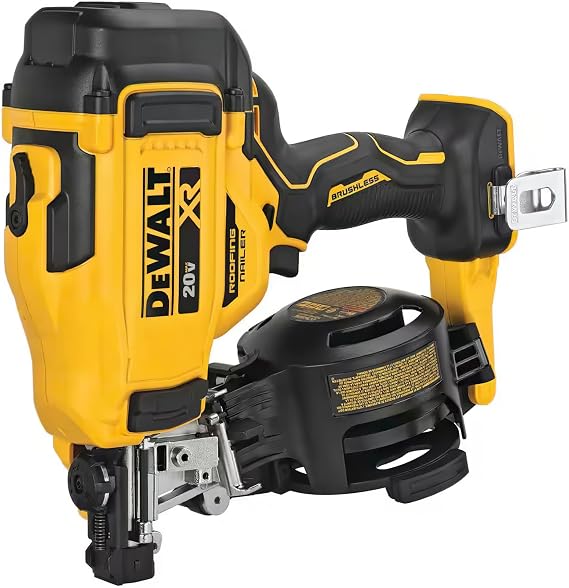
Weight stands out immediately with this roofing nailer, tipping the scales at just under 8 pounds, making it manageable for extended use. Best suited for professionals who need cordless freedom without sacrificing power, its greatest strength lies in its balance between portability and dependable nailing performance.
Setup is straightforward since it runs on a 20V MAX battery system, letting you skip cords and compressors. Day-to-day tasks become smoother because it operates at a 15-degree angle, which fits well with common roofing nails.
Handling is comfortable thanks to its moderate weight and compact dimensions, and the electric power source cuts down on maintenance compared to pneumatic versions.
Performance meets expectations by driving nails efficiently into roofing materials without frequent jams or misses. The construction feels solid, with a blend of materials finished in brushed style adding durability. Strong praise focuses on its cordless convenience and consistent firing, while complaints mention the weight as a bit on the heavier side for some users.
Consistent nailing performance and cordless ease receive high marks, while some find the 7.78-pound weight relatively heavy compared to other options in cordless roofing nailers. The reliable build keeps it going job after job but isn’t the lightest choice for extended use.
Those needing cordless freedom with a sturdy feel and reliable nail driving will appreciate this tool. Users prioritizing minimal weight or wanting an all-in-one kit might want to explore lighter or bundled models elsewhere.
Pros
- Cordless convenience with 20V MAX battery compatibility
- Compact size fits in tight roofing spaces
- Solid build quality with durable materials
- 15-degree angle adapts to most roofing nails
Cons
- Weight close to 8 pounds may tire some users
- Tool only, requires separate battery purchase
| Specification | Details |
|---|---|
| Power Source | ac_dc |
| Item Weight | 7.78 pounds |
| Item model number | DCN45RNB |
| Product Dimensions | 12.97 x 1 x 12.57 inches |
| Size | One Size |
8. Arrow ET501C Cordless Staple and Nail Gun

Great for a range of projects, this nailer handles five different types of fasteners to keep one tool versatile and handy. Ideal for anyone needing a battery-powered option that covers carpentry, crafts, and even roofing, the main strength lies in its multi-functionality combined with solid cordless convenience.
Setting up involves choosing the right fastener type among the staples and brad nails offered. Daily use feels natural with its compact design, helping you move around easily without fatigue.
Using both hands, one on top and one on the trigger, controls kickback well and improves penetration, making it more reliable for precision work on wood and trim.
The tool nails and staples firmly without frequent jams, holding up well over time thanks to its solid build. Most praise mentions its flexibility across projects, while complaints usually involve handling kickback if not held correctly or needing to buy specific sizes for tougher woods like oak and plywood.
Most users appreciate how this tool handles various fasteners efficiently across different jobs, making it a practical all-in-one solution. However, kickback can be a frequent issue without the recommended two-handed grip, which some found challenging during extended use.
Tradespeople or hobbyists needing one versatile cordless nailer for light to moderate projects will find this fits well. Those focused solely on heavy-duty roofing or large-scale construction might want a more specialized, powerful model instead.
Pros
- Covers five types of fasteners for diverse tasks
- Compact cordless design reduces fatigue
- Supports both crafts and heavier wood projects
- Controls kickback well when held properly
Cons
- Requires two-hand grip to prevent kickback
- Must buy additional staple/nail sizes for thicker materials
| Specification | Details |
|---|---|
| Brand Name | Arrow Fastener |
| Model Number | ET501C |
| Item Type Name | 5-In-1 Professional Staple and Nail Gun, Battery Powered Wire Stapler, Brad Nailer for Upholstery, Framing, Roofing, Crafts, Fencing, Cable |
| Included Components | Staple and Nail Gun |
| Number of Items | 1 |
9. Metabo HPT NV45AB2 Roofing Nailer and C3607DWA Circular Saw Kit

Working on a roofing project demands a nailer that can keep up with fast-paced tasks and heavy workloads without weighing you down. A tool that drives nails quickly while being comfortable to handle is exactly what suits roofing contractors and DIYers aiming for efficiency.
The standout feature is how fast it drives nails, letting you cover large surfaces with fewer interruptions.
Setting up involves charging a single 36V MultiVolt Lithium Ion battery, which powers both the nailer and a circular saw included in the kit. The high-capacity magazine holds 120 nails, so you don’t have to stop frequently to reload. The rear handle design makes it balanced in hand, and swapping from nailing to cutting tools is convenient thanks to using the same battery.
Driving up to three roofing nails per second helps finish jobs quickly, with nails consistently driven to the right depth between 70 and 120 psi. The tool feels sturdy yet surprisingly light.
One of the best things noted is how much lighter it is compared to similar circular saws. Some mention that the nailer’s pneumatic power requires connecting to an air compressor, which might limit portability slightly.
Fast nail driving speed and a large nail magazine improve job efficiency noticeably. The lightweight design makes it easier to handle throughout long workdays. A common downside is the need for a supporting air compressor, which can reduce mobility on job sites without easy power access.
Roofing professionals who have air compressors handy will appreciate the speed and balance of this tool. Those needing truly cordless operation might want to consider other options that do not rely on pneumatic power connections.
Pros
- Drives up to 3 nails per second
- Holds 120 nails in the magazine
- Lightest in its class by 2 lbs
- Uses a single battery for nailer and saw
Cons
- Requires pneumatic setup for operation
- May feel limited without an air compressor
| Specification | Details |
|---|---|
| Size | NV45AB2 Only |
| Style | w/ 36V Circ Saw Kit (Rear Handle) |
| Item Package Quantity | 1 |
| Battery Type | 36V MultiVolt Lithium Ion |
10. DEWALT 20V MAX Compact Pin Nailer Kit DCN623D1

Running on a 20V MAX battery with a brushless motor, this nailer suits anyone doing finish, trim, or remodeling work who values cordless convenience. Its biggest strength lies in driving 23 Ga. pin nails from 5/8 in.
to 1-1/2 in. without needing hoses or compressors.
Setting up takes just a moment thanks to the included battery and charger. Day-to-day use feels straightforward, with tool-free adjustments for depth and jam release making changes quick on the fly.
An LED indicator shows when nails are running low, so you don’t get caught off guard mid-task.
It drives nails cleanly and reliably, with a power output that matches the need for delicate finishing without damage. The compact size and lightweight design help keep fatigue down during repetitive use. Most praise its dependable cordless operation, though some mention occasional jams.
The brushless motor and cordless design receive strong praise for offering reliable and efficient nailing without tethering you to cords or compressors. The most commonly mentioned issue is occasional nail jams, which may slow down work briefly but can be cleared up easily with tool-free release.
Those focused on finish and trim work will appreciate the compactness and precision provided by this nailer. Contractors handling heavy framing or longer sessions might find the weight and occasional jams less suitable and may want to explore other specialized options.
Pros
- Brushless motor for better efficiency
- Tool-free jam release and depth adjust
- LED indicator for low nail warning
- Battery and charger included
Cons
- Occasional jamming reported
- Weight can affect long sessions
| Specification | Details |
|---|---|
| Power Source | Battery Powered |
| Voltage | 120 |
| Compatible Nail Sizes | 5/8 in. to 1-1/2 in. (23 Ga.) |
| Speed | 3500 rpm |
| Included Components | Pin Nailer, 2.0Ah Battery Pack, Charger |
11. ONEAND 18V Cordless 23-Gauge Pin Nailer

Anyone working on delicate trim or small roofing repairs will find the ONEAND 18V Cordless 23-Gauge Pin Nailer well suited for precision nailing without the hassle of cords. Its cordless design and light weight make it especially handy for quick fixes and tight spaces.
Day-to-day use involves a straightforward setup thanks to the battery-powered system. Without cords to manage, it’s easier to maneuver around a roof or tight repair spot. The 18-volt battery provides enough power for continuous work without frequent recharges, making it reliable for light to medium nailing tasks.
The pin gauge is ideal for detail work, avoiding damage to materials.
Performance is consistent when driving 23-gauge pins, tackling repair jobs cleanly with an acceptable noise level of 85 db. The build feels solid enough for occasional roofing use, though it’s not designed for heavy framing.
High marks go to its cordless convenience, while some mention it lacks power for tougher materials or larger nails.
Most praise highlights the cordless feature and precision the tool offers, making small repairs or pin nailing quick and neat. The common downside is that it does not handle larger nails or tougher materials well, limiting its application to lighter tasks.
The tool will satisfy those needing a compact pin nailer for minor roofing repairs or detailed finish work. It is less ideal for users requiring a device with enough power for heavy framing or large-scale roofing jobs.
Pros
- Cordless design improves mobility
- Lightweight for easy handling
- Quiet operation at 85 db
- Ideal for delicate pin nailing
Cons
- Limited power for tougher materials
- Not suitable for heavy-duty framing
| Specification | Details |
|---|---|
| Voltage | 18 volts |
| Noise Level | 85 db |
| Power Source | Battery Powered |
| Recommended Uses | Nailing, Repair |
| Additional Features | Cordless |
12. Makita DBN501Z 18V Cordless Compressed Head Nailer

Battery-powered roofing nailers usually focus on power and ease of use, but this one stands out for its versatile performance and user-friendly design. It suits people working on interior construction, woodworking, or furniture assembly who need a cordless tool with reliable impact depth control and a decent nail length capacity.
Setup is straightforward, thanks to its compatibility with the 18 V LXT battery system, so swapping batteries is simple during work. The tool has a tool-free system for clearing nail jams and routine maintenance, which means less downtime. A soft grip and low weight help keep fatigue low, making it easier to use for longer periods without discomfort.
Driving nails up to 50 mm with consistent force feels solid, and controlling the impact depth lets you adjust for different materials easily. The magazine can hold up to 100 nails, so frequent reloading isn’t necessary. Built with durability and comfort in mind, the biggest compliment is how ergonomic and lightweight it is.
A common gripe is that it only comes as a tool-only model, so you need to supply your own battery and charger.
Ergonomics and lightweight design are often praised for allowing fatigue-free work during extended use. The most common drawback is that it comes without a battery or charger, requiring users to have compatible 18 V LXT batteries already on hand.
Ideal for those who already own Makita 18 V batteries and want a cordless tool for detailed interior or furniture projects. People looking for an all-in-one kit or needing longer nail capacity might want to explore other options.
Pros
- Variable impact depth for versatile use
- Ergonomic design with soft grip
- Tool-free nail jam removal
- Compatible with 18 V LXT battery system
Cons
- Comes as tool-only, battery not included
- Limited to maximum nail length of 50 mm
| Specification | Details |
|---|---|
| Power Source | Battery Powered |
| Voltage | 18 volts |
| Maximum Chuck Size | 50 millimeters |
| Magazine Capacity | Up to 100 nails |
| Number of Batteries | 1 |
Best Battery Powered Roofing Nailers Comparison Table
| Product | Power Source | Voltage | Weight | Battery Type |
|---|---|---|---|---|
| DeWalt 20V MAX Roofing Nailer | Battery Powered | 20 volts | – | Rechargeable |
| Metabo HPT 18V Brushless Nailer | Battery Powered | 18 volts | 8.6 pounds | Lithium Ion |
| CRAFTSMAN V20 Roofing Nail Gun | Battery Powered | 20 volts | 8.1 pounds | – |
| DeWalt 20V MAX Cordless Roofing | Battery Powered | 20 volts | 11.58 pounds | Lithium Ion |
| DeWALT DCN45RND1 Roofing Nailer | Battery Powered | 20 volts | – | Lithium Ion |
| Milwaukee M18 Fuel Roofing Nailer | Battery Powered | – | 16 ounces | – |
| DeWalt 20V MAX 15-Degree Nailer | ac_dc | 20 volts | 7.78 pounds | – |
| Arrow ET501C Staple & Nail | Battery Powered | – | – | – |
| Metabo HPT NV45AB2 Nailer Kit | – | – | – | – |
| DEWALT DCN623D1 Pin Nailer Kit | Battery Powered | – | 0.01 ounces | Lithium Ion |
| ONEAND 18V 23-Gauge Pin Nailer | Battery Powered | 18 volts | – | – |
| Makita DBN501Z Compressed Head Nailer | Battery Powered | 18 volts | – | – |
- Power SourceBattery Powered
- Voltage20 volts
- Weight–
- Battery TypeRechargeable
- Power SourceBattery Powered
- Voltage18 volts
- Weight8.6 pounds
- Battery TypeLithium Ion
- Power SourceBattery Powered
- Voltage20 volts
- Weight8.1 pounds
- Battery Type–
- Power SourceBattery Powered
- Voltage20 volts
- Weight11.58 pounds
- Battery TypeLithium Ion
- Power SourceBattery Powered
- Voltage20 volts
- Weight–
- Battery TypeLithium Ion
- Power SourceBattery Powered
- Voltage–
- Weight16 ounces
- Battery Type–
- Power Sourceac_dc
- Voltage20 volts
- Weight7.78 pounds
- Battery Type–
- Power SourceBattery Powered
- Voltage–
- Weight–
- Battery Type–
- Power Source–
- Voltage–
- Weight–
- Battery Type–
- Power SourceBattery Powered
- Voltage–
- Weight0.01 ounces
- Battery TypeLithium Ion
- Power SourceBattery Powered
- Voltage18 volts
- Weight–
- Battery Type–
- Power SourceBattery Powered
- Voltage18 volts
- Weight–
- Battery Type–
How to Choose the Best Battery Powered Roofing Nailer
Choosing the right battery powered roofing nailer involves considering factors like battery life, nail capacity, and weight to ensure efficient and comfortable use. Prioritizing these aspects helps avoid frequent recharging, reduces fatigue, and prevents costly repairs, making the job smoother and more economical.
Power and Performance
Driving nails securely into roofing materials requires enough force to fully penetrate without splitting shingles or wood. Inconsistent power often leads to shallow nails that can pop out or wind up crooked, compromising the roof’s durability.
A tool with steady driving force eliminates misfires and ensures each nail sits flush.
Look for models supporting a range of nail sizes, typically from 1 inch to 1-3/4 inches. Versatility in nail length means the tool adapts to different roofing layers and materials, whether you’re fastening sheathing or shingles. Consistency in nail placement and the ability to handle various nail types keeps your workflow smooth and your roof watertight.
Battery Life and Charging
Battery capacity matters because running out mid-job can cause frustrating delays. Tools with high-capacity lithium-ion batteries usually offer longer runtimes and weigh less, striking a balance between power and comfort. Charging time should be under an hour when possible, and having spare batteries on hand keeps work continuous.
Some batteries come with quick-charge options, which is handy for busy days. Standard runtimes often cover several hundred nails per charge, so choose based on your expected workload. A lightweight battery also reduces strain over hours of use, making material handling easier.
Ergonomics and Weight
Using a heavy or poorly balanced tool on a steep roof quickly leads to tired arms and less precision. A roofing nailer that weighs around 6 to 8 pounds is easier to carry across a slant without losing control.
Even weight distribution helps maintain steady aim, critical for placing nails correctly on angled surfaces.
Rubberized grips reduce hand fatigue and secure your hold despite sweat or rain. Compact size and slim profiles allow access to tight spots under eaves or between rafters. Paying attention to grip shape and tool shape helps when working long hours in awkward positions.
Durability and Build Quality
Repeated exposure to sun, rain, and dust can degrade a poorly made tool fast. Metal components combined with durable polymers resist impacts from drops and protect internal parts from debris buildup. Look for nailers marketed as weather-resistant or jobsite tough.
Strong casings and sealed battery compartments prevent water or dirt from causing malfunctions. Some tools include rubber bumpers on corners to absorb shocks.
This durability means fewer repairs and a longer-lasting investment for regular roofing duties.
Safety Features
A contact trip mechanism ensures nails only fire when the tool’s tip presses against material, cutting down on accidental discharge risks. Additional lockoff switches stop the trigger from engaging unintentionally during transport or setup.
Clear lights or audible alerts for jams and low battery prevent interruptions that could lead to unsafe quick fixes. These safety features maintain proper operation standards, reducing the risk of injury or damage on busy construction sites.
Proper Maintenance and Care for Extending Your Battery Powered Roofing Nailer’s Lifespan
Battery powered roofing nailers require regular upkeep to maintain their performance and extend their lifespan. Start by cleaning the tool after each use; removing dust, dirt, and roofing debris from the nailer body and magazine prevents jams and corrosion. Check the battery contacts for any buildup and clean them to ensure a good connection.
Keep the battery charged according to the manufacturer’s recommendations and avoid letting it fully drain repeatedly. Inspect the nail feed system regularly to ensure nails are feeding smoothly without bending or jamming.
Tighten any loose screws or components to avoid operational issues. Lubrication is minimal compared to pneumatic models but some parts may still need occasional attention, refer to the manual for specific guidance. Store the nailer and its battery in a cool, dry place to prevent moisture damage.
Proper maintenance not only avoids downtime but also helps retain battery health over time.
Safety Precautions to Follow When Using a Battery Powered Roofing Nailer
Operating a battery powered roofing nailer safely begins with understanding the tool’s controls and safety features before use. Keep your hands away from the nail discharge area to prevent injury.
Always wear eye protection to guard against flying debris or misfired nails. Make sure the safety lock is engaged when the nailer is not in use. Hold the nailer firmly and place it flat against the roof surface before pressing the trigger to avoid accidental nail ejections.
Avoid contact with electrical wires or wet surfaces to reduce shock risk. Use the appropriate nail size and type recommended for the task to avoid jams or tool damage. Inspect the tool and battery for any signs of damage prior to starting.
Following these precautions reduces hazards on the job site significantly.
Comparing Battery Powered Roofing Nailers with Pneumatic and Corded Models
Battery powered roofing nailers differ from pneumatic and corded models primarily in mobility and power source. Compared to pneumatic nailers, which require a compressor and air hose, battery models offer freedom of movement without being tethered, making them easier to use on various roof angles and remote locations. Corded nailers provide consistent power but need access to electricity or an extension cord, which can limit range and increase tripping hazards.
Battery nailers often have quicker setup times since they don’t rely on external equipment like compressors or cords. However, their run time depends on battery capacity and may require recharging or battery swaps during large projects.
Pneumatic models generally offer slightly higher nail driving force and faster cycle rates, advantageous for high-volume work. Choosing between these types comes down to balancing convenience, power needs, and job site conditions.
People Also Asked
How Long Does a Battery Powered Roofing Nailer Last on One Charge?
A battery powered roofing nailer typically lasts several hours on a single charge, enough to handle a full roofing project depending on nail frequency. Keeping an extra charged battery on hand helps avoid downtime when the first battery runs out during work.
What Safety Precautions Should I Follow When Using a Roofing Nailer?
Always wear safety glasses and ear protection when operating a roofing nailer to protect from flying nails and noise. Uneven surfaces require stable footing to avoid slips while driving nails into roofing materials.
Are Battery Powered Roofing Nailers Compatible with Standard Nails?
Battery powered roofing nailers usually require manufacturer-approved nails, which may differ slightly from standard roofing nails. Using the correct nails ensures proper depth and reduces jamming or misfiring during use.
How Do I Properly Maintain and Care for a Battery Powered Roofing Nailer?
Regularly clean the nailer’s magazine and nosepiece to prevent dirt buildup that can cause jams. Charge batteries fully before storing the tool for extended periods to maintain battery life and tool readiness.
What Common Problems Occur with Battery Powered Roofing Nailers and Solutions?
Common issues include nail jams and battery drainage. Clearing jams carefully and storing batteries properly helps keep the nailer running smoothly over time.
Conclusion
Choosing a battery powered roofing nailer means focusing on power and run time, nail size compatibility, and how easy it is to handle. The tool should keep up with your pace without frequent recharges and fit the type of nails your work demands. Comfort during use also matters since roofing tasks often need hours of steady nailing.
Pick a nailer that fits your typical job scale and budget to avoid paying for features you won’t use. Check the comparison table above to match each model with the job scope you expect.
The right tool depends on your space and workload, so use the details provided to make a clear choice.

I’m Cody Harrison, a lifelong hunter who has spent many seasons in the woods, marshes, and open country. I write about hunting gear, rifle and bow setups, scouting strategies, tree stands, and field safety. I share lessons from real hunts to help both beginners and experienced hunters prepare better, hunt smarter, and get more out of every trip.


