
Top 12 Best 8 1/2 Miter Saw Hacks You Can’t Miss!
Working with a cheap or poorly matched miter saw can mean uneven cuts, wasted material, and plenty of frustration. The best 8 1/2 miter saw handles precise angle cuts on trim, molding, and smaller wood pieces without the wobble or kickback common in less reliable models. This size hits a sweet spot for many home projects, offering enough power and control without taking up too much space.
Key features that set a good 8 1/2 miter saw apart include a sturdy build with quality steel components, a blade diameter perfectly suited for accuracy around 8 1/2 inches, and motor power in the range of 10 to 15 amps for smooth cutting. Clear, easy-to-adjust angle stops and reliable dust extraction also matter a lot for practical use.
A saw that balances these factors will provide consistent results and less hassle in cleanup and setup.
Need a Quick Check?
| Image | Product | Price |
|---|---|---|
Our Top Picks 1  | Makita LS0816F Miter Saw | Check Price |
Our Top Picks 2  | SEESII Compound Miter Saw | Check Price |
Our Top Picks 3  | Evolution R210CMS Miter Saw | Check Price |
Our Selected Top 12 8 1/2 Miter Saw for Every Budget
This list features twelve carefully chosen 8 1/2 miter saws that vary in features and affordability. Each review covers performance, ideal user types, and highlights both strengths and drawbacks to help you make an informed decision based on your specific needs.
1. Makita LS0816F Slide Compound Miter Saw
Strong power paired with precise cut angles make Makita LS0816F ideal for serious DIYers and pros who need reliable accuracy and versatility. Its balanced weight and compact size mean it suits both workshop and job site use.
Setting up involves straightforward bevel and miter adjustments, thanks to clearly marked positive stops for common angles. The LED light helps follow the cut line clearly, especially in dimmer locations. Soft start means the motor gets going smoothly without a jolt.
Carrying it around is manageable at just over 30 pounds.
Cutting up to 12 inches wide at 90° and using a 10.5 AMP motor running at 5,000 RPM allows fast and clean cuts. The linear ball bearing system contributes to consistent accuracy. Strong build quality lends confidence, while some find the bevel adjustment on the right side a bit limited.
Accuracy in cutting is praised thanks to the linear ball bearing system and positive stops for common angles. Many notice the bevel adjustment range is narrower on the right side and the lock mechanism could use easier access.
The saw is a solid fit for those needing precise compound cuts with easy angle setups and portability. Users needing a broader bevel range or simpler handle design might look toward alternative models.
Pros
- Accurate cuts with linear ball bearing system
- LED light brightly highlights cut line
- Compact and portable at 30.6 lbs.
- Powerful 10.5 AMP motor with soft start
Cons
- Limited bevel adjustment on right side
- Bevel lock access could be easier
| Specification | Details |
|---|---|
| Power Source | Corded Electric |
| Voltage | 120 volts |
| Speed | 5000 rpm |
| Cutting Capacity | 12” at 90°, 8-1/2” at 45° |
| Motor | 10.5 AMP direct drive |
| Bevel Capability | 0°- 47° left, 0°- 2° right |
2. SEESII Compound Miter Saw
Cutting precise angles for framing or trim work becomes a lot easier with this miter saw. Designed for carpenters and woodworkers who value accuracy, it stands out by delivering consistently clean, straight cuts thanks to its laser guide. It’s especially good when you need to save time and reduce material waste.
Setting up involves plugging in its corded electric motor and aligning the piece using the scaled fence and laser cutline. Everyday use is straightforward since the laser guides you exactly where the blade will cut, cutting down guesswork.
Single bevel cutting lets you angle up to 45 degrees quickly, making it a practical tool for various trim and woodworking tasks.
The saw’s 1400 watt motor spins the blade at a quick 49010 rpm, powering through dense hardwood or thick stock without slowing down. Its round blade with 24 teeth handles cuts smoothly, while the solid build feels stable during use.
Users most appreciate the precise laser guide but some mention the single bevel angle limits more complex cuts.
Laser guide accuracy stands out as the biggest advantage, making each cut predictable and clean. The single bevel nature is the most noted limitation, as it restricts the variety of angled cuts possible without repositioning the piece manually.
This saw suits those doing straightforward angled cuts regularly who want reliable power and precision. It may not be the best fit for users needing dual bevel flexibility or completely cordless operation.
Pros
- Precise cuts thanks to laser guide
- Powerful 1400 watt motor
- Quick angle adjustments up to 45°
- Includes scaled fence for easy measuring
Cons
- Limited to single bevel cuts
- Requires 12V batteries for laser
| Specification | Details |
|---|---|
| Power Source | Corded Electric |
| Voltage | 110 volts |
| Speed | 49010 rpm |
| Wattage | 1400 watts |
| Single Bevel Angle | 45 degrees |
3. Evolution Power Tools R210CMS Compound Miter Saw
Cutting through a variety of materials with one blade defines this compact miter saw, ideal for anyone needing versatility in tight workspaces. Its multi-material cutting technology is the standout feature, built to handle steel, aluminum, wood with embedded nails, and plastic without changing blades.
Setting up the saw feels straightforward, especially with the ergonomic handle making it comfortable to use for extended periods. The 1200W motor powers through cuts and the 45˚ bevel tilt and miter angle adjustments offer good flexibility for precision angles.
Lightweight design keeps it manageable around the workshop or job site, fitting easily into small areas without sacrificing power.
Power delivery is consistent with the optimized gearbox and blade system working smoothly at 3750 rpm, making clean, accurate cuts. The build is solid despite its compact size, feeling durable and reliable. The premium tungsten-carbide-tipped blade cuts various materials well, while the most frequent criticism centers on the blade’s 24 teeth count, which some find less efficient on certain cuts.
The saw performs well across different materials thanks to its multi-material blade, making it handy for diverse jobs. Its build and power get high marks, but some users find the 24-tooth blade less effective for smoother finishes on finer cuts.
Anyone needing a compact and versatile miter saw for wood, metal, or plastic will find this meets those needs. For those requiring larger blade sizes or finer cutting teeth for intricate woodworking, another model might be better suited.
Pros
- Multi-material cutting with one blade
- Compact and lightweight design
- Accurate bevel and miter angle adjustments
- Powerful 1200W motor with optimized gearbox
Cons
- Only 24 teeth on the blade for some cuts
- Limited to 8-1/4″ blade size
| Specification | Details |
|---|---|
| Power Source | Corded Electric |
| Wattage | 1200 watts |
| Cutting Angle | 45 degrees |
| Speed | 3750 rpm |
| Blade Size | 210mm / 8-1/4″ |
4. VEVOR Compound Miter Saw

People working on detailed trim and framing projects will appreciate a tool that combines multiple roles in one. Ideal for those needing both straight rip cuts and angled cuts without cluttering the workspace with separate machines.
Its biggest strength lies in replacing both a table saw and a miter saw in a single, compact setup.
Setting up feels straightforward thanks to a corded electric design that runs on standard 120 volts. Adjustment for bevel and miter cuts is smooth and precise, with a 0.1° scale allowing fine tuning up to ±45°. The built-in laser guide is helpful for lining up the cut, saving time and reducing mistakes during daily use.
Cutting performance meets expectations with a blade running at 4800 rpm and delivering clean angles up to 45°. The machine is solidly built to handle regular workshop jobs, with 24 teeth on the blade allowing smooth cuts. Most users praise its accuracy and versatility, while common complaints mention it feeling a bit heavy and less easy to move around.
Many users highlight the laser guide as a huge help for precise alignment and accurate cuts, especially on detailed trim and framing work. The power and versatility stand out as strong points. However, the weight is a frequent drawback, making the saw a bit cumbersome to move around the workshop.
The machine suits those who want to save space and avoid switching between tools while working on multiple cut types. It might not be the best pick for anyone needing a lightweight or highly portable saw for frequent job site moves or outdoor work without easy access to power.
Pros
- Replaces both table saw and miter saw
- Built-in laser guide for accurate cuts
- High precision 0.1° scale for adjustments
- Supports bevel and miter cuts up to ±45°
Cons
- Relatively heavy and less portable
- Requires standard 120V outlet, limiting outdoor use
| Specification | Details |
|---|---|
| Power Source | Corded Electric |
| Voltage | 120 volts_of_alternating_current |
| Speed | 4800 rpm |
| Number of Teeth | 24 |
| Cutting Angle | 45 degrees |
| Wattage | 1440 watts |
5. SKIL 10 Dual Bevel Sliding Compound Miter Saw

Power and precision stand out with this corded electric miter saw that suits serious DIYers and professionals alike. Its biggest strength lies in the powerful 15 AMP motor delivering a steady 4,800 RPM, allowing quick, detailed cuts through sizeable lumber.
Setup is straightforward with clear positive stop positions at 48° and 45° on both left and right bevels. The LED shadow line helps align cuts better than traditional lasers.
Day-to-day cutting handles 2×12 lumber crosscuts at 90 degrees and 2×8 at 45 degrees, making it versatile for framing and trim work.
The saw cuts cleanly with its 40-tooth blade, handling angles up to 50 degrees on both sides with 11 stops for common cuts. Its dual bevel design means no flipping material, speeding up work. Most praise goes to the motor’s power and accurate cutting, while some notes mention the need for occasional blade adjustments.
Strong motor power and precise angled cuts are key praises for this saw, making it reliable on various framing tasks. Adjusting the blade to maintain accuracy is a noted task to keep performance consistent.
Those needing a powerful saw for regular heavy-duty cutting will appreciate this model. Homeowners wanting cordless flexibility or very lightweight tools might want to explore different options that better fit those needs.
Pros
- Powerful 15 AMP motor for fast cuts
- Dual bevel with multiple positive stops
- LED shadow line for improved cut accuracy
- Can handle lumber up to 2×12 crosscut
Cons
- Blade may need frequent adjustments
- Only compatible with corded power source
| Specification | Details |
|---|---|
| Power Source | Corded Electric |
| Voltage | 120 volts |
| Speed | 4800 rpm |
| Current Rating | 15 A |
| Cutting Angle | 50 degrees |
6. Metabo HPT C10FCG2 Compound Miter Saw
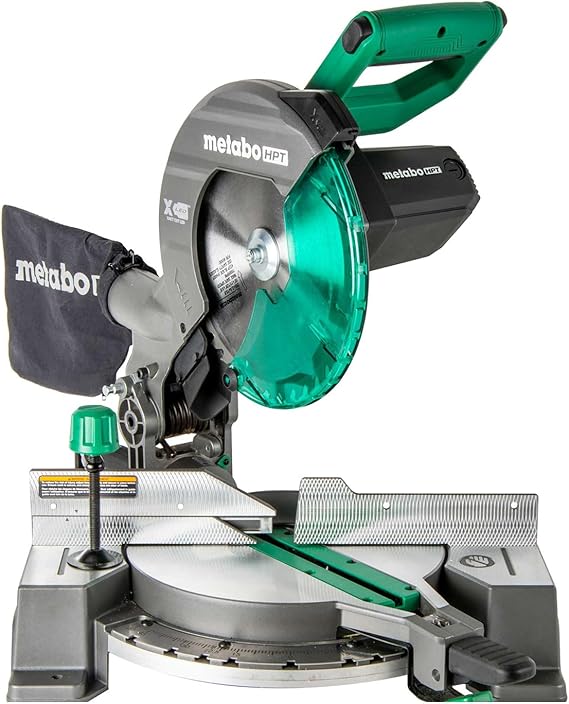
Metabo HPT C10FCG2 Compound Miter Saw is perfect for anyone needing a powerful, precise cutting tool with easy portability. Its strongest asset is the 15-Amp motor that handles tough cuts smoothly, making it great for woodworking projects of various sizes.
Setting up this miter saw is straightforward thanks to the improved miter scale and simple controls, which make adjustments accurate. Its lightweight design at only 24 lbs allows easy transport between job sites. The large table and vice clamping system secure materials firmly, so cuts feel safe and solid every time.
Cutting performance is reliable with a no-load speed reaching 5,000 RPM, delivering smooth and precise cuts up to a 52-degree angle. The build feels sturdy despite its light weight, offering good support on the 10-inch table.
Most praise focuses on its power and accuracy, while some mention wishing for a dual bevel feature.
The motor consistently provides powerful, precise cuts praised in reviews, making the saw extremely reliable for various woodworking tasks. The main complaint centers on the lack of dual bevel capability, which some users see as a limitation for more advanced angled cuts.
People who need a strong, portable single bevel saw for everyday jobs will appreciate this tool. Those planning to work frequently with complex bevels or require multiple angle cuts might want to explore other options that offer dual bevel adjustments.
Pros
- 15-Amp motor delivers strong cutting power
- Lightweight at only 24 lbs for portability
- Large 10-inch table supports materials well
- Vice clamping system stabilizes workpieces securely
Cons
- Lacks a dual bevel feature
- Might feel limited for very complex cuts
| Specification | Details |
|---|---|
| Power Source | Corded Electric |
| Voltage | 120 volts |
| Number of Teeth | 40 |
| Cutting Angle | 52 degrees |
| Wattage | 1950 watts |
7. Hoteche 8-1/4 Sliding Compound Miter Saw

Powerful and precise, this 8-1/4-inch sliding compound miter saw suits woodworkers needing accuracy on a budget. Laser guidance stands out, helping achieve consistent clean cuts, which makes a difference when details matter the most.
Setup is straightforward and quick, with corded electric power ensuring no interruptions. The laser guide stays aligned well, aiding precise cuts up to 310mm by 62mm at standard angles. Adjusting the 45-degree cutting angle and bevel feels solid, making everyday project tasks manageable without extra hassle.
Cutting at 5000 rpm with 1500 watts means this saw manages most woodworking jobs smoothly. The build quality focuses on practical durability with a brushed motor but keeps it simple. Many praise precision from the laser, while some note the smaller blade and weight feel less ideal for very heavy-duty work.
The laser guide stands out for accuracy and is consistently praised in reviews. Common feedback points to the smaller blade size as limiting for some bigger work. The motor, while powerful, sometimes feels less refined during extended use.
Ideal for DIY woodworking and medium-duty tasks that benefit from precise cuts and versatility. Those needing larger capacity or smoother motor operation might look for a bigger, more advanced saw elsewhere.
Pros
- Laser guide ensures precise alignment
- Powerful 1500 watt motor
- Supports 45 degree miter cuts
- Sliding feature increases cutting capacity
Cons
- Blade size limits very large cuts
- Brushed motor can feel less smooth long-term
| Specification | Details |
|---|---|
| Power Source | Corded Electric |
| Voltage | 120 volts_of_alternating_current |
| Speed | 5000 rpm |
| Wattage | 1500 watts |
| Number of Teeth | 24 |
| Cutting Angle | 45 degrees |
8. BOSCH CM8S Sliding Compound Miter Saw

Compact and lightweight, ideal for those needing portability without sacrificing precision. Its strongest asset is ease of transport, thanks to a 37-pound weight and a top carry handle, fitting well in both job site and home workshop scenarios.
Setup feels well thought out, with bevel controls on the side making adjustments simple during work. Expanding base extensions support wider pieces, which adds stability when cutting larger workpieces.
The clear, large miter and bevel scales help keep cuts accurate without constant measuring, making daily tasks smoother.
Performance stays reliable with 1440 watts of power driving a brushless motor, handling many cutting angles up to 47 degrees. The build balances portability and durability; most praise its lightness and control.
Common drawbacks include limited power for extremely heavy-duty cutting and a blade with only 10 teeth, which may reduce smoothness on finer trims.
Lightweight design and balanced handling make it very portable and easy to set up, which is its most praised quality. The biggest drawback reported involves the blade’s tooth count, which can make cuts less smooth compared to other models.
Those who need a manageable, portable saw for mid-range work will find it suits their needs well. People requiring heavy-duty cutting or finer, ultra-smooth finishes might want to consider a model with a higher tooth count and more power.
Pros
- Easy one-handed portability with top carry handle
- Quick bevel adjustments with side controls
- Expanding base supports larger workpieces
- Clear and accurate miter and bevel scales
Cons
- Blade has only 10 teeth, less smooth for fine cuts
- Limited power for heavy chopping tasks
| Specification | Details |
|---|---|
| Power Source | Corded Electric |
| Voltage | 120 volts |
| Wattage | 1440 watts |
| Cutting Angle | 47 degrees |
| Number of Teeth | 10 |
| Weight | 37 Lbs |
9. DEWALT 20V MAX 7-1/4 Cordless Miter Saw

Lightweight and cordless, the DEWALT 20V MAX 7-1/4 Miter Saw fits perfectly in setups where portability and ease of use matter. Ideal for homeowners and light contractors who need dependable cordless power, its biggest strength is cutting accuracy thanks to the integrated cut line cross-cut positioning system.
Setup is straightforward thanks to the cam lock miter handle and adjustable stainless steel miter detent plate with 11 positive stops, which make setting angles quick and consistent. The compact 31.6-pound design means carrying it around is no hassle, and the battery supplies enough juice for over 180 cuts on a 2×4 pine piece before needing a recharge, which covers typical daily tasks well.
The saw cuts smoothly with its brushless motor spinning a 60-tooth blade at 3750 rpm, providing clean results on crown molding and baseboards up to 3 5/8 inches. Build quality feels solid, and the oversized bevel scale helps fine-tune angles without guesswork.
The most frequent complaint is the limited cutting angle of 48 degrees, which may restrict some miter cuts but doesn’t affect most basic jobs.
The saw consistently produces accurate, clean cuts with minimal setup thanks to its integrated cut line system. Many find the limitation of a 48-degree cutting angle restrictive when more precise beveling is required, which could be the main drawback for advanced users.
Ideal for those who prioritize portability and straightforward use for typical crown molding and baseboard work. Users demanding wider cutting angles or extensive continuous work might want to consider a mains-powered or higher-capacity model instead.
Pros
- Lightweight for easy transport and storage
- Accurate cut line cross-cut positioning system
- Brushless motor offers efficient cutting speed
- Adjustable miter stops with 11 positive detents
Cons
- Limited bevel cutting angle of 48 degrees
- Single battery included may limit continuous work
| Specification | Details |
|---|---|
| Power Source | Battery Powered |
| Voltage | 20 volts |
| Blade Teeth | 60 |
| Speed | 3750 rpm |
| Cutting Angle | 48 degrees |
| Weight | 31.6 lbs. |
10. Makita XSL02Z 7-1/2 Dual Slide Compound Miter Saw

Lightweight at just 28.2 lbs with battery, this Makita miter saw is well suited for anyone who values portability and power on the job site. It handles large cuts with ease, making it a solid choice for pros and serious DIYers aiming for fast, precise cuts in dimensional lumber.
Setup is straightforward, thanks to the cordless design that frees you from power cords while working. The 18-volt battery powers a brushless motor spinning at 5,700 RPM, which automatically adjusts speed and torque based on the cut. Cutting large boards up to 2 x 12 at 90 degrees fits common framing tasks well.
It’s easy to carry around, which makes it convenient for changing job locations.
Cut quality benefits from a 4-steel rail sliding system that boosts stability and helps keep cuts straight. The saw usually impresses for its speed and clean finish, though some users note the battery is sold separately, which adds to initial setup costs.
The balance between power and weight means it wears well during extended use without feeling too heavy or bulky.
Many find the saw’s speed and stability impressive thanks to its 4-steel rail system and high RPM motor. The most common downside is the need to buy the battery separately, which can catch people off guard when setting up.
Anyone needing fast, precise cuts on large lumber and who wants a cordless saw will appreciate this model. Those needing versatile angles beyond 90 degrees or budgeting for tools may want to look for other options.
Pros
- Lightweight and easy to carry
- Powerful brushless motor
- Large cutting capacity
- Adjusts speed automatically
Cons
- Battery sold separately
- Limited cutting angle of 90 degrees
| Specification | Details |
|---|---|
| Power Source | Battery Powered |
| Voltage | 18 volts |
| Speed | 5700 rpm |
| Weight | 28.2 lbs. with battery |
| Cutting Capacity | 2″ x 12″ at 90 degrees |
11. Makita LS1219L 12 Dual-Bevel Sliding Compound Miter Saw

Great for those needing a miter saw with extra capacity and precision, it handles large crown molding and long crosscuts without fuss. Its standout feature is the 2-steel rail sliding system, which makes sliding the blade smooth and compact enough to work close to walls.
Setting it up is straightforward, especially with the in-front bevel lock that lets you adjust angles quickly. Daily cutting feels stable thanks to the adjustable miter saw stand, which moves easily on large rubber wheels and supports heavy materials up to 220 lbs.
Dust collection is efficient with dual ports helping keep the workspace cleaner throughout projects.
Cutting through various trims and boards feels precise and reliable. The build is solid and designed for long use, with strong metal rails supporting smooth blade movement. Most praise highlights its large capacity for nested vertical cuts.
Some find its weight a bit high, which can make transport a challenge despite the wheeled stand.
Many users value the saw’s ability to handle large crown molding with clean, precise cuts thanks to the dual-bevel and sliding rail system. The most common downside mentioned is its weight, making it less convenient to move around despite the stand’s wheels.
People working extensively with large trim pieces and looking for accuracy will appreciate this saw. Those needing a lighter, more portable option might want to consider smaller models without the sliding function.
Pros
- Handles large crown molding vertically with ease
- Smooth single slide-glide blade operation
- Dual dust collection ports reduce mess
- Stand supports heavy materials up to 220 lbs
Cons
- Relatively heavy despite wheeled stand
- Size may limit portability in tight spaces
| Specification | Details |
|---|---|
| Power Source | Corded Electric |
| Cutting Capacity | 8″ crown molding, 6-3/4″ baseboard, 15″ crosscuts at 90° |
| Teeth | 60 |
| Sliding System | 2-steel rail sliding system |
| Stand Features | Adjustable height, solid rubber wheels, material support extensions |
12. Makita LS1040 Miter Saw

Cutting wood precisely at the right angle can be a hassle without the right tool. The Makita LS1040 miter saw fits well for both DIY enthusiasts and woodworkers needing reliable 8 1/2 inch cuts.
Its single biggest strength lies in delivering accurate bevel cuts up to 45º with a powerful motor.
Setup is straightforward with simple adjustments for angle and bevel. It runs on corded electric power, so you just plug it in and get started. The blade diameter of 260 mm and electric brake add safety and control, while the double insulation makes handling comfortable.
Noise and vibration are noticeable but pretty manageable during regular use.
Performance is solid with a no-load speed of 4600 rpm and a strong 1650 watt motor pushing through wood cleanly. It can make cuts over 3 by 3 at zero degrees and slightly smaller ones at 45º angles. The build quality is sturdy and practical but some find the saw a bit heavy to move around.
The biggest compliment is how stable the cutting feels, while the common gripe involves the noise level being on the louder side.
Strongest praise centers on stability and precise cutting thanks to a sturdy build and powerful motor. The most frequent complaint involves the noise, with sound pressure reaching 93 dB(A), which can be tiring on longer jobs.
The saw suits woodworkers looking for dependable bevel cuts and power in a fixed workshop setup. Anyone needing a lighter or quieter tool might explore more portable or lower noise options elsewhere.
Pros
- Powerful 1650 watt motor for tough cuts
- Electric brake improves safety and control
- Adjustable bevel range from 45 to 90 degrees
- Double insulated for safer handling
Cons
- Relatively loud at 93 dB(A) noise pressure
- Heavier weight makes portability tougher
| Specification | Details |
|---|---|
| Power Source | Corded Electric |
| Blade Diameter | 260 mm |
| No Load Speed | 4600 rpm |
| Input Wattage | 1650 w |
| Max Bevel Range | 45 – 90 º |
| Cutting Angle | 45 degrees |
Best 8 1/2 Inch Miter Saws Compared Side by Side
| Product | Power Source | Blade Teeth | Cutting Angle | Wattage |
|---|---|---|---|---|
| Makita LS0816F Miter Saw | Corded Electric | 24 | 90 degrees | 1260 watts |
| SEESII Compound Miter Saw | Corded Electric | 24 | 45 degrees | 1400 watts |
| Evolution R210CMS Miter Saw | Corded Electric | 24 | 45 degrees | 1200 watts |
| VEVOR Compound Miter Saw | Corded Electric | 24 | 45 degrees | 1440 watts |
| SKIL 10 Dual Bevel Miter | Corded Electric | 40 | 50 degrees | 1800 watts |
| Metabo HPT C10FCG2 Saw | Corded Electric | 40 | 52 degrees | 1950 watts |
| Hoteche 8-1/4 Sliding Saw | Corded Electric | 24 | 45 degrees | 1500 watts |
| BOSCH CM8S Sliding Miter | Corded Electric | 10 | 47 degrees | 1440 watts |
| DEWALT 20V MAX 7-1/4 Saw | Battery Powered | 60 | 48 degrees | – |
| Makita XSL02Z Dual Slide | Battery Powered | 60 | 90 degrees | 5700 watts |
| Makita LS1219L Sliding Miter | Corded Electric | 60 | 90 degrees | – |
| Makita LS1040 Miter Saw | Corded Electric | 80 | 45 degrees | 1650 watts |
- Power SourceCorded Electric
- Blade Teeth24
- Cutting Angle90 degrees
- Wattage1260 watts
- Power SourceCorded Electric
- Blade Teeth24
- Cutting Angle45 degrees
- Wattage1400 watts
- Power SourceCorded Electric
- Blade Teeth24
- Cutting Angle45 degrees
- Wattage1200 watts
- Power SourceCorded Electric
- Blade Teeth24
- Cutting Angle45 degrees
- Wattage1440 watts
- Power SourceCorded Electric
- Blade Teeth40
- Cutting Angle50 degrees
- Wattage1800 watts
- Power SourceCorded Electric
- Blade Teeth40
- Cutting Angle52 degrees
- Wattage1950 watts
- Power SourceCorded Electric
- Blade Teeth24
- Cutting Angle45 degrees
- Wattage1500 watts
- Power SourceCorded Electric
- Blade Teeth10
- Cutting Angle47 degrees
- Wattage1440 watts
- Power SourceBattery Powered
- Blade Teeth60
- Cutting Angle48 degrees
- Wattage–
- Power SourceBattery Powered
- Blade Teeth60
- Cutting Angle90 degrees
- Wattage5700 watts
- Power SourceCorded Electric
- Blade Teeth60
- Cutting Angle90 degrees
- Wattage–
- Power SourceCorded Electric
- Blade Teeth80
- Cutting Angle45 degrees
- Wattage1650 watts
How to Choose the Right 8 1/2 Miter Saw
Choosing the right 8 1/2 miter saw depends on factors like blade size, cutting capacity, and ease of adjustment, which affect precision and versatility. Prioritizing these features ensures accurate cuts, saves time, and reduces the need for costly replacements or repairs.
Blade Size and Cutting Capacity
Trying to cut wide or thick stock with a saw that doesn’t match can lead to frustrating stoppages or risky forced cuts. An 8 1/2-inch blade typically suits trim work and smaller framing tasks well.
This size keeps the saw compact but limits the maximum cutting depth to around 2 to 3 inches, so thicker lumber or large dimensional stock might not fit through in one pass.
Maximum bevel and miter angles around 45 degrees on most models provide necessary versatility for crown molding and complex angled joints. A good miter saw will have bevel range capable of tilting both left and right for added flexibility.
Daily use is easier when the saw can handle a variety of material widths and thicknesses up to its blade capacity without multiple adjustments or repositioning.
Motor Power and Performance
Motors with at least 10 amps or around 1.5 horsepower deliver enough power to slice through hardwoods and softwoods cleanly without bogging down. Smoother blade operation under load means the motor maintains speed consistently, reducing rough cuts and blade wear.
A weak or struggling motor tends to stall or cause uneven cuts, which is tough to fix after the fact.
Cordless models usually come with brushless motors and battery packs measured in volts, often 18 to 20 volts, balancing runtime and power. Longer battery life and quick charging improve site productivity, but less powerful cordless saws might struggle with denser materials or repeated cuts. Matching the motor to your typical projects ensures consistent performance day to day.
Precision and Adjustability
Angle stops and detents that click firmly into place make it much easier to achieve repeatable precision, especially if you’re making multiple identical cuts. Saw models with clear positive stops at common angles (such as 15, 22.5, 30, and 45 degrees) help speed workflow without double-checking every cut.
Adjusting bevel and miter angles without additional tools saves time and hassle. Smooth, tool-free knobs or levers can make small angle changes faster and more intuitive. Measurement scales need to be large and contrasted enough to read quickly even in low-light conditions.
Some saws include magnified or backlit scales which improve accuracy and reduce errors.
Safety Features
Blade guards that fully cover the cutting area are standard and help keep hands clear without getting in the way of line of sight. Safety switches that prevent accidental startup provide an extra layer of protection when moving or setting up the saw.
Lack of these features increases the risk of injury during frequent power ups and downs.
Antikickback features like riving knives or blade clamps reduce the chance of sudden blade binding and kickback. A stable base with rubber feet or clamps reduces vibration and movement during cuts, making for safer, more controlled operation.
Wobbly or shaky saws compromise cut quality and can lead to accidents over time.
Portability and Storage
A saw that weighs under 20 pounds and includes a solid, ergonomic handle is easier to carry between job sites or up ladders. Hefty models slow down setup and teardown, especially if you move around often.
Compact designs make a difference when working in tight spaces or storing in a crowded workshop or vehicle.
Dust collection ports that fit standard vacuums or come with dust bags help keep the area cleaner and air quality better, cutting down on cleanup time. Without any dust management, sawdust builds up quickly and can obscure cut lines or damage components.
Practical portability features support smoother daily use and less hassle overall.
Tips for Accurate Cuts with an 8 1/2 Inch Miter Saw
Setting up your workpiece correctly is crucial for precise cuts. Always secure the wood tightly against the fence to prevent shifting during the cut. Use clamps if your saw’s onboard vice isn’t strong enough.
Check that the saw blade is sharp, as dull blades tend to cause rough and inaccurate cuts. Align the saw’s miter and bevel angles with a reliable angle gauge. This extra step often improves accuracy beyond relying on built-in scales alone. Before cutting your actual piece, perform a test cut on scrap wood.
This helps you verify settings and adjust for any discrepancies without risking your project material. Finally, operate the saw with smooth, steady pressure instead of forcing it, which might cause drift.
Essential Maintenance Practices to Extend the Life of Your Miter Saw
Regular cleaning prevents dust buildup that can affect both performance and safety. After each use, blow out or vacuum dust from vents, the blade guard, and around the motor housing. Checking the blade for signs of wear and replacing it promptly maintains smooth operation and clean cuts. Lubricate pivot points with light machine oil every few months to keep the miter arm moving freely without stiffness or wobble.
Inspect the electrical cord for damage to avoid shorts or power issues. Store the saw in a dry area to prevent rusting on metal parts.
Keep the fence and base wiped clean and free from debris to allow accurate fence contact and stable work support.
Comparing 8 1/2 Inch Miter Saws with Larger Models for Different Projects
Smaller 8 1/2 inch miter saws tend to be more portable and easier to maneuver in tight spaces compared to larger models. This size often suits hobbyists or DIYers who work with smaller molding, trim, or craft projects rather than heavy-duty framing lumber. However, larger miter saws, such as 12-inch blades, can handle wider boards and thicker stock in a single cut.
They usually provide more power, making them better for prolonged or professional use. The trade-off includes increased weight and space requirements.
For simple household repairs or small woodworking tasks, an 8 1/2 inch model provides precision without unnecessary bulk. Larger models become valuable when working with larger trim, crown molding, or dimensional lumber that won’t fit under a smaller blade.
People Also Asked
How Do I Properly Maintain an 8 1/2 Inch Miter Saw?
Keep the miter saw clean by regularly removing dust and debris from the blade and moving parts. Lubricate the pivot points occasionally to ensure smooth operation and check the blade for sharpness to prevent rough cuts. Store it in a dry place to avoid rust.
What Size Blade Is Compatible with an 8 1/2 Miter Saw?
An 8 1/2 inch miter saw requires an 8 1/2 inch blade for proper fit and function. Using a blade larger or smaller than this can cause safety issues or affect cutting accuracy. Choose blades designed for the type of materials you plan to cut, like wood or laminate.
Are There Safety Tips for Using an 8 1/2 Inch Miter Saw?
Always wear safety glasses and keep your hands at a safe distance from the blade during operation. Make sure the saw is on a stable surface and use clamps to hold the workpiece securely. Disconnect power when changing the blade or making adjustments.
How Long Does a Typical 8 1/2 Inch Miter Saw Last?
The lifespan of an 8 1/2 inch miter saw depends on usage and maintenance but typically lasts several years in a home workshop setting. Replacing the blade regularly and keeping the tool clean extends its life. Avoid forcing the saw through material to minimize wear.
What Common Problems Should I Watch for with My Miter Saw?
Watch for blade dullness, which can cause burning or tearing of the material. Another common issue is misaligned fences or bevel angles that lead to inaccurate cuts. Check for motor overheating or unusual noises as signs the saw might need servicing or repair.
Conclusion
Accuracy, blade size, and ease of adjustment are key factors when choosing an 8 1/2-inch miter saw. A clear scale and smooth detents can help make precise cuts quickly.
Also, consider the power and motor quality, which affect the saw’s ability to cut through different materials without bogging down.
Think about how much space you have and how often you’ll use the saw before making a decision. A compact model might make more sense for occasional use or smaller work areas. Check the comparison table and detailed reviews above to find the best option for your specific needs and budget.

I’m Cody Harrison, a lifelong hunter who has spent many seasons in the woods, marshes, and open country. I write about hunting gear, rifle and bow setups, scouting strategies, tree stands, and field safety. I share lessons from real hunts to help both beginners and experienced hunters prepare better, hunt smarter, and get more out of every trip.


