
Top 12 Best Handheld Jigsaw You Can’t Miss Today!
Using a cheap or poorly chosen handheld jigsaw can turn a straightforward cutting job into a frustrating experience. The blade might wander, cuts could be uneven, or the tool may feel unwieldy during extended use.
The best handheld jigsaw not only delivers precision but also feels balanced and comfortable, which makes a big difference in projects that require both straight and curved cuts.
The key factors that separate a good handheld jigsaw from a less effective one include motor power, orbital settings, and blade change mechanisms. Motors typically range from 4 to 7 amps, with higher power helping when cutting dense materials like hardwood or metal.
Adjustable orbital settings allow control over the aggressiveness of the cut, making it easier to fine-tune for different materials. A tool-free blade changing system adds convenience, especially when switching between wood, metal, or plastic blades. These features impact both performance and ease of use in real-world applications.
Need a Quick Check?
| Image | Product | Price |
|---|---|---|
Our Top Picks 1  | BLACK+DECKER BDEJS300C | Check Price |
Our Top Picks 2  | SKIL Corded JS314901 | Check Price |
Our Top Picks 3  | DEWALT 20V XR DCS334B | Check Price |
Our Selected Top 12 Handheld Jigsaw Picks for Every Need
This list features a variety of handheld jigsaws suited for different skill levels and projects. Each review covers performance details, ideal user types, and highlights the key advantages and drawbacks to help you make an informed choice.
1. BLACK+DECKER Jig Saw BDEJS300C
People working on woodworking or light metal projects will appreciate a tool that balances power and precision. Designed for anyone needing accuracy and control, this jig saw stands out for its variable-speed motor that handles different materials smoothly.
Setup is straightforward with tool-free blade changes thanks to the quick-clamp system. Day-to-day use is made easier by its compact and lightweight design, which reduces vibration and lets you maneuver comfortably.
The built-in dust blower keeps your line of sight clear while the adjustable shoe adds stability during cuts.
Performance feels solid because the 4.5 Amp motor runs up to 3,000 strokes per minute, handling a variety of materials with ease. The base plate tilts up to 45 degrees for beveled cuts, adding versatility.
It’s built for durability, but some users mention the cord limits mobility and tension in the tool can be felt during longer sessions.
Strong points include the variable speed motor that handles multiple materials well and a dust blower that improves cutting accuracy. Most complaints focus on the corded design restricting mobility and some grip tension during longer jobs.
Anyone needing steady, precise cuts on wood or metal will find this reliable and straightforward. Those wanting cordless convenience or very long working sessions without fatigue might prefer a different model.
Pros
- Variable speed for versatile cutting control
- Compact and lightweight for easy handling
- Tool-free blade changes with quick-clamp
- Built-in dust blower keeps cut line clear
Cons
- Corded design limits range of movement
- Can feel tension during extended use
| Specification | Details |
|---|---|
| Power Source | Corded Electric |
| Voltage | 120 volts |
| Current Rating | 4.5 A |
| Speed | 3200 rpm |
| Cutting Angle | 45 degrees |
2. SKIL Corded Jig Saw JS314901
Powerful and precise, the SKIL Corded Jig Saw JS314901 suits anyone needing smooth cuts across various materials. Its standout feature is the 4-stage orbital function, which makes cutting more efficient and adaptable without compromising control.
Setting up takes no time with tool-free blade changes and quick bevel adjustments for angled cuts. The two-finger trigger lets you control speed easily, while the bright halo light ensures the workspace is well-lit.
There’s also a dust blower switch to keep the cutting line visible, which helps maintain accuracy during use.
Cutting performance lives up to expectations with smooth, clean lines on different surfaces thanks to the orbital settings. Built with a firm shoe bevel and quality materials, it feels solid.
The main drawback noted is its corded design limiting mobility compared to cordless options, but power delivery remains consistent without interruptions.
The orbited cutting function and bright light are praised for making cuts clean and visible. Common issues involve restricted movement due to the cord and occasional dust blower weakness in heavy cutting jobs.
Those needing precise cuts on multiple materials with consistent power will appreciate this tool. Users wanting full freedom to move without cords might look elsewhere for a cordless jigsaw option.
Pros
- 4-stage orbital function for varied materials
- Tool-free blade change in seconds
- Bright halo light with 10x LED brightness
- Adjustable shoe bevel without tools
Cons
- Cord limits movement during use
- Sometimes dust blower insufficient for heavy debris
| Specification | Details |
|---|---|
| Power Source | Corded Electric |
| Voltage | 120 volts |
| Wattage | 600 watts |
| Number of Teeth | 10 |
| Current Rating | 6 A |
3. DEWALT 20V MAX XR Cordless Jig Saw DCS334B
DEWALT 20V MAX XR Cordless Jig Saw DCS334B cuts through wood and other materials with precision and lasting power. Those who need a portable yet powerful cutting tool find its brushless motor and compact design especially appealing.
Its standout feature is the combination of variable speed control and orbital action for versatile cutting tasks.
Setting up the jig saw is straightforward thanks to the all-metal, lever-action keyless blade change, which lets you swap blades quickly without any tools. The integrated dust blower keeps your cut lines clear, and the bright LED shines light onto darker surfaces.
Holding the tool is comfortable because of its compact size and grip design, which helps with control during detailed cuts.
The performance is consistent for smooth, accurate cutting across materials, supported by the 4-position orbital action and variable speed trigger. The solid metal construction gives it durability, with easy adjustments on the shoe bevel for angled cuts up to 45 degrees. Some mention that the battery life, while better than previous models, still requires monitoring for longer projects.
The brushless motor and variable speed trigger deliver clean cuts efficiently, while many users appreciate the quick blade changes and clear visibility due to the integrated dust blower and LED. Some users note the battery can run down before finishing very long projects, so keeping extra batteries handy is common.
Anyone needing a reliable, portable cordless jigsaw with easy control will find this model useful. Those who work on large-scale jobs without access to charging might want to consider a corded jigsaw or models with longer battery life.
Pros
- Brushless motor for longer runtime
- Keyless blade change for quick swaps
- Variable speed control for precision
- Bright LED for better visibility
Cons
- Battery life requires attention on longer jobs
- Compact size may feel small for larger hands
| Specification | Details |
|---|---|
| Power Source | Battery Powered |
| Voltage | 20 volts |
| Wattage | 2000 watts |
| Cutting Angle | 45 degrees |
| Number of Teeth | 10 |
4. SEESII Cordless Jig Saw with Batteries

Handles like a dream with no cords to limit your workspace, this jigsaw suits anyone needing a portable cutting tool. Its standout feature is the pair of 21V lithium batteries that keep you going longer without interruptions for charging.
Getting started is straightforward since it comes with two batteries, so swapping them out is quick when one runs low. The thumb-push quick-release blade change makes switching tasks fast, which is essential when working on varied materials.
The ergonomic handle and lightweight design help during extended use, making it comfortable to hold even when cutting at a 45-degree angle.
Cuts through hardwood, pipes, and other materials with precision thanks to the included nine blades catering to different jobs. Its brushed motor runs efficiently, contributing to smooth operation.
Built solidly, the keyless blade change system is a highlight for saving time. Some have noticed the weight balance could be better, but it remains easy to maneuver in tight spots.
Long-lasting power comes from the two included 21V lithium batteries, which reduce the downtime between cuts. The quick blade change is convenient for switching blades but the weight distribution could cause some discomfort during precise cuts.
Ideal for those working on varied materials who need a cordless tool with enough battery life to avoid frequent stops. Better suited to users comfortable with the battery type and slightly sensitive to tool balance might want to consider other options.
Pros
- Two 21V lithium batteries extend runtime
- Quick-release blade change saves time
- Nine blades cover a variety of materials
- Lightweight with ergonomic handle
Cons
- Some find weight balance off during use
- Uses D batteries instead of rechargeable packs
| Specification | Details |
|---|---|
| Power Source | Battery Powered |
| Voltage | 21 volts |
| Wattage | 200 watts |
| Cutting Angle | 45 degrees |
| Batteries Included | 2 D batteries required |
| Blade Shape | Rectangular |
5. 8-In-1 Multi-Purpose Hand Saw

Great for anyone needing a versatile hand saw that adapts to different cutting jobs, the 8-In-1 Multi-Purpose Hand Saw shines through its adjustable blade system. It’s manual, so it suits those who prefer control over power tools and want something handy for various tasks.
Setup is simple since the lockback mechanism firmly holds blades, so swapping blades is quick and reliable. The ergonomic TPR handle really helps reduce hand fatigue during extended use, making it comfortable to hold even when working on tougher materials. You get eight different blades included, covering a wide range of cutting needs without hunting for replacements right away.
Cutting performance depends on the blade you choose, with high-speed HSS steel blades that stay sharp and durable enough for repeated use. The saw’s build feels solid and practical, though some find the manual effort tiring for larger jobs.
The clearest praise is for blade variety and ergonomic comfort, while the most common complaint is fatigue from hand-powered cutting.
The saw gets high marks for blade variety and the comfort of the ergonomic handle, making it easy to use over multiple sessions. Most complaints point to the manual effort, which can get tiring when cutting thicker or tougher materials.
Ideal for DIYers who prefer manual tools and need a range of blade options in one tool. Those requiring fast, heavy-duty cutting should look for a powered jigsaw instead.
Pros
- Eight blades for various cutting needs
- Non-slip ergonomic TPR handle
- Lockback mechanism secures blades firmly
- Durable high-speed steel blades
Cons
- Manual power can be tiring on big projects
- Not suitable for heavy-duty, continuous cutting
| Specification | Details |
|---|---|
| Power Source | Manual |
| Number of Teeth | 32 |
| Blade Shape | Rectangular |
| Special Features | Ergonomic Handle |
6. Fanttik R11 Pro Cordless Mini Reciprocating Saw

Compact and lightweight, the Fanttik R11 Pro Cordless Mini Reciprocating Saw fits comfortably in your hand and is designed for precision in tight spaces. Its main strength lies in being portable while delivering reduced vibration for cleaner, controlled cuts, making it ideal for hobbyists or light professionals needing a handheld jigsaw.
Setup involves installing one D battery, and blade changes require using T-Shank blades that match the specified thickness and length. Pressing the shoe firmly against the workpiece before cutting helps stabilize the blade and reduce jumping.
Its small size and dual counterweight system keep vibration low, so daily use is less tiring and more accurate, especially on thinner materials up to 3/4 inch.
The saw performs well on light materials within the cutting thickness limit and is built with a dual-axis coaxial drive for balanced blade motion. Positive feedback highlights the comfortable grip and minimal vibration, while the main drawback mentioned is the limitation on blade sizes and types, which some find restrictive for tougher jobs.
Strong points include its low vibration and comfortable design that makes cutting controlled and less tiring. Common issues arise from blade restrictions which limit versatility and performance on tougher materials.
People needing a lightweight saw for precise, small-scale cuts will appreciate this model. Those requiring heavy-duty cutting or more blade options should explore other tools better suited for demanding tasks.
Pros
- Lightweight and easy to handle
- Dual counterweight system reduces vibration
- Battery included for immediate use
- Compact size for tight spaces
Cons
- Limited blade options due to clamp size
- Not suitable for thicker or harder materials
| Specification | Details |
|---|---|
| Power Source | Battery Powered |
| Wattage | 160 watts |
| Number of Batteries | 1 D batteries required (included) |
| Cutting Thickness | Max 3/4 inch |
| Blade Clamp Gap | 1.4mm |
| Blade Type | T-Shank, 3–4 inches |
7. Hammerhead 4.8-Amp Jig Saw HAJS048

Powerful corded jigsaw with a 4.8-amp motor suits anyone needing precise and varied wood cuts. The standout feature is the 4-stage orbital action that lets you shift from smooth to aggressive cutting easily.
Setting up involves just plugging it in and selecting the speed that matches your blade and material. The metal base adjusts up to 45° for bevel cuts, and the tool-free T-shank blade change makes switching blades quick.
Connecting a vacuum dust port keeps the work area tidy during use.
It cuts cleanly and handles wood shaping tasks reliably thanks to its 600-watt power. The sturdy metal base feels durable and stable.
Praised for speed control and blade changes, the main downside mentioned is the cord limiting mobility compared to battery-powered models.
Users appreciate the versatile speed settings and orbital stages that make cutting different woods easier. The built-in brake improves accuracy, but the cord can be inconvenient in tight spaces or large projects. Switches between blades are quick and easy thanks to the tool-free system, which makes this jigsaw very efficient to use.
The jigsaw fits well for those who mostly work near power outlets and need consistent power for varied woodcutting tasks. Professionals or hobbyists wanting mobility or lighter tools might prefer a battery-operated jigsaw instead.
Pros
- Adjustable 4-stage orbital for varied cuts
- Brake function for precise finishing
- Dust port eases cleanup during work
- Tool-free blade changes save time
Cons
- Power cord restricts range of motion
- Heavier than cordless alternatives
| Specification | Details |
|---|---|
| Power Source | Corded Electric |
| Current Rating | 4.8 A |
| Wattage | 600 watts |
| Cutting Angle | 45 degrees |
| Number of Teeth | 10 |
| Blade Shape | Rectangular |
8. DEKOPRO Corded Electric Jig Saw

Powerful enough for most DIY woodworking projects, the DEKOPRO Corded Electric Jig Saw suits those who need consistent cutting strength without worrying about battery life. Its biggest strength lies in the adjustable speed, letting you fine-tune the cut based on the material and blade used.
Setting it up is straightforward thanks to the tool-less blade clamp, allowing you to swap blades quickly without extra tools. Daily use feels comfortable due to the ergonomic handle and the metal base plate that adjusts to several angles for bevel cuts. Four orbital settings help achieve smoother or more aggressive cuts depending on the job.
It cuts wood with enough power at 3,000 strokes per minute and handles bevel angles up to 45 degrees. The build focuses on function over flash, with solid metal parts but a basic rectangular blade shape.
Many find the quick blade changes a major convenience, while some mention the need for cord management during use.
Most praise focuses on the easy blade changes and smooth cutting controls. The common issue is managing the cord during use, which some find restricting depending on workspace layout.
Anyone working mainly from one spot or with access to power will appreciate the reliability and control it offers. For frequent outdoor use or areas without power outlets, a cordless alternative may be a better fit.
Pros
- Adjustable speed lets you match blade and material
- Tool-less blade changes save time
- Metal base plate tilts to 45 degrees
- Comfortable ergonomic handle for long use
Cons
- Cord limits mobility on larger job sites
- Basic blade shape may not suit all cuts
| Specification | Details |
|---|---|
| Power Source | Corded Electric |
| Speed | 3000 rpm |
| Cutting Angle | 45 degrees |
| Wattage | 550 watts |
| Voltage | 110 volts |
9. SEESII Corded Jigsaw 500W

When cutting wood, plastic, or even thin metal for home projects, having consistent power and control is key. The SEESII Corded Jigsaw 500W suits anyone handling small DIY jobs or general repairs, standing out mainly for its smooth cutting performance across a range of materials.
Setting up is straightforward thanks to the tool-free blade clamp allowing quick blade swaps. The variable speed dial lets you match cutting pace to the material type, slowing down for metal and speeding up for wood. The adjustable metal shoe supports bevel cuts up to 45°, making angled cuts more manageable.
Its lightweight design and ergonomic handle keep handling comfortable during longer tasks.
Cutting feels stable and accurate due to the sturdy metal shoe, which also helps reduce vibrations. The motor maintains steady power for precise cuts in wood, plastic, and thin metal.
Builds are solid with a brushed motor and a well-balanced design. Most praise highlights how well it handles bevel cuts without wobbling. On the downside, it’s less suited for heavy-duty or very thick materials due to its 500W limit.
Strong power delivery and a stable metal shoe make cutting smooth and accurate, especially when making bevel cuts. The most common complaint is the vibration can increase when cutting tougher materials, affecting comfort slightly during longer projects.
Those working mostly on light to medium materials with occasional angled cuts will appreciate its precision and speed control. People needing a saw for thicker or more demanding materials should consider a higher-powered alternative.
Pros
- Powerful enough for wood, plastic, and thin metal
- Adjustable speed matches different materials
- Tool-free blade change is quick and safe
- Stable metal shoe supports accurate bevel cuts
Cons
- Not suitable for heavy or thick materials
- Vibration reduction good but not perfect under load
| Specification | Details |
|---|---|
| Power Source | Corded Electric |
| Wattage | 500 watts |
| Speed | 0–3000 SPM Variable Speed |
| Cutting Angle | 45 degrees |
| Voltage | 120 volts |
| Blade Shape | T-Shank |
10. BLACK+DECKER Jig Saw BDEJS600C

Generating up to 3,000 strokes per minute, this 5 amp BLACK+DECKER Jig Saw BDEJS600C is built for precision cutting, especially around curves. Ideal for those needing detailed control in woodworking or DIY projects.
Its curve control technology is the standout feature for handling rounded cuts smoothly.
Setup is straightforward with a corded electric power source, so you’re not worrying about batteries. The variable-speed motor lets you adjust the speed quickly depending on the material, with four curve settings making it easier to follow complex shapes.
The adjustable shoe helps keep the saw stable and lets you see the cut line clearly, making daily use less stressful.
The saw cuts through wood cleanly, including beveled cuts up to 45 degrees, thanks to its solid 10-tooth blade. Users appreciate the power and control it offers, especially for detailed curves. The build feels sturdy, but some find the cord limits movement.
People like how stable the shoe is, although the wire guard can get in the way at times.
Many appreciate how well it handles curved and beveled cuts with good precision, thanks to the curve control technology and adjustable shoe. The most common frustration comes from the cord limiting mobility during use, which can be annoying on larger projects.
People wanting reliable corded power and precise control on curves will find this saw useful. Those needing more freedom of movement or cordless operation might look for a different model. It suits home workshops more than on-the-go job sites.
Pros
- Strong 5 amp motor for tough cuts
- Four curve settings for detailed work
- Adjustable shoe improves cut accuracy
- Variable speed up to 3,000 SPM
Cons
- Cord restricts range of movement
- Wire guard can interfere with some cuts
| Specification | Details |
|---|---|
| Power Source | Corded Electric |
| Current Rating | 5 A |
| Voltage | 120 volts |
| Variable Speeds | Yes, up to 3,000 SPM |
| Bevel Capacity | Up to 45 degrees |
| Blade Shape | Rectangular |
11. BLACK+DECKER 20V MAX Cordless Jig Saw BDCJS20C
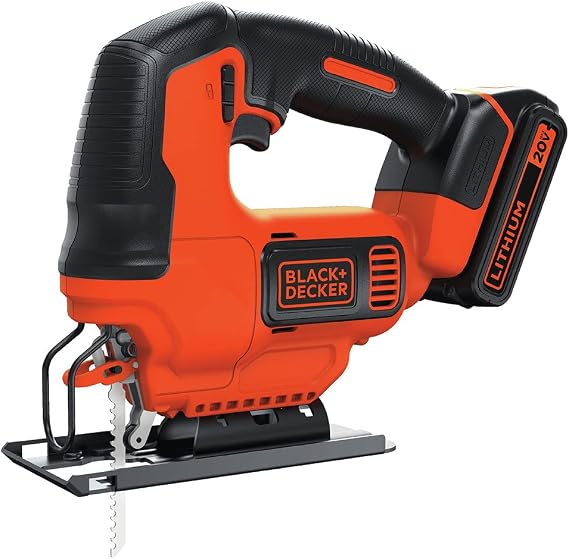
People who often tackle DIY projects or hobby woodworking will find this jig saw fits well with their needs. Its cordless design and variable speed control allow for both simple and intricate cuts without being tethered to an outlet.
The biggest strength lies in its balance between power and maneuverability, offering versatility for various cutting tasks.
Setting it up is straightforward thanks to the tool-free blade changes, which make swapping blades quick and easy. The built-in dust blower keeps your work surface clear, improving visibility as you cut.
Its lightweight construction combined with the 20V battery system reduces hand fatigue and offers plenty of runtime for typical home use.
Performance feels reliable with speeds up to 2,500 rpm, enabling smooth straight and curved cuts. The brushless motor means less maintenance and longer tool life.
Users appreciate the clear line of sight provided by the wire guard but note that the battery life might limit longer, continuous tasks without spare batteries.
The clear line of sight from the wire guard and dust blower is highly praised for precision. Most users find the battery runtime insufficient for extended continuous use without swaps or recharges. The variability in speed control helps adapt to various materials and cut types but comes with the usual cordless trade-off of limited power supply time.
People who prioritize cordless mobility and quick blade changes will appreciate this saw’s features and power. Those needing longer runtime or heavier-duty cutting job should consider tools with larger battery capacity or corded alternatives to avoid interruptions.
Pros
- Tool-free blade changes for convenience
- Built-in dust blower improves cutting visibility
- Variable-speed trigger for better control
- Compatible with PowerConnect battery system
Cons
- Battery may not last for prolonged jobs
- Limited to a maximum 45-degree bevel angle
| Specification | Details |
|---|---|
| Power Source | Battery Powered |
| Voltage | 20 volts |
| Speed | 2500 rpm |
| Cutting Angle | 45 degrees |
| Blade Shape | Rectangular |
12. TaskStar Cordless Jig Saw with Batteries

Battery runtime sets this cordless jigsaw apart, making it ideal for extended cutting without frequent stops. It suits hobbyists and DIYers looking for portability combined with decent power to handle various wood projects. Dual batteries mean less downtime, so you can keep going without waiting long for a recharge.
Getting started is straightforward thanks to the keyless blade change feature, where blades click securely into place within seconds. The ergonomic handle feels comfortable for longer use, and adjusting the bevel angle up to 45° is simple with the included hex wrench.
Handling and setup are designed for smooth daily use, especially with the lightweight design making it easier to maneuver in tight spots.
Cutting performance is solid for a 200-watt, 21-volt cordless jigsaw, running up to 2800 rpm offering good control over straight and angled cuts. The build is practical with a brushed motor and a sturdy base plate, while the common downside mentioned involves blade loosening being rare but sometimes noticed. It performs well for its price point and cordless convenience.
Most users appreciate the extra battery runtime letting them work longer without interruption, though occasional blade loosening can affect cut accuracy. Changing blades quickly and staying portable are big pluses.
Great for anyone needing a cordless jigsaw that handles angled cuts and keeps going with replaceable batteries. Those who require continuous, heavy-duty cutting might prefer a corded model with more power.
Pros
- Two 2.0Ah batteries for longer runtime
- Keyless blade change in seconds
- Adjustable bevel cutting up to 45°
- Ergonomic and lightweight for comfort
Cons
- Blade sometimes loosens during use
- Battery recharge takes 1–2 hours
| Specification | Details |
|---|---|
| Voltage | 21 volts |
| Wattage | 200 watts |
| Speed | 2800 rpm |
| Cutting Angle | 45 degrees |
| Power Source | Battery Powered |
Best Handheld Jigsaws Comparison Table
| Product | Power Source | Wattage | Cutting Angle | Special Features |
|---|---|---|---|---|
| BLACK+DECKER BDEJS300C | Corded Electric | 540 watts | 45 degrees | Variable Speeds |
| SKIL Corded JS314901 | Corded Electric | 600 watts | – | Depth Adjustment |
| DEWALT 20V XR DCS334B | Battery Powered | 2000 watts | 45 degrees | Brushless, 4-position orbital |
| SEESII Cordless Jig Saw | Battery Powered | 200 watts | 45 degrees | Bevel, Keyless Blade Change |
| 8-in-1 Multi Saw | Manual | – | – | Ergonomic Handle |
| Fanttik R11 Pro Saw | Battery Powered | 160 watts | – | Lightweight |
| Hammerhead HAJS048 | Corded Electric | 600 watts | 45 degrees | Brake |
| DEKOPRO Corded Jigsaw | Corded Electric | 550 watts | 45 degrees | Ergonomic Handle |
| SEESII Corded 500W | Corded Electric | 500 watts | 45 degrees | Bevel, Keyless Blade Change |
| BLACK+DECKER BDEJS600C | Corded Electric | 600 watts | 45 degrees | Variable Speeds |
| BLACK+DECKER 20V BDCJS20C | Battery Powered | – | 45 degrees | Brushless |
| TaskStar Cordless Saw | Battery Powered | 200 watts | 45 degrees | Bevel, Keyless Blade Change |
- Power SourceCorded Electric
- Wattage540 watts
- Cutting Angle45 degrees
- Special FeaturesVariable Speeds
- Power SourceCorded Electric
- Wattage600 watts
- Cutting Angle–
- Special FeaturesDepth Adjustment
- Power SourceBattery Powered
- Wattage2000 watts
- Cutting Angle45 degrees
- Special FeaturesBrushless, 4-position orbital
- Power SourceBattery Powered
- Wattage200 watts
- Cutting Angle45 degrees
- Special FeaturesBevel, Keyless Blade Change
- Power SourceManual
- Wattage–
- Cutting Angle–
- Special FeaturesErgonomic Handle
- Power SourceBattery Powered
- Wattage160 watts
- Cutting Angle–
- Special FeaturesLightweight
- Power SourceCorded Electric
- Wattage600 watts
- Cutting Angle45 degrees
- Special FeaturesBrake
- Power SourceCorded Electric
- Wattage550 watts
- Cutting Angle45 degrees
- Special FeaturesErgonomic Handle
- Power SourceCorded Electric
- Wattage500 watts
- Cutting Angle45 degrees
- Special FeaturesBevel, Keyless Blade Change
- Power SourceCorded Electric
- Wattage600 watts
- Cutting Angle45 degrees
- Special FeaturesVariable Speeds
- Power SourceBattery Powered
- Wattage–
- Cutting Angle45 degrees
- Special FeaturesBrushless
- Power SourceBattery Powered
- Wattage200 watts
- Cutting Angle45 degrees
- Special FeaturesBevel, Keyless Blade Change
How to Choose the Right Handheld Jigsaw
Consider factors like power, blade compatibility, and ease of handling to ensure smooth and precise cuts. Choosing the right features helps avoid frequent replacements and repairs, saving both money and frustration during projects.
Power and Motor Type
Many handheld saws on the market run with motors rated between 400 and 700 watts, or 12 to 18 volts in cordless models. Having a motor with higher wattage or voltage often means it can cut through denser materials with less strain.
Users who rely on lower-powered motors might notice frequent stalling or slower cutting, especially on hardwood or thicker plywood.
Variable speed controls make a big difference during daily tasks, allowing adjustments for materials like softwood, metal, or plastic. Motors without this feature can make fine control difficult, leading to rough cuts or damaged workpieces.
Brushless motors have become more common and stand out for delivering consistent power while running cooler and lasting longer. This type of motor reduces maintenance needs compared to brushed versions.
Blade Compatibility and Types
A saw that only accepts a handful of blade sizes limits what you can cut and how cleanly you can do it. Most handy models accept T-shank blades, which offer wide compatibility.
Being able to switch blades without tools saves time; some push-button or lever systems make this process quick and straightforward even under jobsite conditions.
Choosing blades suited for your materials is crucial. Wood blades typically have larger teeth and faster cutting rates, while metal-cutting blades feature finer teeth. Trying to cut metal with a wood blade generally results in premature dulling or breaking.
Having access to various blade types means versatility for different projects, from flooring to pipe cutting.
Ergonomics and Handling
Handling comfort often goes unnoticed until hours of work turn a simple project into an exhausting chore. Saw weight around 3 to 4 pounds usually balances power and ease of use.
A grip covered with rubberized material helps reduce hand fatigue and improves control when making detailed cuts.
Balance relates directly to how steady the tool feels during operation. A well-balanced saw lets users cut more precisely and reduces wrist strain.
Handle style preferences differ; some find a top-handle grip better for overhead or push cuts, while barrel grips generally offer control during intricate or angled cuts. Picking one that suits your common tasks will make the difference over extended use.
Cutting Precision and Features
Adjustable bevel and cutting angle features allow cuts at various inclines, commonly up to 45 degrees, without repositioning the workpiece. Not having this can slow down projects requiring angled joints or trim work.
Many models include orbital settings that let you control how aggressively the blade moves, helping balance speed and cut finish on different materials.
Sometimes a built-in cutting guide or a laser aid can dramatically increase accuracy by showing where the blade will cut. These features help reduce measuring errors and wasted material on tricky cuts. Simple markings on the base plate also assist in depth and angle settings, making repeat cuts more straightforward.
Power Source and Battery Life
Choosing between a corded or cordless model largely depends on where and how you plan to use the tool. Corded versions provide unlimited run time but restrict movement to the length of the cord and available outlets. Cordless alternatives offer portability, which is useful on sites without power access.
Battery capacity, measured in amp-hours (Ah), affects how long a cordless model can operate before needing a recharge. Larger capacity batteries extend runtime but add weight. Fast charging can minimize downtime.
Considering the availability of replacement batteries and whether they share compatibility with other tools in your collection can reduce costs and increase convenience in the long run.
Tips for Maximizing Precision and Efficiency with a Handheld Jigsaw
Choosing the right blade for the material ensures cleaner cuts and less strain on your handheld jigsaw. Wood, metal, and plastic each require different blade types and teeth per inch (TPI) to work effectively.
Secure the workpiece firmly using clamps; this minimizes vibrations that can cause inaccurate cuts.
Here are some practical tips to improve cutting precision and efficiency:
- Mark your cut line clearly with a pencil or marker to guide the saw.
- Set the jigsaw’s orbital action (if available) to match the material, lower settings for fine cuts, higher for faster rough cuts.
- Start the cut with the blade off the material, then gently engage it to prevent splintering.
- Maintain a steady, moderate speed rather than forcing the tool through the cut.
These actions help reduce blade deflection and improve control, resulting in smoother and more accurate cuts.
Essential Maintenance Practices to Prolong Your Jigsaw’s Lifespan
Regular cleaning is the simplest way to keep your handheld jigsaw running reliably. Sawdust and debris can accumulate around the blade and inside the motor housing, causing overheating or blade binding.
Use compressed air or a small brush to clear these areas after each use.
Follow these maintenance practices:
- Check the blade condition often; replace dull or bent blades promptly.
- Keep the blade clamp mechanism clean and lubricated to ensure blades change smoothly.
- Inspect the power cord for cuts or wear to avoid electrical hazards.
- Store the jigsaw in a dry place to prevent rust or corrosion of metal parts.
Adhering to these habits extends the life of your jigsaw and maintains safe, efficient operation over time.
Comparing Handheld Jigsaws to Other Cutting Tools for Versatile Projects
Handheld jigsaws stand out for their ability to make curved and intricate cuts that straight saws cannot achieve. While circular saws excel at long, straight cuts, jigsaws provide more control and maneuverability in tight spaces.
Consider these differences for project versatility:
- Jigsaws use thinner blades, which are better suited for detailed work on wood, plastic, and metal sheets.
- Their compact size allows cutting at various angles, including bevel cuts.
- Reciprocating saws have rugged blades designed for demolition and rough cuts, making them less suitable for finish carpentry.
Choosing a handheld jigsaw is beneficial when your project demands precision and flexibility in shaping materials rather than only large, straight cuts.
People Also Asked
How Do I Properly Size a Handheld Jigsaw Blade?
Choose a blade that matches the thickness and type of material you plan to cut. Blades come in various lengths and T-shank or U-shank styles, so pick one compatible with your jigsaw’s blade holder. Using the right blade prevents wobbling and ensures cleaner cuts.
What Safety Precautions Should I Follow When Using a Handheld Jigsaw?
Always wear safety glasses and secure the material firmly before starting. Keep hands away from the blade and unplug the jigsaw when changing blades or making adjustments. Wearing hearing protection can be helpful during extended use.
How Can I Extend the Lifespan of My Handheld Jigsaw?
Regularly clean dust and debris from vents and moving parts to avoid overheating. Lubricate the blade clamp if recommended by the manufacturer. Store the jigsaw in a dry place and check the power cord for damage to keep the tool in good condition.
What Are Common Problems with Handheld Jigsaws and How to Fix Them?
Common issues include blade sticking, imprecise cuts, and motor stalling. Replace dull or bent blades, ensure the base plate is aligned, and check for debris clogging the blade area. Using blades suitable for the material will minimize these problems.
Are Different Blades Compatible with All Handheld Jigsaw Models?
Not all blades fit every handheld jigsaw due to different shank designs and sizes. Most modern jigsaws use T-shank blades, which are widely compatible, but older models might need U-shank blades. Verify blade compatibility with your specific jigsaw model before purchase.
Conclusion
Look for a jigsaw that feels comfortable in your hand and has controls that are easy to reach and use. Pay attention to the cutting speed and how well the blade stays in place since these affect how clean and accurate your cuts will be.
Battery life or cord length also matter based on where you’ll be working.
Choose a jigsaw that fits your workspace and how often you expect to use it to avoid overspending on features you won’t need. Check the comparison table and earlier reviews to see which models match your preferences and budget before making a decision.

I’m Cody Harrison, a lifelong hunter who has spent many seasons in the woods, marshes, and open country. I write about hunting gear, rifle and bow setups, scouting strategies, tree stands, and field safety. I share lessons from real hunts to help both beginners and experienced hunters prepare better, hunt smarter, and get more out of every trip.


