
Top 12 Best Low Cost Miter Saw Deals You Can’t Miss
Using a low-quality miter saw tends to lead to uneven cuts and frequent adjustments, thanks to imprecise angle settings or a blade that dulls quickly. Finding the best low cost miter saw means dealing with these issues without spending too much. It’s common for those on a budget to sacrifice durability or cutting accuracy, which only slows down projects and adds frustration.
A reliable low-cost miter saw usually has a steel or aluminum fence that stays rigid during cuts and a blade size around 10 to 12 inches, which fits most home projects. Motor power in the 10 to 15 amp range delivers enough torque to cut through hardwood and softwood cleanly.
Features like a straightforward bevel adjustment and an easy-to-change blade make daily use more practical, while basic safety mechanisms such as blade guards and electric brakes help prevent accidents.
Need a Quick Check?
| Image | Product | Price |
|---|---|---|
Our Top Picks 1  | Unbranded 10″ Compound | Check Price |
Our Top Picks 2  | SKIL 7-1/4″ Miter Saw | Check Price |
Our Top Picks 3  | SEESII 8-1/4″ Compound | Check Price |
Our Selected Top 12 Low Cost Miter Saw for Different Needs
This list features affordable miter saws suitable for various woodworking needs, highlighting their performance, target users, and key advantages and drawbacks. Each review helps readers understand which saw aligns best with their specific projects and skill levels.
1. Unbranded 10-Inch Compound Miter Saw
Perfect for hobbyists and occasional users, this 10-inch compound miter saw delivers strong power for its cost. Its biggest strength lies in the 15-amp motor, which cuts through wood and soft metal efficiently without straining. It suits anyone needing reliable, straightforward precision without spending a lot.
Setup is straightforward with the lightweight and portable design making it easy to move around the workspace. The transparent blade guard offers clear visibility to keep cuts accurate and safe.
Holding materials firmly with the vise clamp allows clean, stable cuts, while the dust collection bag helps keep work areas less messy.
Cutting power and precision meet expectations well; the 5000 rpm speed lets it handle a wide range of tasks smoothly. Construction feels solid enough for casual use, focusing on practical features rather than premium materials. The most praised aspect is the motor’s reliable strength, while some users note that longer or tougher cuts can challenge the saw’s limits.
The strong 15-amp motor gets recognized for easy cutting through soft metals and wood, while some highlight limits when working with thicker pieces. The clear blade guard and vise clamp improve safety and accuracy during jobs.
Anyone needing a straightforward, budget-friendly saw for light to medium tasks will find it practical and effective. Those requiring heavy-duty cutting or more durable construction might want to consider more expensive options.
Pros
- 15-amp motor delivers solid cutting power
- Transparent blade guard for safety and accuracy
- Vise clamp secures materials firmly
- Dust collection bag reduces workspace mess
Cons
- Not ideal for very thick or tough materials
- Durability could be better for frequent heavy use
| Specification | Details |
|---|---|
| Power Source | Corded Electric |
| Voltage | 120 volts |
| Speed | 5000 rpm |
| Current Rating | 15 A |
| Cutting Angle | 45 degrees |
2. SKIL 7-1/4-Inch Single Bevel Miter Saw
Cutting precise angles on wood can be tricky without the right tool. Ideal for hobbyists or anyone working on tight spaces, this miter saw’s biggest strength lies in its compact design that fits flush against walls without sacrificing cutting capacity.
It suits projects like crown molding, baseboards, and framing where accuracy matters.
Setup is straightforward since the saw is lightweight and easy to carry, weighing less than 25 pounds. The fixed compact rail system reduces how much space it takes on your bench, making it easy to work in cramped areas.
The quick miter lock lets you adjust to common angles fast, while the LED shadow line offers a clear, precise cutting guide, which keeps jobs neat without relying on noisy lasers.
Powering through cuts up to 2×10 lumber and 3-1/2-inch crown molding, the 1200-watt motor handles everyday tasks with little fuss. The construction is thoughtful, focusing on stability and portability, though some might find the 24-tooth blade less smooth on tougher cuts.
Praised for accuracy and compactness, a common gripe involves the limited blade teeth count affecting fineness of cut.
Accuracy is the strongest point here, thanks to the LED shadow line and quick miter lock, which make precise cutting straightforward. The main limitation comes from the blade’s 24 teeth, which can make cuts rougher compared to blades with more teeth. The compact and lightweight build is another highlight that users appreciate for storage and handling.
People working on home improvement or woodworking projects in tight spaces will find this saw handy and efficient. Those needing very fine or double bevel cuts might want to look for something with a finer blade or more advanced features.
Pros
- Compact design fits tight spaces easily
- LED shadow line improves cutting accuracy
- Lightweight under 25 pounds for easy transport
- Quick miter lock speeds up angle adjustments
Cons
- Blade has only 24 teeth, less smooth cuts
- Limited to single bevel miter cuts
| Specification | Details |
|---|---|
| Power Source | Corded Electric |
| Wattage | 1200 watts |
| Cutting Angle | 45 degrees |
| Number of Teeth | 24 |
| Blade Size | 7-1/4 Inch |
3. SEESII 8-1/4-Inch Compound Miter Saw
Cutting through hardwood and decking is handled by the powerful 4900 RPM motor, making this compound miter saw ideal for DIY carpenters and woodworkers who need reliable accuracy without spending a lot. Precision is boosted by a built-in laser guide that projects a clear line on the material for straight cuts.
Setting up involves plugging into a 110-volt source, then quickly referencing the scaled fence for length measurements. The single bevel adjustment to 45 degrees is straightforward, allowing you to angle your cuts for trim or framing tasks.
Daily operation is simplified by the laser marker, which saves time on marking lines manually.
Blade power is strong enough to slice through tougher stock smoothly, supported by a round 8-1/4 inch blade with 24 teeth. The saw’s build supports durability with consistent performance, though some users note the speed rating is unusually high at 49010 rpm, which could be a print error. Most appreciate how well the laser guide makes cutting easier and more accurate.
The saw is praised for its laser guide that consistently aids in making straight, professional cuts. Complaints focus on confusing specifications, mainly the unusually high rpm figure and the separate requirement for 12V batteries even though it operates on a corded electric source.
People wanting accurate, strong cutting for carpentry and woodworking projects will find it meets their needs well. Anyone needing a miter saw with clear, consistent specs or who wants purely cordless operation might want to consider other options.
Pros
- Integrated laser guide for precise cutting
- Powerful 4900 RPM motor cuts hardwood easily
- Simple single bevel 45° adjustment
- Scaled fence for quick length measurements
Cons
- Speed listed as 49010 rpm may be inaccurate
- Requires 12V batteries despite corded power
| Specification | Details |
|---|---|
| Power Source | Corded Electric |
| Speed | 49010 rpm |
| Voltage | 110 volts |
| Wattage | 1400 watts |
| Blade Diameter | 8-1/4 inches |
| Number of Teeth | 24 |
4. Hoteche 8-1/4-Inch Sliding Compound Miter Saw

Carpenters and hobby woodworkers looking for a budget-friendly sliding compound miter saw will find this one suits small to medium projects well. Its biggest strength is the built-in laser guide, which makes lining up cuts straightforward and accurate.
Setup involves plugging in the corded electric saw and adjusting the laser for alignment. The sliding feature lets you cut wider boards, up to 310mm by 62mm, without backing out.
Day-to-day use benefits from the 5000rpm speed, which cuts through wood smoothly and quickly, while the 45-degree cutting angle lets you handle common angled cuts easily.
Cutting precision stays consistent thanks to the laser, making angled and bevel cuts with neat edges. The 1500-watt motor delivers solid power, but some mention that the build can feel a bit light compared to pricier models. The most common issue noted is the blade quality, which may require upgrading for frequent use.
Many users appreciate the laser guide’s accuracy in cutting, which consistently helps achieve clean lines. The motor runs smoothly at 5000rpm, but the lighter build and blade quality sometimes draw criticism, especially for heavier or frequent use.
People working on smaller woodworking projects or starting out will appreciate the balance of price and features. Those needing a heavy-duty saw or high-end durability might consider spending more on a different model.
Pros
- Laser guide for precise cuts
- Good cutting capacity for size
- Fast and smooth cutting speed
- Easy angle adjustment
Cons
- Blade quality may need upgrading
- Build feels lighter than some competitors
| Specification | Details |
|---|---|
| Power Source | Corded Electric |
| Voltage | 120 volts |
| Speed | 5000 rpm |
| Cutting Angle | 45 degrees |
| Wattage | 1500 watts |
| Cutting Capacity | 310mm x 62mm at 0° mitre and 90° bevel |
5. DEWALT 12-Inch Double Bevel Miter Saw

Compact at 35cm by 45cm by 25cm, this 12-inch double bevel miter saw fits well in tight workshop spaces. It suits woodworkers and DIYers looking for heavy-duty power combined with precise cutting guidance.
Its key strength lies in the 1100 watt, 15 amp motor that handles tough jobs without lag.
Setup involves plugging into a standard 110 volt outlet, no batteries needed for power though it does require one AAA battery for its auxiliary functions. Daily use benefits from the integrated cutline blade positioning and XPS LED shadow line technology, making alignment simple and removing guesswork before making cuts.
Performance is solid, with a 3,800 rpm motor speed and 80-tooth blade providing smooth cuts through various materials. The saw is well-built with durable components fit for long-term use. Many users praise its dust collection system catching the majority of sawdust while some mention the saw’s weight as a bit heavy for frequent relocation.
The dust collection collects most sawdust, keeping the work area cleaner, but the saw’s weight makes moving it around a challenge. Its power and accuracy score highly in daily woodworking tasks.
Woodworkers prioritizing power and precision with a stable setup will find it a solid match. Anyone needing frequent portability might want to examine lighter options first.
Pros
- Powerful 1100 watt, 15 amp motor
- Accurate cut line positioning system
- XPS LED shadow line for precise alignment
- Efficient dust collection capturing over 75% dust
Cons
- Heavier than some portable miter saws
- Requires AAA battery for blade positioning system
| Specification | Details |
|---|---|
| Power Source | Corded Electric |
| Voltage | 110 volts |
| Speed | 3800 rpm |
| Number of Teeth | 80 |
| Current Rating | 15 A |
6. Metabo HPT 10-Inch Compound Miter Saw
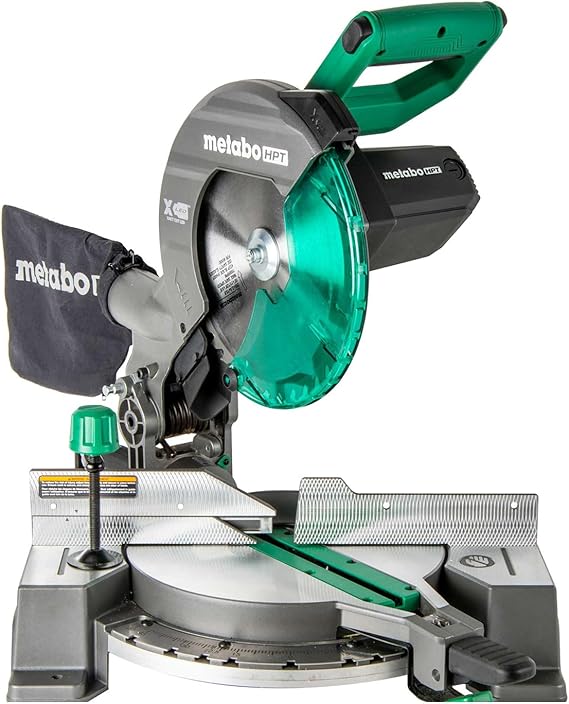
Metabo HPT 10-Inch Compound Miter Saw delivers powerful and precise cuts with its 15-Amp motor, making it an excellent fit for woodworking enthusiasts and DIYers on a budget. Its strength lies in combining high power with user-friendly features, allowing for accurate angle cuts without breaking the bank.
Setting it up is straightforward thanks to improved miter scales and controls that help dial in exact angles quickly. The large 10-inch table offers solid support for the materials, while a vice clamping system keeps pieces secure as you work.
At just 24 lbs, you can easily carry it between locations or take it along to job sites.
It handles cutting tasks smoothly with a no-load speed of 5,000 RPM, fitting a 40-tooth blade that delivers clean crosscuts and bevels up to 52 degrees. The lightweight design doesn’t sacrifice durability, built for regular use with stable construction.
Most praise centers around its precision, while some find the 10-inch blade size limits cutting larger materials.
The biggest compliment highlights its accuracy and stable cutting performance, making it trusted for detailed woodworking. On the downside, the smaller blade size can be restrictive when working with wider lumber or thicker stock.
Woodworkers who need precise, portable miter cuts within moderate size ranges will appreciate this saw. Those requiring wider cuts or dual bevel functionality may want to explore models with larger blades or additional bevel options.
Pros
- Powerful 15-Amp motor for smooth cuts
- Lightweight at 24 lbs for portability
- Large table supports materials well
- Vice clamp secures workpieces safely
Cons
- Blade limited to 10 inches for larger cuts
- Single bevel may limit some angle cuts
| Specification | Details |
|---|---|
| Power Source | Corded Electric |
| Voltage | 120 volts |
| Number of Teeth | 40 |
| Cutting Angle | 52 degrees |
| Wattage | 1950 watts |
7. CRAFTSMAN 12-Inch Mitre Saw

Feels solid and straightforward when cutting wood, good for hobbyists and casual woodworkers. Its biggest strength lies in cutting accuracy thanks to a clever locking system that keeps your workpiece firmly in place.
Setting up involves placing your material against the cam-shaped pins that twist and lock onto the honeycomb base, preventing movement during cutting. The extended lip on the base helps hold a miter box steady, while the built-in saw stop avoids cutting into the box itself.
Molded storage bins make it easy to keep the pins and pencil close at hand for quick adjustments.
The saw cuts precise mitres at 45 and 90 degrees, plus face angles at 45 and 22.5 degrees for more complex shapes like octagons. Its rectangular blade with 80 teeth delivers clean cuts. The strongest praise mentions how secure and accurate the cuts come out.
A common complaint points to some limitations when dealing with very thick materials.
Strong points include the cam-shaped locking pins that keep workpieces steady for very accurate cuts. Most users find the saw reliable and easy to use, though the built-in saw stop can restrict the blade’s depth and pose a problem for thicker materials.
This saw fits well with hobbyist woodworkers or anyone doing detailed miter cuts on light to medium materials. Those regularly handling thicker boards or professional-level projects might consider a more powerful model with deeper cutting ability.
Pros
- Accurate cuts thanks to locking cam-shaped pins
- Multiple cut angles including 45 and 22.5 degrees
- Extended lip stabilizes miter box during cuts
- Convenient molded storage for pins and pencil
Cons
- Saw stop may limit cutting depth in some cases
- Not ideal for very thick or heavy materials
| Specification | Details |
|---|---|
| Number of Teeth | 80 |
| Cutting Angle | 45 degrees |
| Blade Shape | Rectangular |
| Special Features | Cam-shaped pins for secure and accurate cuts |
8. DEWALT 12-Inch Single Bevel Compound Miter Saw

Great for anyone needing a reliable, low-cost miter saw that cuts accurately, this DEWALT model stands out with its strong motor and precise miter system. It suits hobbyists and occasional DIYers looking for solid performance without overspending, especially for standard dimensional lumber cutting.
Setup involves mounting the saw and plugging it into a 120V outlet, no battery fuss. The tall sliding fence supports vertical cuts up to 5-1/2 inches, which covers most typical baseboards or wider trim.
Changing angles is straightforward thanks to the 14 positive stops on the stainless-steel miter detent plate, allowing quick adjustments to common angles with solid stops for accuracy. The bevel adjusts from 0 to 48 degrees left and a small tilt right, fitting various compound cut needs.
Powered by a brushless motor running at 4500 rpm, it handles cross cuts up to 2 inches by 8 inches smoothly at 90 degrees, with slightly less capacity at 45 degrees. The build feels durable, with machined base fence support adding stability during cuts. Positive notes mention how accurate and smooth the angle stops are, while some find the right bevel adjustment’s limited 3 degrees restrictive for certain projects.
The saw receives praise for its accurate angle stops and powerful motor that make cutting standard lumber easy and precise. The most common complaint is about the limited bevel range on the right side, which may restrict certain angled cuts.
People working mostly with typical baseboards or trim will be happy with this saw, enjoying its stability and smooth operation. Those needing wide bevel cuts to the right or greater cutting capacity at angles may want to consider other options.
Pros
- Strong 1800-watt brushless motor
- 14 positive stops for common angles
- Tall sliding fence supports wide vertical cuts
- Precise miter system with machined fence support
Cons
- Limited 3-degree bevel adjustment to the right
- Cross cut capacity reduced at 45 degrees
| Specification | Details |
|---|---|
| Power Source | Corded Electric |
| Voltage | 120 |
| Speed | 4500 rpm |
| Blade Diameter | 12-Inch |
| Wattage | 1800 watts |
| Number of Teeth | 80 |
9. Evolution Power Tools 8-1/4-Inch Compound Miter Saw

Compact design and multi-material cutting capability make the Evolution Power Tools 8-1/4-Inch Compound Miter Saw a fitting choice for DIY enthusiasts and smaller workshop spaces. Its standout feature is the ability to cut through steel, aluminium, wood with embedded nails, and plastic using one blade.
Setting it up is straightforward thanks to a lightweight build and ergonomic handle, making it easy to move and adjust. The saw offers precise angle adjustments with a 0˚ – 45˚ bevel tilt and 45˚ – 45˚ miter angle capability, so aligning cuts for different projects is simple. The corded electric source ensures consistent power without worrying about battery life.
The saw performs well cutting through various materials smoothly, thanks to a 1200W hi-torque motor and optimized gearbox. It feels solid and reliable while still being compact.
Users often praise its versatility and cutting accuracy, though some mention the blade size limits cutting capacity on thicker pieces.
Reviews highlight smooth cutting performance and versatility across materials as a main strength. The most common downside is the relatively small 8-1/4-inch blade, which restricts thicker cuts somewhat on larger projects.
People who need a compact, multi-material saw that delivers precise angles for everyday tasks will be satisfied. Those frequently working with very thick lumber or seeking cordless convenience might consider different options.
Pros
- Multi-material cutting with one blade
- Compact and lightweight for easy handling
- Accurate bevel and miter angle adjustments
- Includes premium tungsten-carbide-tipped blade
Cons
- Blade size limits cutting thickness
- No cordless option for portability
| Specification | Details |
|---|---|
| Power Source | Corded Electric |
| Wattage | 1200 watts |
| Speed | 3750 rpm |
| Cutting Angle | 45 degrees |
| Blade Size | 8-1/4 Inch (210 mm) |
10. DEWALT 20V MAX XR 10-Inch Double Bevel Miter Saw

One of the first things you notice is how powerful and compact this cordless miter saw is, especially for a 20V model. It’s well-suited for those who want strong cutting performance in a lightweight and portable package without being tied down by a cord.
Its biggest strength lies in balancing power with battery efficiency.
Setup is straightforward thanks to its cordless design, letting you work anywhere without worrying about outlets. The bevel gear transmission plays a clear role in saving battery, so you get more cuts per charge. Dust collection is surprisingly good, capturing most of the mess.
Handling is easy too, with a lightweight build that doesn’t tire your arms during extended use.
Cutting through baseboards or crown molding feels smooth and accurate, with enough capacity for larger stock up to 6 inches wide. The build quality is solid and practical for jobsite use. Most users appreciate how long the battery lasts, but a common downside mentioned is the 22.5-degree bevel limit, which may be restrictive in some projects.
The most praised feature is its excellent battery run time supported by the bevel gear transmission, allowing many cuts per charge. The main drawback is the limited bevel angle of 22.5 degrees, which restricts more complex cuts. Setup and daily use benefit from cordless freedom but require managing battery life and separate batteries.
People working on baseboards, crown molding, or framing who need portability and good run time will appreciate this saw. Users requiring wider bevel angles or those unwilling to buy batteries separately might want to consider other options better accommodating those needs.
Pros
- Cordless for easy mobility
- Efficient dust collection captures 97%
- Lightweight design reduces fatigue
- Compatible with various 20V batteries
Cons
- Bevel limited to 22.5 degrees
- Requires separate battery purchase
| Specification | Details |
|---|---|
| Voltage | 20 volts |
| Power Source | Battery Powered |
| Number of Teeth | 32 |
| Cutting Angle | 22.5 degrees |
| Wattage | 250 watts |
11. DEWALT 20V MAX 7-1/4-Inch Miter Saw

Great for anyone needing a portable and accurate miter saw without spending too much. What stands out most is the integrated cut line cross-cut positioning system, making precise cuts much easier and reducing guesswork. It’s a solid choice for DIYers and light professionals looking to avoid bulky or complicated setups.
Setup is straightforward, largely thanks to the compact and lightweight design at just 30 lbs. Moving it around the job site is painless. The cam lock miter handle and the oversized bevel scale make adjusting angles quick and clear, so you don’t waste time fiddling with small dials or sliders.
Battery power keeps things cordless but still powerful.
Cutting performance is accurate with the system’s positive stops and carefully machined fence that hold materials firmly. The saw handles nested crown moldings up to 3 5/8 inches with no sweat. Most people appreciate the ease of angle adjustments and portability.
A common complaint is the single battery included, which might limit longer work sessions unless you have extras.
The most praised feature is how the cross-cut positioning system improves accuracy without needing constant adjustments. Users commonly note the convenience of a lightweight, portable saw but mention that having just one battery can slow down work during longer projects.
Anyone working on home projects or smaller professional jobs will appreciate the balance of accuracy and portability this saw offers. Those needing nonstop, heavy-duty cutting might want to consider tools that include multiple batteries or have higher bevel capabilities.
Pros
- Integrated cut line for accurate positioning
- Lightweight and easy to transport
- Adjustable miter plate with 11 positive stops
- Battery powered for cordless convenience
Cons
- Only one battery included, limits continuous use
- Bevel capacity limited to common angles
| Specification | Details |
|---|---|
| Power Source | Battery Powered |
| Voltage | 20 volts |
| Weight | 30 lbs. |
| Cutting Angle | 90 degrees |
| Speed | 4500 rpm |
12. Unbranded 10-Inch Sliding Compound Miter Saw

Cutting wood or soft metal for DIY projects calls for a saw that balances power with precision at an affordable price. Suited for hobbyists or light professional use, this 10-inch sliding compound saw stands out for its surprisingly strong motor that handles a variety of materials with ease.
Daily setup is straightforward with a reliable corded electric power source, and the saw feels light enough to carry between job sites. The transparent blade guard offers clear line of sight while cutting, and the vise clamp keeps workpieces steady.
Collecting dust into a bag helps keep the workspace tidy without fuss.
Performance impresses with a solid 15-amp motor that spins the blade up to 5000 RPM, delivering clean, sharp cuts up to a 45-degree angle. The build combines portability with functional features like bevel capability and dust collection, though some users find the clamp a bit fiddly to adjust.
It meets expectations for light to medium tasks without unnecessary bulk.
The saw delivers solid power and clean cuts thanks to its 15-amp motor and 5000 RPM blade speed, with users appreciating the clear blade guard and dust collection system for safety and cleanliness. The adjustable vise clamp, while useful, is often mentioned as difficult to fine-tune during use.
Ideal for those needing a capable, portable saw for woodworking and light metalwork, it works well where weight and price are considerations. Users requiring more advanced angle cuts or frequent clamp adjustments might want to explore different models.
Pros
- Strong 15-amp motor for reliable cutting power
- Transparent blade guard for clear visibility
- Vise clamp secures materials firmly
- Dust collection bag keeps workspace clean
Cons
- Clamp mechanism can be tricky to adjust
- Limited to 45-degree cutting angle
| Specification | Details |
|---|---|
| Power Source | Corded Electric |
| Speed | 5000 rpm |
| Voltage | 120 volts |
| Current Rating | 15 A |
| Cutting Angle | 45 degrees |
Best Low Cost Miter Saws Comparison Table
| Product | Power Source | Blade Size | Cutting Angle | Watts |
|---|---|---|---|---|
| Unbranded 10″ Compound | Corded Electric | 10 | 45° | 1900 |
| SKIL 7-1/4″ Miter Saw | Corded Electric | 7-1/4 | 45° | 1200 |
| SEESII 8-1/4″ Compound | Corded Electric | 8-1/4 | 45° | 1400 |
| Hoteche 8-1/4″ Sliding | Corded Electric | 8-1/4 | 45° | 1500 |
| DEWALT 12″ Double Bevel | Corded Electric | 12 | 90° | 1675 |
| Metabo HPT 10″ Compound | Corded Electric | 10 | 52° | 1950 |
| CRAFTSMAN 12″ Mitre | – | 12 | 45° | – |
| DEWALT 12″ Single Bevel | Corded Electric | 12 | 90° | 1800 |
| Evolution 8-1/4″ Compound | Corded Electric | 8-1/4 | 45° | 1200 |
| DEWALT XR 10″ Double | Battery Powered | 10 | 22.5° | 250 |
| DEWALT 20V MAX 7-1/4 | Battery Powered | 7-1/4 | 90° | 2600 |
| Unbranded 10″ Sliding | Corded Electric | 10 | 45° | 1900 |
- Power SourceCorded Electric
- Blade Size10
- Cutting Angle45°
- Watts1900
- Power SourceCorded Electric
- Blade Size7-1/4
- Cutting Angle45°
- Watts1200
- Power SourceCorded Electric
- Blade Size8-1/4
- Cutting Angle45°
- Watts1400
- Power SourceCorded Electric
- Blade Size8-1/4
- Cutting Angle45°
- Watts1500
- Power SourceCorded Electric
- Blade Size12
- Cutting Angle90°
- Watts1675
- Power SourceCorded Electric
- Blade Size10
- Cutting Angle52°
- Watts1950
- Power Source–
- Blade Size12
- Cutting Angle45°
- Watts–
- Power SourceCorded Electric
- Blade Size12
- Cutting Angle90°
- Watts1800
- Power SourceCorded Electric
- Blade Size8-1/4
- Cutting Angle45°
- Watts1200
- Power SourceBattery Powered
- Blade Size10
- Cutting Angle22.5°
- Watts250
- Power SourceBattery Powered
- Blade Size7-1/4
- Cutting Angle90°
- Watts2600
- Power SourceCorded Electric
- Blade Size10
- Cutting Angle45°
- Watts1900
How to Choose the Right Low Cost Miter Saw
Choosing the right low cost miter saw means focusing on key features like blade size, cutting accuracy, and durability. Prioritizing these ensures efficient and precise cuts, reducing errors and the need for replacements, which ultimately saves money and avoids inconvenience during projects.
Blade Size and Type
Different blade sizes drastically change what can be cut and how easily. A 10-inch blade typically handles most trim and framing lumber efficiently, while a 12-inch blade lets you cut wider boards or thicker stock like dimensional lumber.
Smaller blades limit cutting capacity and might struggle with metals unless they are specifically designed for that. Paying attention to the blade type matters too: carbide-tipped blades last longer and are better for wood, but steel blades designed with fine teeth are necessary for metals or plastics.
Replacement blades vary in price depending on the material and size, but keeping spare ones that fit your saw type is a sensible move. Common sizes like 10-inch blades have good availability and an affordable range around $20 to $40.
Choosing the right blade upfront saves frustration and cost later, especially if you switch between wood and metal cutting tasks.
Power and Motor Performance
The motor rating directly affects how smoothly and fast the saw cuts through material. A saw with a motor below 10 amps might slow or stall when cutting thick hardwoods, reducing efficiency and producing rough edges. Motors rated 12 amps or higher maintain consistent power under load, giving cleaner cuts and preventing unnecessary wear on the machine.
This consistency is critical for handling tougher materials without overheating.
Power consumption also matters in practical terms. Many models require standard 120V outlets, fitting most home and job site setups, but more powerful motors might draw more current and demand a dedicated circuit.
Considering energy efficiency can lower operating costs and avoid tripped breakers when using other tools simultaneously.
Accuracy and Adjustability
Accurate angle and bevel settings make a big difference in how well trim fits in corners or angled joins hold up. Saws that offer detent stops at common angles save time and reduce errors.
Locks that hold the angle firmly prevent shifts during cuts, which is important to avoid ruined pieces. Small adjustments should be smooth but tactile enough to dial in precise measurements without guesswork.
Laser guides and markers are helpful but not essential. Models that include a reliable laser or shadow line make it easier to see the cut path, helping reduce mistakes especially in low light or on darker materials. However, the true precision depends more on the quality of the angle stops and bevel adjustments than on added gadgets.
Safety Features
Safety mechanisms on a saw can prevent serious injuries. Blade guards that fully cover the spinning blade and retract smoothly are critical to avoid accidental contact.
A safety switch or electric brake that stops the blade quickly after release adds another layer of protection. These features are worth prioritizing over added bells and whistles.
Stability is often overlooked but affects safety and cut quality alike. A solid, non-slip base keeps the saw from shifting mid-cut, while a firm clamp system holds material steady. Some models have dust collection ports or included bags that reduce airborne debris and keep the line of sight clear for accurate cuts.
Portability and Size
Tools that weigh less than 30 pounds are easier to carry between job sites or up ladders. Heavy saws can tire you out quickly and make moving challenging.
Compact models fit better in a crowded work van and take up less storage space in small workshops or garages. Height and footprint also matter if workspace is limited.
Power source options affect where the saw can be used. Corded models need access to an outlet but generally offer unlimited run time and stable power.
Cordless saws provide freedom to work anywhere but require battery management and may have shorter operational periods before needing recharge. Choosing between the two depends on mobility needs and frequency of use.
Tips for Maximizing Accuracy with Your Low Cost Miter Saw
Zeroing in on precise cuts requires consistent setup checks before each use. Make sure the fence is square to the blade and the bevel angle locks tightly.
Loose adjustments may cause inaccurate angles or uneven cuts. Clamping your workpiece firmly prevents movement that throws off measurements during the cut. Also, double-check your measuring tools and mark cut lines clearly to avoid guesswork.
Using a sharp blade designed for your material keeps the kerf clean, reducing splintering and improving edge quality. Slower cutting speeds and steady feed rates improve control, especially on delicate trims or angle joints. Patience and careful preparation impact accuracy far more than rushing cuts or ignoring small misalignments.
Essential Maintenance Practices to Prolong Your Miter Saw’s Lifespan
Regular cleaning prevents dust buildup that can clog moving parts and impair blade function. After each project, brush away debris from the motor vents, pivot points, and table surface.
Keep the blade sharp and replace it if it becomes dull or chipped; a blunt blade strains the motor and produces rough cuts. Periodically check the alignment of the fence and bevel stops and re-adjust as needed to maintain cutting precision. Applying a light lubricant to pivot joints reduces friction and wear over time.
Also, inspect the power cord for frays or damage to ensure safety and consistent power delivery. Taking time for these routine tasks extends the saw’s life and keeps performance dependable.
Common Mistakes to Avoid When Using Budget Miter Saws
Cutting corners on setup leads to frustrating results and safety risks. Avoid skipping blade calibration or failing to secure your material, which can cause inaccurate cuts and kickback. Don’t use dull or wrong-type blades; they increase motor strain and damage wood edges.
Rushing through cuts without steady control often causes binding or rough finishes. Be mindful of maximum cutting capacity, forcing large pieces through a compact saw risks damage.
Neglecting routine maintenance, such as cleaning and lubrication, speeds up wear and tear. Also, avoid ignoring safety precautions like using eye protection and checking the blade guard for proper function. Sticking to proper use and care extends the durability of budget miter saws and improves the quality of your work.
People Also Asked
How Do I Choose the Right Size Miter Saw Blade?
Select a blade size that matches the capacity of your miter saw, commonly 10 or 12 inches. For finer cuts, a blade with more teeth generally works better but can slow down cutting speed; balance cutting needs with blade size and tooth count.
What Safety Precautions Should I Follow When Using a Miter Saw?
Always wear safety glasses and keep hands clear of the blade path when operating the saw. Secure your workpiece firmly to prevent movement or kickback, which can lead to accidents during cutting.
How Can I Extend the Lifespan of My Miter Saw?
Regularly clean sawdust and debris from moving parts, and check the blade for sharpness to keep cuts smooth. Lubricating pivot points occasionally will prevent stiffness and wear in the mechanism.
What Are Common Problems with Low Cost Miter Saws?
Low cost miter saws often have less durable motors and plastic parts that wear out faster. Blade adjustments can be less precise, so double-check measurements before cutting to avoid mistakes.
Is a Low Cost Miter Saw Compatible with Standard Blades?
Most low cost miter saws use standard 10 or 12-inch blades, so replacement blades are widely available. Confirm the arbor size matches before buying blades to ensure proper fit and safe operation.
Conclusion
Choosing an affordable miter saw depends mainly on its cutting capacity, ease of use, and durability. The saw should handle the types of projects you plan without struggling or needing constant adjustments. Look for simple controls and safety features you feel confident using regularly.
Consider where you’ll store the saw and how often you will use it before making a purchase. A compact model might be better for limited space, while a sturdier saw fits heavy, frequent work. Check the comparison table and detailed reviews above to match the best option to your needs and budget.

I’m Cody Harrison, a lifelong hunter who has spent many seasons in the woods, marshes, and open country. I write about hunting gear, rifle and bow setups, scouting strategies, tree stands, and field safety. I share lessons from real hunts to help both beginners and experienced hunters prepare better, hunt smarter, and get more out of every trip.


