
Top 12 Best Table Saw Blade for Trim Work You Need Now
Working with trim means dealing with delicate cuts that can easily chip or splinter if the blade isn’t up to the task. A dull or inappropriate saw blade often tears through the wood instead of slicing cleanly, leaving rough edges and wasted material. The best table saw blade for trim work offers sharp, precise teeth that keep cuts clean and accurate, so the work looks professional without extra sanding or patching.
Choosing the right blade typically hinges on the tooth count, blade diameter, and tooth design. Blades designed for trim work usually have 80 to 100 teeth to make smoother cuts on thin or soft materials like molding.
The size needs to match the saw, commonly 10 inches for home and workshop saws. Tooth geometry, such as an alternate top bevel, helps reduce tear-out and provides better control. Thin kerf blades also reduce material waste and require less power from the saw, which is helpful if you’re using a less powerful model.
Need a Quick Check?
| Image | Product | Price |
|---|---|---|
Our Top Picks 1  | WEN 10″ 80T Blade | Check Price |
Our Top Picks 2  | WORKPRO 10″ 80T Blade | Check Price |
Our Top Picks 3  | 10″ 120T Miter Blade | Check Price |
Our Selected Top 12 Table Saw Blade for Trim Work Worth Buying
This list features a carefully chosen selection of table saw blades designed specifically for trim work. Each review explains how the blade performs, who it is best suited for, and highlights its main strengths and weaknesses to help you make an informed decision.
1. WEN BL1080 10-Inch 80-Tooth Woodworking Saw Blade
Woodworking enthusiasts and trim carpenters will appreciate a blade made for precision and smooth finishes with the WEN BL1080. Designed to tackle both hard and softwoods, its biggest strength lies in the ultra-thin kerf paired with a high tooth count, delivering clean, refined cuts suited for detailed trim work.
Setting it up is straightforward thanks to the standard 5/8-inch arbor size, compatible with most 10-inch table saws and miter saws. Everyday use benefits from an 80-tooth design that keeps cuts ultra-fine while minimizing tear-out.
The 1/10-inch kerf aids efficiency by removing less material per pass, reducing strain on power tools as you cut through various wood types.
Cutting performance stands out with smooth, precise edges reducing the need for excessive sanding afterward. Built with carbide tips that keep sharpness for extended periods, this blade handles frequent use well.
High marks come from its clean finish, while some point out that the slower feed rates needed for the fine teeth can stretch out cutting time.
The blade delivers very clean and precise finishes, greatly reducing sanding on trim work. However, the finer teeth require feeding wood more slowly, which can prolong cutting time.
People who prioritize smooth, accurate cuts and work primarily on trim and finish carpentry will find this blade well suited. Those needing quick, rough cuts might prefer a blade with fewer teeth and a wider kerf.
Pros
- Ultra-thin kerf for efficient material removal
- 80 carbide-tipped teeth ensure fine finished cuts
- Compatible with most 10-inch saws
- Handles both hard and softwoods smoothly
Cons
- Slower cutting speed due to high tooth count
- Not ideal for rough or fast cuts
| Specification | Details |
|---|---|
| Diameter | 10-inch (254 mm) |
| Arbor Size | 5/8-inch (15.88 mm) |
| Teeth Count | 80 carbide-tipped |
| Kerf Thickness | 1/10-inch (2.4 mm) |
| Max RPM | 6000 |
2. WORKPRO 10-Inch 80-Tooth Circular Saw Blade
Carving a niche for trim work, the WORKPRO 10-Inch 80-Tooth Circular Saw Blade stands out with its high tooth count designed specifically for clean, precise cuts. It suits woodworkers and hobbyists who prioritize smooth edges without frequent resharpening. The biggest strength lies in its carbide-tipped teeth that promise lasting sharpness.
Setting up is straightforward with a standard 10-inch fit, making it compatible with many saw models. The thin kerf design minimizes material waste and reduces cutting resistance, so cuts feel smoother and require less effort. The alternating top bevel tooth layout plays a crucial role in limiting splintering, which makes the finish on trim pieces look much cleaner straight out of the cut.
In use, this blade delivers sharp and accurate cuts over repeated jobs without dulling quickly, thanks to tungsten carbide tips. The build quality holds up well under continuous trim work, although a few have found the blade less forgiving on harder or thicker hardwoods. Most praise focuses on its cutting precision, while occasional complaints mention a need for closer attention to alignment to maintain cut quality.
The blade is highly regarded for maintaining sharpness and delivering clean, smooth cuts ideal for detailed trim work. Some users note it requires careful setup to avoid uneven cuts, especially when facing tougher wood types. The carbide tips significantly extend blade life compared to more basic options.
DIY woodworkers and professionals focused on fine trim detail will appreciate this blade’s performance and durability. Those frequently cutting dense hardwoods or requiring extremely aggressive cutting might want to explore blades designed for heavier duty use to avoid alignment challenges.
Pros
- Long-lasting tungsten carbide tipped teeth
- Thin kerf design reduces waste and effort
- ATB tooth geometry minimizes splintering
- Compatible with standard 10-inch saws
Cons
- Less effective on very hardwood materials
- Alignment critical to maintain cut quality
| Specification | Details |
|---|---|
| Brand Name | WORKPRO |
| Model | W124880AE |
| Unit Count | 1 Count |
| Number of Items | 1 |
| Set Name | 80T |
3. 10-Inch 120-Tooth Miter Saw Blade
TOYAKI’s 10-Inch 120-Tooth Miter Saw Blade is ideal for anyone needing precise trim work on wood or soft materials. Its biggest strength lies in delivering fine, clean cuts, making it well-suited for detailed woodworking projects where finish quality is key.
Installation is straightforward thanks to the standard 16mm arbor size, fitting most common saw models quickly. Using it day to day, the engineered tooth pattern keeps vibrations low, so your cuts stay steady and accurate.
The blade’s high tooth count helps maintain a smooth operation without sacrificing cutting speed.
Crafted from high-grade steel, this blade is built to last and maintain its consistent cutting quality over time. It excels at delivering clean and precise edges, essential for trim work. A noted downside is that the blade might feel a bit slower cutting through thicker materials due to the fine teeth arrangement.
The blade consistently provides clean, accurate cuts with minimal vibration, making it a great option for fine woodworking tasks. A frequent drawback is that its high tooth count causes slower cutting speed on denser or thicker wood pieces.
Excellent choice for anyone focused on trim work and softwood cutting who prioritizes smooth finishes. Those working primarily with harder, thicker materials or needing faster cuts might want to consider blades designed for rougher, heavier-duty tasks.
Pros
- 120 teeth for smooth, precise cuts
- Fits common miter saws with 16mm arbor
- Reduces vibration during operation
- Durable high-grade steel construction
Cons
- May cut slower on thicker materials
- Only compatible with 16mm arbor size saws
| Specification | Details |
|---|---|
| Brand Name | TOYAKI |
| Unit Count | 1 Count |
| Included Components | Saw Blade |
| Part Number | TK-254W |
| Arbor Size | 16mm |
| Teeth | 120-Tooth |
4. FOXBC 10-Inch 60-Tooth Thin Kerf Table Saw Blade

Feeling solid and smooth in use, this blade is clearly designed for those who care about fine trim work with clean, accurate cuts. It suits anyone needing precise crosscuts on a variety of wood types, with its thin kerf standing out as the biggest strength for reducing waste and easing cut resistance.
Setup is straightforward since it fits most 10-inch miter and table saws, including popular brands like DeWalt and Makita. The thin kerf of 0.087 inches means it slices through materials with less effort, producing less vibration and noise. Day-to-day, it handles oak, pine, melamine, plywood, and molding with ease, providing a cleaner finish and requiring less fiddling to get a good cut.
Cutting performance is very smooth thanks to the 60 teeth and high-density tungsten carbide construction, giving good wear resistance over time. The blade feels durable and tough on harder woods, with minimal noise and vibration during crosscuts.
Some mention occasional minor chipping on very hard wood edges, which can be a downside depending on usage frequency.
High-density tungsten carbide construction ensures good wear resistance and smooth cuts, but minor edge chipping can occur on very hard woods. The thin kerf helps reduce both waste and cutting resistance, making it a good choice for trim and crosscut tasks requiring precision.
People working with common woods like pine and oak, or who use multiple brands of 10-inch saws, will find this blade a practical and reliable option. Those needing blades for very hard or thicker materials might want to explore other options designed specifically for heavy-duty use.
Pros
- Thin kerf reduces waste and burn marks
- Compatible with many 10-inch table and miter saws
- High-density tungsten carbide for long-lasting sharpness
- Low vibration and noise during cutting
Cons
- May chip slightly on very hard woods
- Only available in a 10-inch size
| Specification | Details |
|---|---|
| Diameter | 10 inch |
| Teeth | 60 |
| Kerf width | 0.087 inch |
| Arbor size | 5/8 inch |
| Material | High-density tungsten carbide |
| Fits | DeWalt, Skil, Metabo, Makita, most 10-inch saws |
5. 10-Inch 80-Tooth Circular Saw Blade

Ideal for anyone focused on trim work, this 10-Inch 80-Tooth Circular Saw Blade offers precise, clean cuts every time. Its biggest strength lies in delivering exceptional smoothness and accuracy thanks to the high tooth count and sharp carbide edges, perfect for detailed woodworking projects.
Setting it up on your table saw is straightforward with its 5/8 inch arbor size, fitting most standard saws. The blade’s thin laser-cut kerf makes cutting quick while minimizing waste.
Its premium alloy steel construction resists bending, so handling it day to day feels reliable and stable without worries about distortion during use.
It excels at giving clean, fine cuts that look professional and prevent unnecessary sanding. The tungsten carbide teeth stand up well to heat and abrasion, keeping the edge sharper longer than basic blades. The most frequent issue is its compatibility, as not all saws may handle blades with 80 teeth equally well, particularly at max RPM limits.
The blade consistently delivers very clean, smooth cuts that reduce finishing work while maintaining sharpness thanks to its tungsten carbide teeth. However, some users find it challenging to match with certain saws due to its speed and size requirements.
Woodworkers focused on detailed trim work who have compatible saws will appreciate this blade’s performance. Those using saws with lower RPM limits or non-standard arbors might want to consider a different option for compatibility and safety.
Pros
- Extremely smooth cuts with high tooth count
- Durable carbide teeth resist heat and wear
- Thin kerf improves cutting speed and reduces waste
- Resists bending for consistent accuracy
Cons
- Not ideal for saws with lower max RPM
- May require precise fit due to 5/8 inch arbor size
| Specification | Details |
|---|---|
| Diameter | 10 inch (254 mm) |
| Arbor size | 5/8 inch (15.88 mm) |
| Max RPM | 7000 |
| Teeth | 80T tungsten carbide |
| Material | Premium alloy steel |
| Brand | Revvstark |
6. 8-1/4-Inch 80-Tooth Miter Saw Blade

High-grade carbide teeth give this 8-1/4-inch saw blade its sharpness and durability, making it a solid choice for fine trim work in woodworking. It suits anyone needing precise, clean cuts on various saw types including miter and table saws. Its biggest strength lies in producing smooth finishes with minimal splintering.
Installation on compatible saws is straightforward thanks to its standard 8.25-inch diameter and 2.4mm thickness. The blade feels well-balanced and stable during use, which helps keep cuts clean and consistent. Its design makes it easy to switch between miter saws, table saws, and circular saws without losing precision or risking instability.
Cutting results are notably clean, with fine finish results on wood materials backed by the carbide construction that supports long-lasting sharpness. Positive feedback highlights its accuracy and durability, while some mention that its thickness may not suit all types of woodworking projects seeking ultra-thin cuts.
It holds up well under regular demands and continues to perform reliably after repeated use.
Sharp carbide teeth deliver clean and precise cuts widely praised by users. Common feedback notes the 2.4mm thickness can be a bit thick for some detailed trim tasks requiring ultra-fine blades.
This blade fits well for anyone needing an all-around trim blade with durability and smooth finishes on standard 8-1/4-inch saws. Those needing ultra-thin or specialty blades might look elsewhere for their projects.
Pros
- Ultra-sharp carbide teeth for precision cuts
- Balanced thickness for stable cutting
- Works with multiple saw types
- Fine finish with minimal splintering
Cons
- Thickness may not suit very thin cuts
- Limited to 8.25 inch diameter saws
| Specification | Details |
|---|---|
| Diameter | 8.25 inch |
| Teeth Count | 80 |
| Thickness | 2.4mm |
| Material | Carbide |
| Compatibility | Miter saws, table saws, circular saws |
7. DEWALT 10-Inch 40-Tooth Table Saw Blade

Sharpness and accuracy stand out with this 10-inch, 40-tooth table saw blade from DEWALT, designed specifically for trim work. It suits woodworkers and DIYers needing clean, precise cuts and durability that lasts much longer than standard blades.
Setup is straightforward, and installing the blade on a compatible table saw fits easily without fuss. The optimized tooth geometry ensures cutting accuracy, which helps maintain detail in fine trim work while reducing tear-out. The ultra-sharp carbide edge keeps cuts clean, making finish sanding less necessary after cutting.
Performance-wise, the blade cuts smoothly through trim with minimal effort, holding up well over time thanks to its high-quality carbide teeth. Its construction promises up to three times the life of typical blades, but some users find it a bit slower on harder woods.
The most common praise focuses on its sharp cutting edge, while the main complaint is it doesn’t excel on dense hardwoods as quickly.
Many praise the blade’s lasting sharpness and smooth, accurate cutting performance, especially on softer woods typical in trim work. Some notice it takes more time when cutting harder materials, affecting project speed.
People focused on clean, detailed trim cuts with standard woods will appreciate this blade. Those regularly working with dense hardwoods might want to look for a blade designed specifically for tougher materials to save time.
Pros
- Sharp ultra carbide for clean, precise cuts
- Optimized tooth geometry improves accuracy
- Durable design rated for up to 3X life
- Fits standard 10-inch table saws easily
Cons
- Slower on harder, dense hardwoods
- Single blade included, no multipack option
| Specification | Details |
|---|---|
| Brand Name | DEWALT |
| Model | Dewalt – DWA11040 |
| Unit Count | 1 Count |
| Number of Teeth | 40 |
| Included Components | (1) Saw Blade |
8. FOXBC 8-1/4-Inch 60-Tooth Table Saw Blade

Perfect for trim work, the FOXBC 8-1/4-Inch 60-Tooth Table Saw Blade stands out with its ultra-thin kerf, delivering fast and clean cuts essential for detailed finish tasks. Ideal for those needing precision on hardwood, softwood, and plywood, it balances cutting speed with durability without slowing down your workflow.
Setting up the blade is straightforward thanks to its 5/8 arbor size, fitting most table saws without any hassle. Its 60 teeth ensure smooth slicing, reducing splintering on delicate edging and trim pieces.
The thin kerf means less resistance during cuts, so the saw runs smoothly while preserving material integrity. It handles everything from decking to siding finishes with reliable consistency.
Carved from high-density tungsten carbide, the blade is durable and wear-resistant, promising longevity through repeated use. It cuts cleanly and sharply, perfect for maintaining the crisp edges needed in finish carpentry. Positive reviews highlight its long life and accurate cuts, while the main drawback noted is that it’s designed specifically for smaller 8-1/4 saws, limiting its compatibility.
The blade receives praise for its combination of cutting speed and long life, making it reliable for finish cuts in decking and siding. Its primary limitation is size compatibility, as it only fits 8-1/4″ saws, which may restrict use for those with larger table saws.
Woodworkers focused on trim and precision finish cuts will appreciate its clean edges and efficiency. Those working with bigger saws or heavy demolition tasks should consider a different blade better suited for rough cuts or larger diameters.
Pros
- Ultra-thin kerf for fast, clean cuts
- High-density tungsten carbide for durability
- 60 teeth reduce tear-out on trim work
- Fits standard 5/8″ arbor table saws
Cons
- Only compatible with 8-1/4″ table saws
- Not suitable for heavy demolition cutting
| Specification | Details |
|---|---|
| Diameter | 8-1/4 Inch |
| Tooth Count | 60-Tooth, ATB |
| Kerf | 0.079″ |
| Arbor | 5/8″ |
| Material | High-density tungsten carbide |
9. Luckyway 10-Inch 32T & 60T Table/Miter Saw Blades, 2-Pack

Handling trim work on a table saw requires a blade that offers smooth, clean cuts without damaging delicate edges. Luckyway’s 10-Inch 32T & 60T blades come in a 2-pack that’s great for both cross-cutting and ripping through various wood types, offering versatility that suits hobbyists and pros focusing on precision trim projects.
Setting these blades up on a standard 10-inch saw is straightforward thanks to their standard 5/8 inch arbor size. Switching between the 32-tooth for fine cross-cuts and the 60-tooth for smoother finishes is simple and helps tailor the cut to the material. The blades feel solid and don’t require frequent adjustments during regular use, keeping things efficient on the job.
Cutting through softwood and plywood, the blades maintain good edge quality without splintering, which is crucial for trim. The fully hardened steel blade body resists bending, meaning cuts stay accurate even with repeated use.
The most frequent downside is that the blades aren’t ideal for ultra-fine or finish-grade cuts compared to blades with higher tooth counts.
The blades consistently provide clean edges and hold their shape well, suited to multiple wood types and panel materials. Some users note the finish isn’t quite as smooth as higher-tooth blades, which matters when razor-sharp trim finishes are required.
Those working on general trim and cross-cutting in DIY or workshop settings will find these blades practical and durable. Professionals needing the smoothest finish on delicate trim might consider blades with finer teeth or specialized profiles instead.
Pros
- Good edge finish on a variety of woods
- Solid steel body resists bending
- Includes both cross-cut and rip blades
- Fits standard 10-inch saws easily
Cons
- Not ideal for ultra-fine trim cuts
- Tooth count may limit finish quality on delicate trims
| Specification | Details |
|---|---|
| Blade Diameter | 10 inch |
| Tooth Count | 32T & 60T |
| Arbor Size | 5/8 inch |
| Material | Fully hardened steel blade body |
| Quantity | 2 Count |
10. 10-Inch 32T, 60T & 80T Table/Miter Saw Blades, 3-Pack

Offering three tungsten carbide-tipped blades with 32, 60, and 80 teeth, this 10-inch set fits 5/8 arbor table and miter saws perfectly for trim work. Its ultra-thin 0.098 kerf design stands out, delivering fast, clean cuts and requiring less cutting power, ideal for fine woodworking and detailed projects.
Setup involves swapping out blades based on material and cut type, which is straightforward thanks to standard sizing. The thinner kerf cuts through hardwoods, plywood, and even nail-embedded wood with less resistance. The range from 32T for framing to 80T for fine finishes covers most trim work scenarios, meaning fewer blade changes during a project.
Performance reflects clean, accurate cuts with minimal tear-out on hardwoods and softwoods, leveraging the durability of C3 grade tungsten carbide. The blades maintain sharpness across various wood types, though some note the 32T blade isn’t best suited for very fine cuts. The build quality generally supports long life, but the blade tooth count choice affects cut smoothness versus speed significantly.
The blades are praised for holding sharp edges well and cutting through a variety of woods cleanly, including oak and pine, while the common drawback is that the 32T blade tends to produce rougher edges than higher tooth count blades when used on finish work. The ultra-thin kerf helps with smoother operation but doesn’t eliminate the tooth count effect on.
Woodworkers focusing on trim work with a variety of materials will appreciate the versatility this set offers. Those needing extremely fine cuts might prefer blades with consistently higher tooth counts or specialized finishing blades. Compatibility with standard arbors and standard saws makes it a good fit for most hobbyists and pros who want a range in one pack.
Pros
- Three blades covering framing to fine finish needs
- Ultra-thin kerf reduces power required and improves control
- Durable C3 grade tungsten carbide blades
- Compatible with standard 5/8″ arbor saws
Cons
- 32-tooth blade not ideal for very fine cuts
- Limited max RPM of 6,000 restricts use on some high-speed saws
| Specification | Details |
|---|---|
| Blade Diameter | 10 Inch |
| Teeth Counts | 32T, 60T, 80T |
| Arbor Size | 5/8″ |
| Kerf | 0.098″ |
| Material | C3 Grade High-Density Tungsten Carbide |
| Max RPM | 6,000 |
11. FOXBC 10-Inch 90-Tooth Polished Finish Saw Blade

Woodworkers focused on trim work will find this blade ideal for producing smooth, precise cuts. It suits those who need fine detail and minimal sanding after cutting. Its standout feature is the polished finish that matches the quality of 220-grit sandpaper, ensuring clean results every time.
Installing the saw blade is straightforward with its 5/8 arbor, fitting most 10-inch table and miter saws like DeWalt, Skil, and Makita. The thin 0.087 kerf allows for reduced material waste and smoother cuts, helping maintain accuracy during trim work. Handling the blade daily feels reliable thanks to its corrosion-resistant polished surface and consistent tooth geometry.
The double side grind tooth design makes cutting through wood smooth and produces a finish that usually doesn’t need extra sanding. The specially designed foxcarbide tips hold their edge well over time, offering good durability.
One downside reported is that the high tooth count can slow cuts slightly compared to blades with fewer teeth, but the finish quality justifies this trade-off.
The polished finish delivers exceptionally smooth cuts, often without needing sanding, making trim work efficient and precise. However, the 90-tooth count means cutting can feel slower compared to coarser blades designed for speed rather than finish quality.
Anyone focused on detailed trim and finishing work will appreciate the blade’s fine cut and durability. Those seeking faster cuts or working on rough framing should consider blades with fewer teeth and a wider kerf instead.
Pros
- Produces finish comparable to 220-grit sandpaper
- Compatible with many 10-inch saw models
- Durable, wear-resistant foxcarbide teeth
- Thin kerf reduces material waste
Cons
- High tooth count can slow cutting speed
- Not ideal for rough or fast cuts
| Specification | Details |
|---|---|
| Blade Diameter | 10 inch |
| Number of Teeth | 90 |
| Kerf | 0.087 inch |
| Arbor Size | 5/8 inch |
| Design Features | Double Side Grind tooth geometry, Axial Shear-face grind |
12. 10-Inch 80-Tooth Carbide Saw Blade
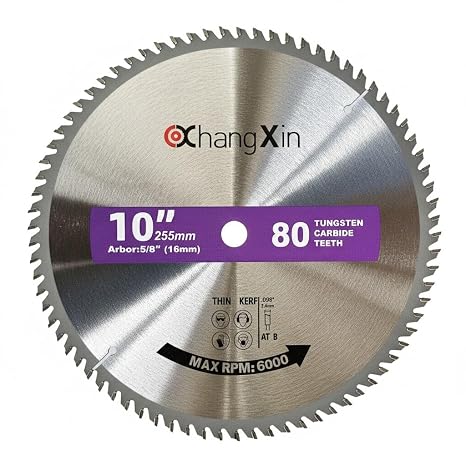
Designed for smooth crosscuts and fine finish work, this 10-inch 80-tooth carbide saw blade suits anyone focusing on trim, cabinetry, or detailed woodworking. Its 80-tooth design stands out by minimizing chipping and delivering clean cuts on hardwood, softwood, plywood, and MDF.
Setting up the blade is straightforward since it fits many 10-inch miter saws and table saws with a 5/8-inch arbor. Daily operation benefits from its carbide-tipped teeth, which ensure consistent performance without frequent sharpening.
The blade handles delicate trim work well, helping keep edges neat and precise across different wood types.
Cutting results show a very clean finish that requires little sanding afterward, especially on softer materials. The blade is made with precision-ground carbide tips, making it durable for routine woodworking tasks. Some users mention that while it excels in smooth cuts, the number of teeth can slow down faster rough cuts, but that’s expected for this level of finish quality.
The blade consistently delivers fine finish cuts with minimal chipping, which is its biggest strength, while some reviews mention that it performs slower when making rough cuts. The precision-ground carbide teeth hold up well for trimming and cabinetry, but this comes at a trade-off in cut speed.
Anyone focused on neat, detailed trim work and cabinetry will find this blade suited to their needs. Those who prioritize faster rough cuts might want to consider a blade with fewer teeth for better speed.
Pros
- Smooth cuts with minimal chipping on trim
- Fits many 10-inch miter and table saws
- Durable carbide-tipped teeth for everyday use
- Works on hardwood, softwood, plywood, and MDF
Cons
- Slower feed rate for rough cuts
- Generic brand may raise quality concerns
| Specification | Details |
|---|---|
| Blade Diameter | 10-Inch (255mm) |
| Number of Teeth | 80T |
| Arbor Size | 5/8-Inch |
| Included Components | 1 Tct Saw Blade |
| Manufacturer | Changxin |
Best Table Saw Blades for Trim Work Comparison
| Product | Size | Teeth Count | Tooth Type | Included Components |
|---|---|---|---|---|
| WEN 10″ 80T Blade | 10 | 80T | Carbide-Tipped Ultra-Fine | 10-Inch 80-Tooth Blade |
| WORKPRO 10″ 80T Blade | 10 | 80T | – | Circular Saw Blade |
| 10″ 120T Miter Blade | 10 | 120T | – | Saw Blade |
| FOXBC 10″ 60T Thin Kerf | 10 | 60T | – | 10 inch Saw Blade |
| 10″ 80T Circular Blade | 10 | 80T | – | Circular saw blade |
| 8-1/4″ 80T Miter Blade | 8-1/4 | 80T | – | Saw Blade |
| DEWALT 10″ 40T Table Blade | 10 | 40T | – | (1) Saw Blade |
| FOXBC 8-1/4″ 60T Blade | 8-1/4 | 60T | – | 8-1/4″ Table Saw Blade |
| Luckyway 10″ 2-Pack Blades | 10 | – | – | 2 Saw Blades |
| 10″ 3-Pack Saw Blades | 10 | 32T,60T,80T | – | 3-Pack Saw Blades |
| FOXBC 10″ 90T Polished | 10 | 90T | – | 10 inch Saw Blade |
| 10″ 80T Carbide Blade | 10 | 80T | Carbide-Tipped | 1 Tct Saw Blade |
- Size10
- Teeth Count80T
- Tooth TypeCarbide-Tipped Ultra-Fine
- Included Components10-Inch 80-Tooth Blade
- Size10
- Teeth Count80T
- Tooth Type–
- Included ComponentsCircular Saw Blade
- Size10
- Teeth Count120T
- Tooth Type–
- Included ComponentsSaw Blade
- Size10
- Teeth Count60T
- Tooth Type–
- Included Components10 inch Saw Blade
- Size10
- Teeth Count80T
- Tooth Type–
- Included ComponentsCircular saw blade
- Size8-1/4
- Teeth Count80T
- Tooth Type–
- Included ComponentsSaw Blade
- Size10
- Teeth Count40T
- Tooth Type–
- Included Components(1) Saw Blade
- Size8-1/4
- Teeth Count60T
- Tooth Type–
- Included Components8-1/4″ Table Saw Blade
- Size10
- Teeth Count–
- Tooth Type–
- Included Components2 Saw Blades
- Size10
- Teeth Count32T,60T,80T
- Tooth Type–
- Included Components3-Pack Saw Blades
- Size10
- Teeth Count90T
- Tooth Type–
- Included Components10 inch Saw Blade
- Size10
- Teeth Count80T
- Tooth TypeCarbide-Tipped
- Included Components1 Tct Saw Blade
How to Choose the Right Table Saw Blade for Trim Work
Choosing the right table saw blade for trim work means focusing on blade tooth count, material, and sharpness to ensure clean cuts and less damage to delicate trim pieces. Getting these factors right prevents costly mistakes and extends the blade’s lifespan, saving time and money.
Blade Size and Compatibility
The size of the blade has a direct impact on performance and safety. Using a blade that doesn’t fit the arbor properly can cause wobbling or even damage the saw.
Many table saws require a 10-inch diameter blade, but some models might use 8 or 12 inches. The arbor hole must match the saw’s specification exactly; a loose fit leads to instability.
Blades also have a maximum RPM rating, which should never be exceeded by the saw’s operational speed. Thicker blades often offer smoother cuts and require less power, but they might not be compatible with every saw. Checking your saw’s manual and matching the blade’s thickness and size prevents potential issues like motor strain or poor cut quality.
Tooth Count and Configuration
The number of teeth on a blade plays a big role in the smoothness of cuts. Blades with 80 or more teeth usually give a cleaner edge, which is crucial for trim pieces where visible imperfections stand out.
Lesser tooth counts tend to cut faster but cause rougher edges.
To avoid tearout, especially on laminates or MDF, blades with alternate top bevel or triple-chip grind designs make a noticeable difference. These tooth configurations help the blade slice cleanly rather than tear fibers.
Matching the tooth design to the type of material you work with limits frustration and cleanup after cutting.
Material and Coating Quality
Carbide-tipped teeth offer solid durability and stay sharp longer during repeated trim cuts. Cheaper steel teeth dull quickly, causing more chip-out and rough edges.
The blade body’s metal also matters, stainless steel or coated steel resists rust and heat better than plain steel.
Heat-resistant coatings reduce friction and stop resin from building up on the blade. Resin buildup can slow down cuts and make edges sticky and fuzzy.
A good coating helps the blade run cooler and cleaner, translating into more reliable cuts over time.
Cut Quality and Precision
Trimming small, delicate pieces demands a blade that keeps edges smooth without chipping. Some blades are designed with features that minimize splintering by stabilizing the kerf, preventing the blade from wandering off line.
This maintains precision, which is key to fitting trim perfectly without extra sanding.
Good blades leave a clean cut that avoids roughness, reducing the need for time-consuming touch-ups. Look for blades specifically marketed for fine finish cuts, as these typically have tighter manufacturing tolerances and tooth geometry optimized for neatness.
Safety and Heat Management
Heat buildup can warp blades during heavy use, throwing off cuts and causing dangerous vibrations. Heat expansion slots or vents are practical in cutting down this warping, keeping the blade flat and stable. This stability helps maintain accuracy and control.
Blades that reduce vibration also make cutting safer, as they lessen hand fatigue and improve machine handling. A design attentive to heat dissipation and vibration support means the blade lasts longer and maintains performance over repeated jobs without overheating or coming loose.
Optimizing Cut Quality: Tips for Using a Table Saw Blade in Trim Work
Choosing the right blade tooth count and configuration makes a big difference when cutting trim. Blades with more teeth, typically around 60 to 80, produce cleaner, smoother cuts with less tear-out on delicate moldings and softwoods.
Using a thin-kerf blade reduces material waste and requires less power from the saw, which helps maintain precision.
Adjust the blade height carefully so it just clears the thickness of the trim stock. Setting the blade too high increases tear-out on the underside of the cut piece.
Use featherboards or push sticks to keep the trim steady and feed it at a steady, moderate pace to prevent burning or chipping the edges.
Additional practical tips:
- Check the blade alignment with the miter gauge and fence to avoid angled cuts.
- Use a zero-clearance insert to support the wood fibers near the blade.
- Consider crosscut blades specifically designed for smooth finish cuts on trim.
Maintaining and Cleaning Your Table Saw Blade for Longer Life
Resin and pitch buildup on table saw blades dull cutting edges and affect cut quality over time. Cleaning the blade regularly prolongs its sharpness and reduces heat buildup that can warp or damage the blade.
Use a dedicated blade cleaner or a solution of household detergent and water with a soft brush to remove grime.
After cleaning, dry the blade thoroughly and apply a light coat of oil or rust inhibitor to prevent corrosion, especially if you don’t plan to use it for a while. Avoid using harsh wire brushes or metal scrapers that could nick the teeth.
Maintaining your blade includes:
- Checking for missing or damaged teeth before each use.
- Keeping the blade properly tightened to the arbor to prevent wobbling.
- Storing blades in a dry, protected place to avoid moisture exposure.
Common Mistakes to Avoid When Cutting Trim with a Table Saw
One common mistake when cutting trim is rushing the feed rate. Pushing the wood too fast often results in rough, splintered edges, while feeding it too slowly can burn the wood and dull the blade.
A steady, controlled feed keeps cuts clean and extends blade life.
Using a blade with the wrong tooth count can also cause issues. Blades with too few teeth tend to tear out trim edges, while blades with excessive teeth slow down the work unnecessarily and may overheat.
Other frequent errors include:
- Not securing the trim piece firmly, which causes chatter and uneven cuts.
- Failing to align the fence properly, leading to angled or inconsistent cuts.
- Ignoring the importance of a zero-clearance insert, which supports the cut edges and minimizes tear-out.
People Also Asked
How Do I Choose the Right Blade Size for Trim Work?
Choose a blade size that fits your table saw’s arbor and diameter specifications, typically 10 inches, which is standard for most trim work. A smaller diameter blade may not cut as cleanly, so picking the right size helps prevent rough edges on delicate trim pieces.
What Safety Precautions Should I Follow When Using a Table Saw Blade?
Always unplug the saw before changing blades and wear eye protection. Keeping the blade guard in place when cutting also reduces the risk of accidents. Holding the trim firmly and using a push stick keeps hands safely away from the blade.
How Long Does a Typical Trim Work Saw Blade Usually Last?
The lifespan of a trim work blade varies but usually falls between several weeks to a few months, depending on frequency and material type. Sharpen or replace the blade once you notice burning or rough cuts to maintain clean edges.
Can I Use a Standard Blade for Both Trim and General Cuts?
A standard general-purpose blade works but may not deliver clean cuts on trim since it often has fewer teeth. Using a blade with more teeth designed for finish work results in smoother edges, which is better for trim that will be painted or stained.
What Are Common Problems When Cutting Trim with a Table Saw Blade?
Common issues include tear-out, chipping, and burning. These often happen when the blade is dull, the feed rate is too fast, or the blade is not suited for fine cuts. Choosing a blade with a higher tooth count and feeding material steadily reduces these problems.
Conclusion
Choosing the right table saw blade for trim work means focusing on the blade’s tooth count, its material, and how clean the cut needs to be. A higher tooth count generally gives smoother cuts, which is important for detailed trim pieces.
The blade’s material affects durability and how often you’ll need to sharpen or replace it. Pay attention to the blade size to ensure it fits your table saw.
Consider how much space you have around your saw and how often you plan to cut trim. A less expensive blade might work if you use it only occasionally, while frequent work calls for a more durable blade.
Check the comparison table above to find a blade that suits your setup and budget. The picks listed there cover a range of needs and prices, making it easier to decide.

I’m Cody Harrison, a lifelong hunter who has spent many seasons in the woods, marshes, and open country. I write about hunting gear, rifle and bow setups, scouting strategies, tree stands, and field safety. I share lessons from real hunts to help both beginners and experienced hunters prepare better, hunt smarter, and get more out of every trip.


