
Top 12 Best Table Saw Blade for General Use Revealed!
Using a dull or inappropriate saw blade slows down cutting and leaves rough, uneven edges. The best table saw blade for general use cuts through different materials cleanly without frequent replacement.
It handles plywood, hardwood, and softwood without causing tears or burning marks, making typical woodworking and carpentry projects easier and more precise.
A good general-purpose table saw blade often has 40 to 50 teeth, balancing speed and smoothness. Carbide-tipped teeth stay sharp longer than steel blades, saving time and money over multiple cuts. The blade diameter should match the saw, usually 10 or 12 inches.
Proper arbor size and secure fit are essential for safety and consistent cutting performance, while a blade designed to minimize heat buildup extends its service life and reduces the risk of warping during use.
Need a Quick Check?
| Image | Product | Price |
|---|---|---|
Our Top Picks 1  | DEWALT 10″ Table Saw Blade | Check Price |
Our Top Picks 2  | Luckyway 10″ Table Blade | Check Price |
Our Top Picks 3  | Carbide Tip 8″ Wood Blade | Check Price |
Our Selected Top 12 Table Saw Blade for General Use Worth Your Money
This list features a carefully chosen selection of table saw blades designed for versatile, everyday use. Each review covers performance details, ideal user profiles, and highlights key strengths and weaknesses to help you find the best fit for your woodworking needs.
1. DEWALT 10 Table Saw Blade 40T
DEWALT 10 Table Saw Blade 40T is designed for general use with its focus on longevity and clean cuts. Ideal for those looking for a reliable blade that offers sharpness and accuracy for everyday woodworking tasks, its biggest strength lies in the optimized tooth geometry for enhanced cutting precision.
Setting up the blade is straightforward due to its standard 10-inch size, making it compatible with most table saws. The ultra-sharp carbide teeth stay sharp longer, which means fewer blade changes.
The design promotes smooth cutting, reducing the effort required to push through various wood types during daily projects.
This blade performs consistently well on different materials with a clean finish, thanks to its precise tooth geometry. Built by DEWALT with durable carbide tips, it supports up to three times longer life than standard blades. Most praise highlights the clean cutting, while some mention that it may not be ideal for highly specialized or fine finish work.
This blade receives strong praise for delivering clean, accurate cuts and lasting significantly longer than many others. The main drawback mentioned is its limitation when precision finishing is required on delicate projects. The tooth design suits a wide range of woodcutting needs but falls short on ultra-fine or detailed cutting tasks.
Anyone needing a durable, general-purpose blade that holds its edge well will find this a solid choice. Those focused on fine woodworking or specialized blades for unique materials might want to look elsewhere for options tailored specifically to those needs.
Pros
- Up to 3x life compared to standard blades
- Optimized tooth geometry for accuracy
- Ultra sharp carbide teeth for clean cuts
- Compatible with most 10-inch table saws
Cons
- Not specialized for very fine finish work
- Single blade included, no multi-pack option
| Specification | Details |
|---|---|
| Brand Name | DEWALT |
| Model | Dewalt – DWA11040 |
| Unit Count | 1 Count |
| Number of Teeth | 40T |
| Included Components | 1 Saw Blade |
2. Luckyway 10 Table Saw Blade 40T
Sharp and reliable, this 10-inch blade cuts through wood cleanly and consistently. Great for anyone needing a solid general-purpose saw blade, its thin kerf helps reduce waste and keep cuts smooth.
Its biggest strength lies in balancing precision with durable build quality, making it versatile for most table and miter saws.
Setting up is straightforward thanks to its standard 5/8-inch arbor size, matching most miter and table saws. The ultra-thin 1/10-inch kerf allows for efficient cuts without putting too much strain on the motor.
Daily use proves the blade holds up well, slicing through various wood types with minimal effort and less tear-out than thicker blades.
Performance stays consistent with 40 tungsten carbide tipped teeth that handle general wood cutting well. Its build feels solid, designed to maintain sharpness and running stability at speeds up to 5350 RPM.
Reviews often praise its clean cutting edges, though some users note it lacks in heavy-duty applications requiring more aggressive tooth counts or thicker blades.
Clean cutting quality stands out as a key advantage, making woodworking projects look professional. The most common drawback mentioned is that the blade can wear down quicker when used on very hard hardwoods or in demanding conditions.
Woodworkers who need a reliable blade for everyday general-purpose cutting will appreciate this. Those frequently cutting thicker or tougher materials should look for blades designed specifically for heavier use.
Pros
- Compatible with most 10-inch miter and table saws
- Thin kerf delivers clean, efficient cuts
- Durable tungsten carbide teeth hold sharpness well
- Comes as a convenient 2-pack set
Cons
- Not ideal for heavy-duty or thicker material cuts
- Blade may dull faster with very hard woods
| Specification | Details |
|---|---|
| Diameter | 10 inch (254 mm) |
| Arbor Size | 5/8 inch (15.88 mm) |
| Teeth Count | 40 Tungsten Carbide Tipped Teeth |
| Kerf Thickness | 1/10 inch (2.4 mm) |
| Maximum Speed | 5350 RPM |
3. Carbide Tip 8 Wood Cutting Saw Blade 40T
Carbide Tip 8 Wood Cutting Saw Blade 40T suits anyone needing a reliable blade for general woodworking. Its biggest strength lies in the balance of performance and durability, handling various wood types without needing frequent changes.
Setup involves mounting the blade on a standard 5/8 arbor, commonly found on portable and table saws. The 8 diameter and thin 0.1 kerf allow for precise cuts with minimal waste. The ATB tooth design provides smooth, clean cuts on materials like hardwood, chipboard, and laminate, making it handy for different projects.
Performance on wood is steady and fast, slicing through soft and hard materials with little fuss. Hard carbide tips hold their edge well over time, while the anti-vibration construction reduces wobble during use. One consistent note is that it’s not suited for metal cutting, which limits its versatility beyond woodworking.
Many users praise how the blade cuts cleanly and smoothly on a variety of wood types with minimal vibration. A common downside mentioned is that it cannot be used on metal, which restricts its applications strictly to woodworking.
This blade fits well for anyone focusing on woodworking tasks across soft, hard, or composite woods. Those needing multi-material capability including metal cutting should look for a blade designed with that versatility in mind.
Pros
- Well-balanced design minimizes vibration
- 40 teeth for smooth ripping and crosscutting
- Hard carbide tips last a long time
- Thin kerf reduces material waste
Cons
- Not usable for metal cutting
- Limited to 6600 max RPM
| Specification | Details |
|---|---|
| Diameter | 8″ / 200mm |
| Teeth Count | 40T Carbide Tip |
| Plate Thickness | 0.055″/1.4mm |
| Arbor Size | 5/8″ (16mm) |
| Max RPM | 6600 |
| Kerf | 0.1″/2.54mm |
4. DEWALT 12 General Purpose Saw Blade 40T

Carbide teeth create clean cuts suited for general workshop tasks and hobbyists seeking reliable performance. Designed with optimized tooth geometry, it aims to deliver accuracy on a wide array of materials, standing out with its promise of up to twice the lifespan compared to comparable blades.
Setting up the blade happens easily as it fits standard 12-inch table saws without hassle. The sharpness maintained by the ultra-sharp carbide ensures smooth cuts, reducing the need for extra sanding or finishing work. Frequency of blade changes lessens thanks to its durability, letting you focus more on the project and less on tools.
Performance remains consistent across different woods and general uses, with cutting accuracy benefiting from the optimized tooth design. The build quality feels solid, balancing toughness with precision. Most remarks praise how long the blade keeps its edge, though some mention it might not be ideal for specialized or ultra-fine work requiring higher tooth counts.
The longest-lasting feature is the up to 2X life provided by the sharp carbide teeth, greatly reducing replacement frequency. Some users note that the 40-tooth count blade might not deliver the smoothest finish for delicate or detailed woodworking projects.
People working on general cutting tasks and needing durability will find this blade well-suited, especially for routine workshop use. Those focused on specialty cutting or requiring ultra-fine finishing might want to explore blades with higher tooth counts or specialized designs instead.
Pros
- Up to 2X life compared to similar blades
- Optimized tooth geometry for accuracy
- Ultra-sharp carbide ensures clean cutting
- Fits standard 12-inch table saws easily
Cons
- Not ideal for ultra-fine or specialized cuts
- Single unit package may require frequent reordering
| Specification | Details |
|---|---|
| Brand Name | DEWALT |
| Model | Dewalt – DWA11240 |
| Unit Count | 1 Count |
| Number of Items | 1 |
| Included Components | (1) Saw Blade |
5. FOXBC 10 Thin Kerf Crosscut Table Saw Blade 60T

Sharpness and clean crosscuts stand out immediately with this 10 thin kerf saw blade, ideal for anyone needing smooth finish cuts on a variety of woods. Its biggest strength lies in delivering fine finish results with less vibration and noise, making it a solid choice for general use on table saws.
Installation is straightforward with the 5/8 arbor fitting most 10-inch miter or table saws from popular brands like DeWalt and Makita. The thin kerf of 0.087 helps minimize waste and requires less power from saws, which means easier handling and consistent performance throughout regular cutting tasks involving oak, pine, or plywood. Less vibration also makes longer work sessions less tiring.
Cutting remains smooth and fast thanks to the 60-tooth design and high-density tungsten carbide teeth, which offer good durability and wear-resistance. The blade’s fine tooth count excels in crosscutting, producing minimal tear-out on melamine or molding. A reported downside is that it might not be the best fit for heavy ripping tasks.
It’s built tough enough to last while delivering consistently clean edges.
The blade is praised for its smooth and precise crosscuts with little vibration, making longer use comfortable. A common complaint focuses on its limitation when handling more demanding ripping tasks due to the fine tooth count and kerf design. It’s best suited for finish-oriented projects rather than aggressive woodworking.
People needing clean, fine finish cuts on softer woods and melamine will appreciate this blade’s performance and longevity. Those requiring heavy ripping or working with very dense hardwoods might want to select a blade designed specifically for those tasks for better results.
Pros
- Fits most 10-inch miter and table saws
- Thin kerf reduces waste and power usage
- Produces smooth crosscuts with minimal tear-out
- Durable tungsten carbide teeth hold edge well
Cons
- Not ideal for heavy ripping cuts
- Less effective on very hard or dense materials
| Specification | Details |
|---|---|
| Diameter | 10 inch |
| Tooth Count | 60 Tooth |
| Kerf Thickness | 0.087 inch |
| Arbor Size | 5/8 inch |
| Material | High-density tungsten carbide |
6. CMT Orange Tools 10 Combination Saw Blade

Choosing a saw blade that can tackle both soft and hardwood along with plywood without constantly swapping blades makes this an excellent pick for general use. Its main advantage lies in its versatility, holding up well in various materials while delivering clean cuts.
Installation is straightforward thanks to the standard 5/8 arbor size. The blade’s design with 15 alternating top bevel teeth plus one flat tooth helps provide smooth, precise cuts whether you’re working with hardwood or softer materials like plywood. It stays relatively clean after cutting, which helps maintain cutting quality without frequent stops for cleaning.
The blade cuts efficiently through different types of wood without bogging down, showing a commendable balance between speed and finish. Made from carbide-tipped components, it holds its edge longer than standard steel blades.
Some users mention it can wear faster under heavy-duty or highly abrasive plywoods, but generally it’s reliable for consistent, quality cuts.
The blade is praised for its versatile cutting ability across various wood types and its durable carbide tips. A common drawback is somewhat faster wear when used intensively on plywood, which can affect long-term sharpness.
People who work with mixed materials like soft and hardwood or plywood regularly will find it a practical choice. Those needing ultra-thin kerf blades for minimal waste or exclusively cutting very abrasive materials might look elsewhere for options tailored specifically for those demands.
Pros
- Works well on soft and hardwood, plus plywood
- Carbide tips extend cutting life
- Standard 5/8″ arbor fits most table saws
- Balanced tooth design for smooth cuts
Cons
- Edge wears faster on heavy plywood use
- Thickness (kerf) creates slightly more material waste
| Specification | Details |
|---|---|
| Brand Name | CMT ORANGE TOOLS |
| Model | 256.050.10 |
| Diameter (D) | 10″ |
| Arbor Size (B) | 5/8″ |
| Teeth Configuration | 15 ATB + 1 FLAT |
| Kerf (K) | 0.102″ |
7. CMT Orange Tools 10 General Purpose Saw Blade

Cutting through a variety of wood types can be tricky with the wrong blade, but this one is designed to tackle everything from hardwoods to plywood with ease. Ideal for anyone needing a reliable blade that works well on portable or stationary table saws, its standout feature is versatility across different materials and cuts.
Setup is straightforward since it fits most common saw types including miter and slide miter saws. The laser-cut heat expansion and sound dampening slots help keep the blade stable and reduce noise, making daily cutting smoother.
Using it for both crosscuts and rip cuts suits projects requiring flexibility without swapping blades constantly.
The industrial chrome carbide teeth hold sharpness well and offer a clean finish for rip and crosscut applications on various wood types. The build quality is solid thanks to its laser-cut steel plate body with tensioning ring for precise, consistent cuts.
One highlight among reviews praises its cutting precision, while some mention the blade thickness may slow cuts slightly.
Precision cutting and material versatility stand out as its best qualities, praised often for clean cuts on various woods. The main drawback noted is the blade’s thickness, which can cause slower cutting compared to thinner blades designed for speed.
People working on mixed material projects with standard saws will appreciate the adaptability and durability of this blade. Users needing ultra-fast cuts or fine finishing might prefer a specialized blade for those tasks instead.
Pros
- Handles hardwood, softwood, plywood easily
- Fits multiple saw types including miter saws
- Laser-cut slots reduce noise and vibration
- Sharp industrial chrome carbide teeth
Cons
- Thicker blade may slow cutting speed
- Not specialized for fine finish or super fast cuts
| Specification | Details |
|---|---|
| Model | 251.042.10 |
| Diameter | 10 |
| Arbor Size | 5/8 ß |
| Tooth Angle | ATB 15 |
| Kerf (K) | 0.110 |
| Plate Thickness (P) | 0.071 |
8. 10 Table Saw Blade 60T

A 10-inch diameter and 60 carbide teeth make this table saw blade ideal for general woodworking. It suits anyone needing fast, clean cuts with a durable blade that resists bending and delivers true precision. Its thin laser-cut kerf ensures smooth, accurate sawing results.
Setup is straightforward with a standard 5/8 inch arbor size, fitting most table saws without issue. The super thin kerf reduces material waste and requires less power from your saw, making daily cutting faster.
The premium alloy steel and tungsten carbide teeth provide a sharp edge that holds up well during repeated use.
Cutting hardwoods and softwoods alike feels consistent and clean, thanks to the high abrasion and heat resistance of the carbide teeth. The blade stays true without flexing, which helps maintain precise bevels and straight cuts. Praise often highlights its sharpness, but some mention that the blade requires regular cleaning for peak performance.
Strong sharpness and precise cuts stand out, while the need for regular cleaning to keep performance high appears often in comments. Its resistance to deflection helps maintain clean edges over time.
Anyone doing a range of woodworking projects will find it a reliable choice for general use. People looking for blades that handle extremely high RPM or specialized materials may want to explore other options.
Pros
- Sharp carbide teeth resist wear and heat
- Thin kerf supports fast, clean cuts
- Fits standard 5/8 inch arbor
- Durable alloy steel body resists bending
Cons
- Needs regular cleaning to maintain sharpness
- Max RPM of 7000 limits use on some powerful saws
| Specification | Details |
|---|---|
| Diameter | 10 inch (254 mm) |
| Arbor Size | 5/8 inch (15.88 mm) |
| Number of Teeth | 60 T |
| Max RPM | 7000 |
| Material | Premium alloy steel with tungsten carbide teeth |
9. FOXBC 8-1/4 Table Saw Blade 60T

Great for anyone working with hardwood, softwood, or plywood needing clean, precise cuts on an 8-1/4 inch table saw. It stands out with an ultra-thin kerf that offers fast and durable cutting performance, keeping operations smooth and efficient on the jobsite or workshop.
Setup is straightforward, thanks to its 5/8 arbor size which fits most standard table saws. The 60-tooth alternating top bevel design means cuts feel smoother and less taxing, especially during finish work like decking, siding, or plywood projects.
Its thinner kerf reduces material waste and puts less strain on the saw’s motor, noticeable during extended or detailed jobs.
Cutting speed strikes a good balance with long blade life due to tungsten carbide teeth, which stay sharper longer even with frequent use in tougher materials. The blade’s build quality holds up well under regular wear.
Positive feedback often highlights clean, chip-free edges, while the main downside is the blade’s thickness, which may not suit rougher ripping tasks as well.
The blade excels in producing clean, precise finish cuts with minimal chipping, making it well suited for detailed woodworking and finish carpentry. The most frequently noted drawback is its limited use for rough ripping, as the thin kerf isn’t built for heavy-duty jobs.
Those focusing on fine, accurate cuts in siding, decking, or plywood will appreciate its performance and longevity. Tradespeople or woodworkers needing a blade for aggressive ripping may want to look elsewhere for a thicker, more heavy-duty option.
Pros
- Ultra thin kerf for faster cuts
- Sharpness lasts through heavy use
- Clean, smooth finish on hardwood and plywood
- Easy to install on most table saws
Cons
- Not ideal for heavy ripping operations
- Blade thickness limits durability with rough cuts
| Specification | Details |
|---|---|
| Blade Diameter | 8-1/4 Inch |
| Teeth | 60-Tooth ATB |
| Kerf | 0.079″ |
| Arbor Size | 5/8″ |
| Material | High-density tungsten carbide |
10. DEWALT 10 Miter and Table Saw Blade Combo

Designed for both miter and table saws, this blade combo stands out with tungsten carbide edges that stay sharp longer than typical blades. Ideal for general use, it suits anyone needing reliable, crisp cuts with less vibration and a fast, smooth cutting experience.
Setup is straightforward thanks to the standard 5/8” arbor size that fits most saws easily. Using two blades, one with 60 teeth and another with 32 teeth, allows for versatile cutting styles.
The thin kerf helps reduce resistance during cuts, making day-to-day work quicker and less tiring. The computer-balanced plate keeps the blade steady, minimizing wobble so cuts remain accurate and surfaces stay clean.
Cutting performance holds up well across various materials, making it suitable for general woodwork and construction tasks. The durable tungsten carbide edges maintain a sharp, true edge over time, although some feedback mentions edge dulling after heavy use. The combi-pack approach with two different tooth counts covers a range of cutting needs but might not suit highly specialized jobs.
One of the best features praised is the combination of two blades that suit different cutting needs, while the toughest carbide material helps keep sharpness longer than many competitors. Some users do find the edges dull with frequent heavy use, which is the main downside mentioned.
Those doing general woodworking or construction will appreciate the balance of durability and cutting speed. Someone needing a blade for very fine or unusual cuts might want to consider a more specialist option tailored to their specific needs.
Pros
- Tungsten carbide edges stay sharp longer
- Thin kerf allows faster, smoother cuts
- Computer-balanced plate reduces vibration
- Comes with both 60 and 32 tooth blades
Cons
- Edges may dull after heavy or prolonged use
- Not specialized for highly precise or unique cuts
| Specification | Details |
|---|---|
| Brand Name | DEWALT |
| Model | DW3106P5 |
| Arbor Size | 5/8” |
| Included Components | 60 and 32 Tooth Blades (2-Pack) |
| Unit Count | 1 Count |
| Warranty Description | Satisfaction Guarantee |
11. WEN 10 Carbide-Tipped Woodworking Saw Blade 40T
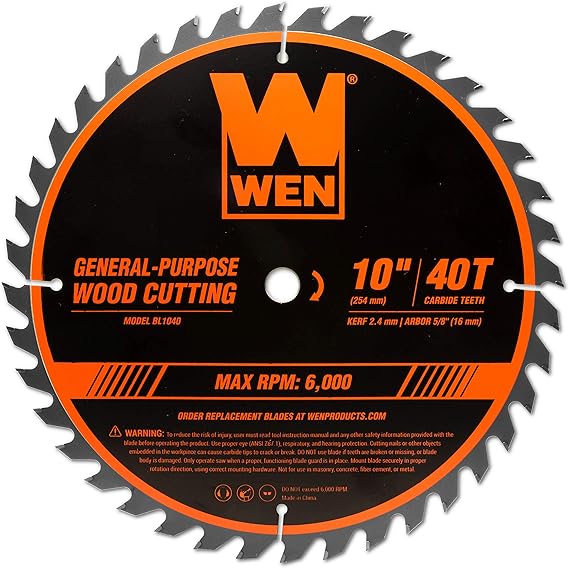
WEN 10 Carbide-Tipped Woodworking Saw Blade 40T suits anyone needing a solid 10-inch blade for general wood cutting. It cuts through both hardwood and softwood cleanly, with a thin kerf that makes precise slicing its standout feature.
Installation fits most 10-inch miter, jobsite, and table saws with its 5/8-inch arbor. The 40 carbide-tipped teeth stay sharp while providing smooth and steady cuts daily. Its ultra-thin 1/10-inch kerf helps reduce waste and creates less drag, making repeated cuts easier to handle over extended work sessions.
The blade offers consistent performance across different woods, making it reliable for general use. Built with carbide tips for durability, it handles frequent cutting without dulling quickly. The clearest feedback from users praises its clean cuts, while the most common downside is some reduced durability when used on very tough hardwoods.
This blade’s sharpness lasts through many quick, clean cuts across wood types, making it reliable. Some note that stronger hardwoods wear down the teeth sooner, which may require more frequent replacement for heavy-duty work.
Woodworkers working with a variety of woods will appreciate the balance of durability and precision here. Those focused mainly on very hard hardwoods should consider more specialized blades designed for heavier use.
Pros
- Thin kerf for precise, clean cuts
- Compatible with most 10-inch saws
- Carbide tips hold sharpness well
- Handles both hard and softwood
Cons
- Dulling occurs faster on very hard woods
- Limited to 6000 RPM maximum speed
| Specification | Details |
|---|---|
| Diameter | 10 inch (254 mm) |
| Arbor Size | 5/8 inch (15.88 mm) |
| Teeth | 40 carbide-tipped |
| Maximum Speed | 6000 RPM |
| Kerf Thickness | 1/10 inch (2.4 mm) |
12. Freud 10 Thin Kerf General Purpose Saw Blade

Running smoothly and cutting quickly, this saw blade fits well for general use around a workshop. Its biggest strength lies in making fast, clean cuts without much resistance, thanks to the positive hook angle and thin kerf design.
It works well with standard 5/8 arbor table saws and handles a variety of wood types with ease.
Setup goes quickly since it matches the common 5/8 arbor size and doesn’t require heavy modifications. Daily use feels efficient as the Perma-Shield non-stick coating cuts down on pitch build-up, meaning less cleaning and smoother operation. The blade’s 40 teeth with an ATB grind help produce fine cuts while the 13° hook angle pulls wood through steadily, making feeds easier.
Cutting performance stays consistent because of the premium TiCo HI-Density carbide teeth, which stay sharp for long stretches. The heavy-duty, thick kerf and plate add stability to reduce blade wobble during cuts.
Most praise comments focus on its clean and reliable cuts, though some mention it’s heavier than thinner blades and requires a bit more power from the saw. Longevity is impressive thanks to solid build quality.
Most reviews remark on the clean, fast, and smooth cutting action this blade delivers, making it reliable for general purpose use. Some users note that it feels heavier and demands more motor power compared to lighter blades, which can affect handling on less powerful saws.
Woodworkers looking for precision and durable blade performance will be satisfied with this option. Those with lighter or less powerful table saws might want to choose a blade with a thinner kerf to reduce load and improve ease of use.
Pros
- Positive hook angle for fast cuts
- Perma-Shield coating reduces pitch build-up
- Stable thick kerf and plate
- Long cutting life from TiCo carbide teeth
Cons
- Heavier than standard thin kerf blades
- Needs more power from the saw motor
| Specification | Details |
|---|---|
| Arbor | 5/8″ |
| Diameter | 10″ |
| Kerf | .094″ |
| Teeth | 40 |
| Hook Angle | 13° |
| Plate Thickness | .071″ |
Best Table Saw Blades for General Use Comparison
| Product | Brand | Size | Teeth Count | Included Components |
|---|---|---|---|---|
| DEWALT 10″ Table Saw Blade | DEWALT | 10 | – | (1) Saw Blade |
| Luckyway 10″ Table Blade | Luckyway | 10 | 40T | Table/Miter saw blade |
| Carbide Tip 8″ Wood Blade | KuangBBBTools | 8 | 40T | – |
| DEWALT 12″ General Purpose Blade | DEWALT | 12 | – | (1) Saw Blade |
| FOXBC 10″ Thin Kerf Crosscut | FOXBC | 10 | 60T | 10 inch Saw Blade |
| CMT Orange 10″ Combination Blade | CMT ORANGE TOOLS | 10 | – | – |
| CMT Orange 10″ General Purpose | CMT ORANGE TOOLS | 10 | – | – |
| 10″ Table Saw Blade 60T | Revvstark | 10 | 60T | Circular saw blade |
| FOXBC 8-1/4″ Table Blade | FOXBC | 8-1/4 | 60T | 8-1/4″ Saw Blade |
| DEWALT 10″ Miter & Table | DEWALT | 10 | – | 2-Blade Combo Set |
| WEN 10″ Carbide Wood Blade | WEN | 10 | 40T | Carbide-Tipped Wood Blade |
| Freud 10″ Thin Kerf General | Freud | 10 | – | Combination (Thin Kerf) Blade |
- BrandDEWALT
- Size10
- Teeth Count–
- Included Components(1) Saw Blade
- BrandLuckyway
- Size10
- Teeth Count40T
- Included ComponentsTable/Miter saw blade
- BrandKuangBBBTools
- Size8
- Teeth Count40T
- Included Components–
- BrandDEWALT
- Size12
- Teeth Count–
- Included Components(1) Saw Blade
- BrandFOXBC
- Size10
- Teeth Count60T
- Included Components10 inch Saw Blade
- BrandCMT ORANGE TOOLS
- Size10
- Teeth Count–
- Included Components–
- BrandCMT ORANGE TOOLS
- Size10
- Teeth Count–
- Included Components–
- BrandRevvstark
- Size10
- Teeth Count60T
- Included ComponentsCircular saw blade
- BrandFOXBC
- Size8-1/4
- Teeth Count60T
- Included Components8-1/4″ Saw Blade
- BrandDEWALT
- Size10
- Teeth Count–
- Included Components2-Blade Combo Set
- BrandWEN
- Size10
- Teeth Count40T
- Included ComponentsCarbide-Tipped Wood Blade
- BrandFreud
- Size10
- Teeth Count–
- Included ComponentsCombination (Thin Kerf) Blade
How to Choose the Right Table Saw Blade
Choosing the right table saw blade involves considering tooth count, material compatibility, and blade thickness to ensure smooth, accurate cuts. Matching these factors to your projects reduces wear and tear, prevents damage, and ultimately saves time and money by avoiding frequent replacements or mistakes.
Blade Diameter and Arbor Size
Most table saws require blades of specific diameters, such as 10 or 12 inches, and this size must match the machine’s design to fit correctly. Using a blade with a diameter that doesn’t align with your saw can cause improper installation or even damage the equipment.
Arbor size is another critical factor; standard arbors usually measure around 5/8 inch, but some models vary. A blade that doesn’t match the arbor will wobble during operation, leading to uneven cuts and safety risks.
Choosing blades with standard diameter and arbor settings simplifies replacements and upgrades. This way, buying a new blade doesn’t involve guessing compatibility or searching for rare sizes.
Making sure these dimensions match your saw ensures a snug fit and consistent performance every time you use it.
Tooth Count and Configuration
Blades with a high tooth count, often 60 teeth or more, make smoother cuts that suit fine woodworking projects or finishing work. Using too few teeth, such as 24 or 30, speeds up ripping through thick wood but leaves a rougher edge. Choosing the right tooth count affects not just cut quality but also workload on the saw.
Tooth design also changes the cutting experience. Alternate Top Bevel (ATB) teeth provide clean crosscuts, while Flat Top Grind (FTG) teeth excel at fast ripping.
Selecting the right configuration depends on whether you do more precise or rough cutting.
- 60+ teeth for smooth, clean cuts
- 24-30 teeth for fast ripping
- ATB for crosscuts and finishing
- FTG for ripping lumber
Material and Coating
Blades with carbide-tipped teeth maintain sharpness much longer than those with steel teeth alone. This translates to less frequent sharpening and better cuts over time. The blade body should be made of heat-treated steel to resist warping during heavy use, since bending affects cut accuracy.
Coatings play a practical role in daily work. A low-friction coating reduces heat build-up and prevents resin from sticking to the blade, which can dull teeth faster and cause drag. Paying attention to these material and coating features results in a smoother operation and longer blade life.
Cutting Capacity and Compatibility
A blade suitable for a variety of materials like hardwood, plywood, and laminates offers flexibility in the workshop. Thickness, or kerf width, impacts the cutting power your saw must deliver. Thin-kerf blades require less motor effort and reduce waste but may flex if the saw isn’t stable.
Blades need to match your saw’s power rating. A high-powered saw can handle thicker blades, while lower-power models perform better with thinner blades to avoid strain.
This balance helps maintain cutting efficiency and extends equipment longevity.
Durability and Maintenance
Choosing a blade that holds its edge means fewer interruptions for sharpening or replacements, which saves money and time. Some blades come with coatings that make cleaning off pitch and resin easier, keeping cuts sharp and smooth.
Simple maintenance extends the blade’s life and reliability.
Warranties and customer support offer a sense of security. A blade backed by good after-sale service tends to be more dependable, helping you avoid poor purchases that end up costing more. These factors matter a lot after regular use wears down even the best blades.
Optimizing Cutting Performance with the Right Table Saw Blade Techniques
Blade height and feed rate significantly impact cutting performance. Setting the blade so its teeth are just above the material improves cut quality and reduces tear-out. Pushing the workpiece steadily but without force helps the teeth slice smoothly rather than grind.
Choosing the correct number of teeth also matters for different cuts. Fewer teeth mean faster cuts but rougher edges, while more teeth provide smoother results at slower speeds.
Maintaining a clean, sharp blade is essential because buildup from resin or pitch can cause burning and decrease accuracy.
- Adjust blade height to about 1/8 inch above the workpiece
- Keep pushes consistent, avoiding rushing
- Select tooth count according to cut type (fewer for ripping, more for crosscutting)
- Clean the blade regularly to remove resin
Essential Maintenance Practices to Extend the Life of Your Table Saw Blade
Removing pitch and resin buildup prevents excessive heat and wear on the blade. Regular cleaning with appropriate solvents keeps the teeth sharp and reduces friction. Inspecting the blade for nicks or missing teeth allows timely replacement before cuts become rough or dangerous.
Storing blades in a dry place prevents rust, which can weaken the steel and shorten blade life. Loosening the arbor nut properly and using the correct wrench helps avoid damage during blade changes. Periodic sharpening can restore performance, especially on carbide-tipped blades that dull over time.
- Clean blade after every few uses with dedicated blade cleaner
- Check for damages before each use
- Store the blade flat or hung to avoid warping
- Tighten arbor nuts securely but avoid overtightening
Comparing Carbide-Tipped and Steel Blades for Versatile Cutting Tasks
Carbide-tipped blades maintain sharpness longer than steel blades, which reduces the frequency of sharpening and improves durability. They handle hardwood, softwood, plywood, and non-ferrous metals better than steel blades, making them a versatile choice for many projects.
Steel blades tend to be less expensive but wear out faster, often requiring more frequent replacement or sharpening. They are more suitable for quick, rough cuts where blade longevity is less important. Carbide-tipped options perform better at high speeds and preserve cleaner edges on diverse materials.
- Carbide-tipped blades resist heat and wear, lasting longer
- Steel blades cost less but dull quickly
- Carbide handles harder materials with cleaner cuts
- Choose based on project demands and budget
People Also Asked
How Do I Choose the Right Size Table Saw Blade?
Choose a blade that fits your table saw arbor and matches the diameter recommended in your saw’s manual. Verify the blade’s size before buying to avoid compatibility issues and check if the arbor hole and blade thickness are suited for your saw model.
What Safety Precautions Should I Take When Using a Table Saw Blade?
Always unplug the saw before changing blades, wear safety glasses, and use a push stick to keep hands away from the blade. Staying alert and avoiding loose clothing can prevent accidents as well.
How Often Should I Replace or Sharpen My Table Saw Blade?
Replace or sharpen your blade when cuts become rough or require extra force. Regularly inspect the blade for dullness or damage and have a professional sharpen it when it no longer cuts smoothly.
Can I Use One Blade for Cutting Both Wood and Metal?
Using one blade for both wood and metal is not ideal because blades are designed for specific materials. Metal cutting blades have special teeth and coatings that differ from wood blades, which helps keep the blade sharper and safer.
What Are Common Problems with Table Saw Blades and How to Fix Them?
Common problems include blade wobble, dullness, and tooth damage. Check blade alignment, clean pitch buildup, and replace or sharpen the blade if teeth are chipped or dull for better cutting performance.
Conclusion
Choose a table saw blade that fits the types of materials you work with most often, especially if you cut a mix of wood types. Look for a blade that balances smooth cuts and long-lasting sharpness. Pay attention to the number of teeth and the blade’s thickness, as these affect both the quality of the cut and compatibility with your saw.
Consider how much space you have for storage and how frequently the blade will be in use before making a purchase. A price that suits your budget without sacrificing performance is important too. Review the comparison chart and detailed reviews above to find a blade that matches your specific needs.

I’m Cody Harrison, a lifelong hunter who has spent many seasons in the woods, marshes, and open country. I write about hunting gear, rifle and bow setups, scouting strategies, tree stands, and field safety. I share lessons from real hunts to help both beginners and experienced hunters prepare better, hunt smarter, and get more out of every trip.


